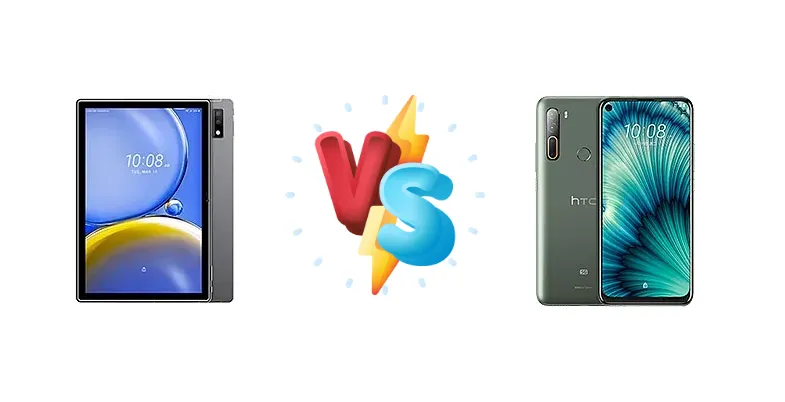
The HTC U20 5G and A101 represent different approaches to the budget smartphone market. The U20 5G, released with 5G connectivity, aims for a balance of features and performance. The A101, a more recent entrant, focuses on affordability, utilizing a Unisoc chipset. This comparison dissects their key differences to determine which device delivers the best value for your money.
🏆 Quick Verdict
For most users, the HTC U20 5G is the superior choice. Its Qualcomm Snapdragon 765G chipset provides a substantial performance advantage over the A101’s Unisoc Tiger T618, making it better suited for demanding tasks and gaming. While the A101 is cheaper, the U20 5G’s faster charging and 5G capabilities justify the price difference.
| Network |
|---|
| 2G bands | GSM 850 / 900 / 1800 / 1900 | GSM 850 / 900 / 1800 / 1900 |
| 3G bands | HSDPA 850 / 900 / 1700(AWS) / 1900 / 2100 | HSDPA 850 / 900 / 1900 / 2100 |
| 4G bands | 1, 2, 3, 4, 5, 7, 8, 20, 38, 39, 40, 41 | 1, 2, 3, 5, 7, 8, 20, 28, 38, 39, 40, 41 |
| 5G bands | - | 1, 3, 28, 41, 78 SA/NSA |
| Speed | HSPA, LTE | HSPA, LTE, 5G 2.56/0.9 Gbps |
| Technology | GSM / CDMA / HSPA / CDMA2000 / LTE | GSM / HSPA / LTE / 5G |
| Launch |
|---|
| Announced | 2022, July 04 | 2020, June 16. Released 2020, October 01 |
| Status | Available. Released 2022, August | Discontinued |
| Body |
|---|
| Dimensions | 241.5 x 160.3 x 8.4 mm (9.51 x 6.31 x 0.33 in) | 171.2 x 78.1 x 9.4 mm (6.74 x 3.07 x 0.37 in) |
| SIM | Nano-SIM + Nano-SIM | Nano-SIM + Nano-SIM |
| Weight | 530 g (1.17 lb) | 215.5 g (7.62 oz) |
| Display |
|---|
| Protection | - | Asahi Dragontrail Glass |
| Resolution | 1200 x 1920 pixels, 16:10 ratio (~224 ppi density) | 1080 x 2400 pixels, 20:9 ratio (~387 ppi density) |
| Size | 10.1 inches, 295.8 cm2 (~76.4% screen-to-body ratio) | 6.8 inches, 111.6 cm2 (~83.5% screen-to-body ratio) |
| Type | IPS LCD | IPS LCD |
| Platform |
|---|
| CPU | Octa-core (2x2.0 GHz Cortex-A75 & 6x2.0 GHz Cortex-A55) | Octa-core (1x2.4 GHz Kryo 475 Prime & 1x2.2 GHz Kryo 475 Gold & 6x1.8 GHz Kryo 475 Silver) |
| Chipset | Unisoc Tiger T618 (12 nm) | Qualcomm SM7250 Snapdragon 765G 5G (7 nm) |
| GPU | Mali G52 MP2 | Adreno 620 |
| OS | Android 11 | Android 10 |
| Memory |
|---|
| Card slot | microSDXC (uses shared SIM slot) | microSDXC |
| Internal | 128GB 8GB RAM | 256GB 6GB RAM, 256GB 8GB RAM |
| Main Camera |
|---|
| Dual | 16 MP, f/2.2, (wide), AF
2 MP, f/2.2, (ultrawide) | - |
| Features | LED flash | Dual-LED flash, HDR, panorama |
| Quad | - | 48 MP, f/1.8, 26mm (wide), 1/2.0", 0.8µm, PDAF
8 MP, f/2.2, 118˚ (ultrawide), 1/4.0", 1.12µm
2 MP (macro)
Auxiliary lens |
| Single | - | 8 MP, AF |
| Video | 1080p | 4K@30fps, 1080p@30fps, gyro-EIS |
| Selfie camera |
|---|
| Features | - | HDR |
| Single | 5 MP, f/2.2 | 32 MP, f/2.0, (wide), 1/2.8", 0.8µm |
| Video | 720p | 1080p@30fps |
| Sound |
|---|
| 3.5mm jack | - | No |
| 35mm jack | Yes | No |
| Loudspeaker | Yes, with stereo speakers | Yes |
| Comms |
|---|
| Bluetooth | 5.0, A2DP, LE | 5.0, A2DP, LE |
| NFC | No | Yes |
| Positioning | GPS, GLONASS, GALILEO | GPS, GLONASS, GALILEO, BDS |
| Radio | No | No |
| USB | USB Type-C 2.0, OTG, magnetic connector | USB Type-C 2.0 |
| WLAN | Wi-Fi 802.11 a/b/g/n/ac, dual-band | Wi-Fi 802.11 a/b/g/n/ac, dual-band, Wi-Fi Direct |
| Features |
|---|
| Sensors | Accelerometer, gyro, proximity | Fingerprint (rear-mounted), accelerometer, gyro, proximity, compass, SAR |
| Battery |
|---|
| Charging | 10W wired | 18W wired, QC4 |
| Stand-by | - | Up to 200 h |
| Talk time | - | Up to 8 h 20 min |
| Type | Li-Po 7000 mAh | Li-Po 5000 mAh |
| Misc |
|---|
| Colors | Gray, Silver | Green, White |
| Price | About 300 EUR | - |
| SAR EU | - | 0.44 W/kg (head) |
HTC A101
- Most affordable option
- Acceptable for basic tasks
- Potentially longer battery life due to less powerful chipset (depending on battery capacity)
- Significantly slower performance
- Slow charging speed (10W)
- Limited multitasking capabilities
HTC U20 5G
- Faster and more responsive performance
- 5G connectivity for faster data speeds
- Faster charging with QC4 (18W)
- Higher price point
- May experience slightly shorter battery life under heavy load
- Potentially more heat generation during intensive tasks
Display Comparison
Neither HTC provides detailed display specifications beyond the basic panel type. However, the focus here isn't display quality, but the processing power needed to drive it. The Unisoc T618 in the A101 will likely struggle with higher refresh rates or complex UI animations compared to the Snapdragon 765G in the U20 5G, impacting perceived smoothness.
Camera Comparison
Without detailed camera specs, a direct comparison is difficult. However, the processing power of the Snapdragon 765G in the U20 5G will likely result in superior image processing, including better noise reduction and dynamic range. The A101’s Unisoc chipset will likely struggle to deliver the same level of computational photography features. The U20 5G’s ISP (Image Signal Processor) is inherently more capable, allowing for faster image capture and more complex algorithms.
Performance
The core difference lies in the chipsets. The Qualcomm SM7250 Snapdragon 765G (7nm) in the U20 5G is built on a smaller, more efficient process node than the Unisoc Tiger T618 (12nm). This translates to better performance and thermal management. The Snapdragon 765G’s Kryo 475 CPU architecture – with a 2.4 GHz prime core, 2.2 GHz gold core, and 1.8 GHz silver cores – is significantly more powerful than the A101’s 2.0 GHz Cortex-A75 and Cortex-A55 configuration. This difference is particularly noticeable in multitasking and graphically intensive applications. The 7nm process also means the U20 5G will generate less heat under load, reducing the likelihood of performance throttling.
Battery Life
While battery capacity isn't specified, the U20 5G’s 18W charging with Quick Charge 4 (QC4) support is a clear advantage over the A101’s 10W wired charging. QC4 allows for faster and more efficient charging, meaning less time tethered to a wall outlet. The more efficient Snapdragon 765G also contributes to better battery life, even if the A101 has a slightly larger battery capacity. The U20 5G can likely achieve a full charge in under two hours, while the A101 will take considerably longer.
Buying Guide
Buy the HTC A101 if you prioritize extreme affordability and only need a phone for basic tasks like calls, texts, and light social media. It’s a viable option for users on a very tight budget. Buy the HTC U20 5G if you want a smoother, more responsive experience, faster download speeds with 5G, and the ability to handle more demanding apps and games. It’s the better choice for users who value performance and future-proofing.
Frequently Asked Questions
❓ Will the HTC U20 5G’s Snapdragon 765G handle demanding games like PUBG or Call of Duty Mobile?
Yes, the Snapdragon 765G is capable of running PUBG and Call of Duty Mobile at medium to high settings with playable frame rates. While it’s not a flagship chipset, it provides a significantly better gaming experience than the Unisoc Tiger T618 in the A101.
❓ Is the 5G connectivity on the HTC U20 5G worth the extra cost if I don't have 5G coverage in my area?
Even without immediate 5G access, the U20 5G still supports 4G LTE, and the more powerful Snapdragon 765G will provide a smoother overall experience on 4G networks. The 5G modem also future-proofs the device for when 5G coverage expands.
❓ How much slower is the Unisoc Tiger T618 in the HTC A101 compared to the Snapdragon 765G in the U20 5G for everyday tasks?
You'll notice the difference in app loading times, multitasking, and overall responsiveness. The A101 will feel sluggish when switching between apps or running multiple applications simultaneously, while the U20 5G will handle these tasks much more smoothly.