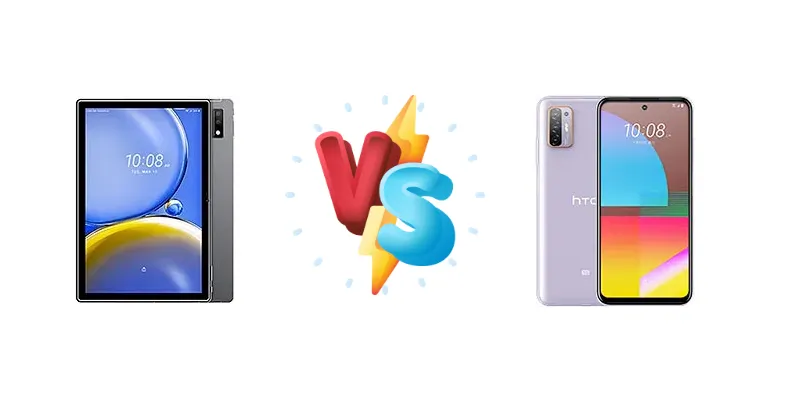
HTC's budget offerings, the A101 and Desire 21 Pro 5G, represent different approaches to affordability. The A101 focuses on basic functionality with a Unisoc chipset, while the Desire 21 Pro 5G aims for a more modern experience with Qualcomm's 5G capabilities. This comparison dissects the key differences to help you determine which device best suits your needs.
🏆 Quick Verdict
For most users, the HTC Desire 21 Pro 5G is the superior choice. Its Snapdragon 690 chipset, built on an 8nm process, delivers significantly better performance and 5G connectivity, justifying the slightly higher price. The faster 18W charging with Quick Charge 4 support is also a notable advantage.
| Network |
|---|
| 2G bands | GSM 850 / 900 / 1800 / 1900 | GSM 850 / 900 / 1800 / 1900 |
| 3G bands | HSDPA 850 / 900 / 1700(AWS) / 1900 / 2100 | HSDPA 850 / 900 / 1700(AWS) / 1900 / 2100 |
| 4G bands | 1, 2, 3, 4, 5, 7, 8, 20, 38, 39, 40, 41 | 1, 3, 5, 7, 8, 20, 28, 38, 39, 40, 41 |
| 5G bands | - | 1, 3, 5, 7, 28, 41, 78 SA/NSA |
| Speed | HSPA, LTE | HSPA, LTE, 5G |
| Technology | GSM / CDMA / HSPA / CDMA2000 / LTE | GSM / HSPA / LTE / 5G |
| Launch |
|---|
| Announced | 2022, July 04 | 2021, January 13 |
| Status | Available. Released 2022, August | Available. Released 2021, January 21 |
| Body |
|---|
| Dimensions | 241.5 x 160.3 x 8.4 mm (9.51 x 6.31 x 0.33 in) | 167.1 x 78.1 x 9.4 mm (6.58 x 3.07 x 0.37 in) |
| SIM | Nano-SIM + Nano-SIM | Nano-SIM + Nano-SIM |
| Weight | 530 g (1.17 lb) | 205 g (7.23 oz) |
| Display |
|---|
| Resolution | 1200 x 1920 pixels, 16:10 ratio (~224 ppi density) | 1080 x 2400 pixels, 20:9 ratio (~393 ppi density) |
| Size | 10.1 inches, 295.8 cm2 (~76.4% screen-to-body ratio) | 6.7 inches, 108.4 cm2 (~83.0% screen-to-body ratio) |
| Type | IPS LCD | IPS LCD, HDR10, 90Hz |
| Platform |
|---|
| CPU | Octa-core (2x2.0 GHz Cortex-A75 & 6x2.0 GHz Cortex-A55) | Octa-core (2x2.0 GHz Kryo 560 Gold & 6x1.7 GHz Kryo 560 Silver) |
| Chipset | Unisoc Tiger T618 (12 nm) | Qualcomm SM6350 Snapdragon 690 5G (8 nm) |
| GPU | Mali G52 MP2 | Adreno 619 |
| OS | Android 11 | Android 10 |
| Memory |
|---|
| Card slot | microSDXC (uses shared SIM slot) | microSDXC (uses shared SIM slot) |
| Internal | 128GB 8GB RAM | 128GB 8GB RAM |
| Main Camera |
|---|
| Dual | 16 MP, f/2.2, (wide), AF
2 MP, f/2.2, (ultrawide) | - |
| Features | LED flash | Dual-LED flash, HDR, panorama |
| Quad | - | 48 MP, f/1.8, 26mm (wide), 1/2.0", 0.8µm, PDAF
8 MP, f/2.2, 118˚ (ultrawide)
2 MP (macro)
Auxiliary lens |
| Video | 1080p | 4K@30fps, 1080p@30fps, gyro-EIS |
| Selfie camera |
|---|
| Features | - | HDR |
| Single | 5 MP, f/2.2 | 16 MP, (wide) |
| Video | 720p | 1080p@30fps |
| Sound |
|---|
| 3.5mm jack | - | No |
| 35mm jack | Yes | No |
| Loudspeaker | Yes, with stereo speakers | Yes |
| Comms |
|---|
| Bluetooth | 5.0, A2DP, LE | 5.1, A2DP, LE |
| NFC | No | Yes |
| Positioning | GPS, GLONASS, GALILEO | GPS, GLONASS, GALILEO, BDS |
| Radio | No | No |
| USB | USB Type-C 2.0, OTG, magnetic connector | USB Type-C 2.0, OTG |
| WLAN | Wi-Fi 802.11 a/b/g/n/ac, dual-band | Wi-Fi 802.11 a/b/g/n/ac, dual-band, Wi-Fi Direct |
| Features |
|---|
| Sensors | Accelerometer, gyro, proximity | Fingerprint (side-mounted), accelerometer, gyro, proximity, compass |
| Battery |
|---|
| Charging | 10W wired | 18W wired, QC4 |
| Type | Li-Po 7000 mAh | Li-Po 5000 mAh |
| Misc |
|---|
| Colors | Gray, Silver | Blue, Purple |
| Price | About 300 EUR | About 350 EUR |
HTC A101
- Most affordable option
- Functional for basic tasks
- Simple and easy to use
- Outdated Unisoc chipset
- Slow 10W charging
- No 5G connectivity
HTC Desire 21 Pro 5G
- 5G connectivity for faster data speeds
- More powerful Snapdragon 690 chipset
- Faster 18W charging with Quick Charge 4
- Slightly higher price
- May not be significantly better in everyday tasks for casual users
- Software support may be limited
Display Comparison
Display specifications are not provided for either device. However, given their market positioning, it's reasonable to assume both utilize LCD panels. The Desire 21 Pro 5G likely benefits from a more refined display calibration due to Qualcomm's optimization capabilities. Bezels are expected to be larger on the A101, reflecting its lower price point. Color accuracy is likely to be standard on both, prioritizing power efficiency over color gamut coverage.
Camera Comparison
Camera details are limited. It's safe to assume both devices feature multi-camera setups, but the quality will heavily depend on sensor size and image processing. The Desire 21 Pro 5G likely benefits from Qualcomm’s image signal processor (ISP), offering improved noise reduction and dynamic range. The A101 will likely rely on Unisoc’s ISP, which is less sophisticated. Without specific sensor information, it’s difficult to make definitive claims, but the Snapdragon 690’s ISP gives the Desire 21 Pro 5G a clear edge in image quality.
Performance
The core difference lies in the chipsets. The HTC Desire 21 Pro 5G’s Qualcomm Snapdragon 690 (8nm) offers a substantial advantage over the A101’s Unisoc Tiger T618 (12nm). The 8nm process node translates to better power efficiency and thermal management, meaning the Snapdragon 690 can sustain peak performance for longer periods. While both CPUs feature an octa-core configuration with 2x2.0 GHz performance cores, the Snapdragon’s Kryo 560 Gold cores are architecturally more advanced than the Cortex-A75 cores in the Unisoc chip. This results in faster application loading times and smoother multitasking on the Desire 21 Pro 5G. The 5G modem integrated into the Snapdragon 690 is a key differentiator, enabling access to next-generation cellular networks.
Battery Life
Battery capacity is not specified for either device. However, the Desire 21 Pro 5G’s 18W charging with Quick Charge 4 support is a significant advantage over the A101’s 10W charging. Quick Charge 4 allows for faster charging cycles and more efficient power delivery. While a larger battery capacity on the A101 could partially offset the slower charging, the Snapdragon 690’s superior power efficiency means the Desire 21 Pro 5G will likely offer comparable or better battery life despite potentially having a smaller battery.
Buying Guide
Buy the HTC A101 if you prioritize extreme affordability and only need a phone for basic tasks like calls, texts, and light social media. It's a suitable option for first-time smartphone users or as a backup device. Buy the HTC Desire 21 Pro 5G if you want a more future-proof device with 5G connectivity, smoother performance for multitasking and gaming, and faster charging speeds. It's ideal for users who want a reliable and capable smartphone without breaking the bank.
Frequently Asked Questions
❓ Will the Unisoc T618 in the A101 struggle with modern mobile games?
Yes, the Unisoc T618 is a budget chipset and will likely struggle with graphically demanding games. You'll likely need to lower graphics settings significantly, and even then, expect frame rate drops and stuttering. The Snapdragon 690 in the Desire 21 Pro 5G offers a much smoother gaming experience.
❓ How much faster is the 5G connectivity on the Desire 21 Pro 5G compared to 4G?
5G speeds can be significantly faster than 4G, potentially offering download speeds 10-100 times faster depending on network conditions and carrier support. This translates to quicker downloads, smoother streaming, and lower latency for online gaming. However, 5G availability varies greatly by location.
❓ Is the Quick Charge 4 support on the Desire 21 Pro 5G compatible with all USB-C chargers?
While the Desire 21 Pro 5G uses USB-C, to take full advantage of Quick Charge 4, you'll need a charger that also supports the Quick Charge standard. Standard USB-C chargers will still work, but charging will be slower.