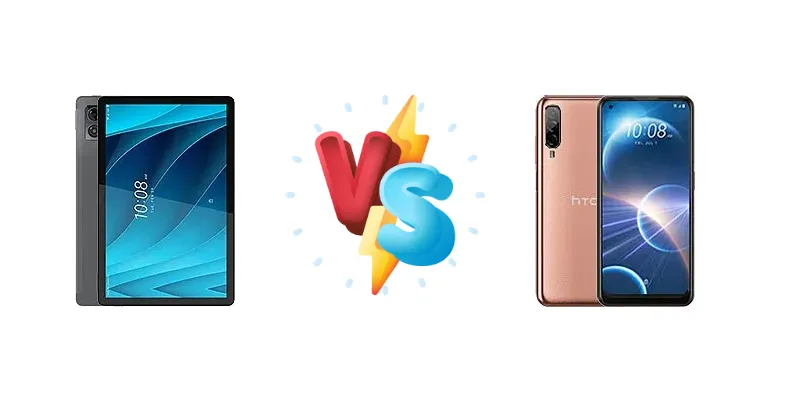
HTC continues to offer options in the budget and mid-range smartphone space, but navigating their lineup can be tricky. We're pitting the HTC A101 Plus, a value-focused device, against the HTC Desire 22 Pro, which adds 5G connectivity and faster charging. This comparison will dissect the core differences to help you determine which device best suits your needs.
🏆 Quick Verdict
For most users, the HTC Desire 22 Pro is the superior choice. Its Snapdragon 695 chipset, built on a more efficient 6nm process, delivers noticeably better performance and 5G capabilities. The 18W charging, including wireless and reverse wired options, is a significant advantage over the A101 Plus’s 10W wired charging.
| Network |
|---|
| 2G bands | GSM 850 / 900 / 1800 / 1900 | GSM 850 / 900 / 1800 / 1900 |
| 3G bands | HSDPA 850 / 900 / 2100 | HSDPA 850 / 900 / 1700(AWS) / 1900 / 2100 |
| 4G bands | LTE | 1, 3, 5, 7, 8, 20, 28, 38, 39, 40, 41 |
| 5G bands | - | 1, 3, 7, 20, 28, 41, 78 SA/NSA |
| Speed | HSPA, LTE | HSPA, LTE, 5G |
| Technology | GSM / HSPA / LTE | GSM / HSPA / LTE / 5G |
| Launch |
|---|
| Announced | 2024, May 03 | 2022, June 28 |
| Status | Available. Released 2024, May 03 | Available. Released 2022, July 10 |
| Body |
|---|
| Dimensions | 256.6 x 168.2 x 7.5 mm (10.10 x 6.62 x 0.30 in) | 166.3 x 76.9 x 9.4 mm (6.55 x 3.03 x 0.37 in) |
| SIM | Nano-SIM + Nano-SIM | Nano-SIM + Nano-SIM |
| Weight | 501 g (1.10 lb) | 205.5 g (7.27 oz) |
| | - | IP67 dust/water resistant (up to 1m for 30 min) |
| Display |
|---|
| Protection | - | Corning Gorilla Glass |
| Resolution | 1200 x 1920 pixels, 16:10 ratio (~207 ppi density) | 1080 x 2412 pixels, 20:9 ratio (~400 ppi density) |
| Size | 10.95 inches, 347.7 cm2 (~80.6% screen-to-body ratio) | 6.6 inches, 104.8 cm2 (~82.0% screen-to-body ratio) |
| Type | IPS LCD | IPS LCD, 120Hz |
| Platform |
|---|
| CPU | Octa-core (2x1.6 GHz Cortex-A75 & 6x1.6 GHz Cortex-A55) | Octa-core (2x2.2 GHz Kryo 660 Gold & 6x1.7 GHz Kryo 660 Silver) |
| Chipset | Unisoc T606 (12 nm) | Qualcomm SM6375 Snapdragon 695 5G (6 nm) |
| GPU | Mali-G57 MP1 | Adreno 619 |
| OS | Android 14 | Android 12 |
| Memory |
|---|
| Card slot | microSDXC (uses shared SIM slot) | microSDXC (uses shared SIM slot) |
| Internal | 128GB 8GB RAM | 128GB 8GB RAM |
| Main Camera |
|---|
| Dual | 13 MP
Secondary lens | - |
| Features | LED flash | Dual-LED flash, HDR, panorama |
| Triple | - | 64 MP, f/1.8, (wide), PDAF
13 MP, f/2.4, 118˚ (ultrawide)
Auxiliary lens |
| Video | 1080p | 1080p@30fps |
| Selfie camera |
|---|
| Features | - | HDR |
| Single | 8 MP | 32 MP, f/2.0, (wide) |
| Video | - | 1080p@30fps |
| Sound |
|---|
| 3.5mm jack | - | Yes |
| 35mm jack | Yes | Yes |
| Loudspeaker | Yes, with stereo speakers | Yes |
| Comms |
|---|
| Bluetooth | 5.0, A2DP, LE | 5.1, A2DP, LE |
| NFC | No | Yes |
| Positioning | Unspecified | GPS, GLONASS, GALILEO, BDS |
| Radio | No | Unspecified |
| USB | USB Type-C 2.0, OTG, magnetic connector | USB Type-C 2.0, OTG |
| WLAN | Wi-Fi 802.11 a/b/g/n/ac, dual-band | Wi-Fi 802.11 a/b/g/n/ac, dual-band, Wi-Fi Direct |
| Features |
|---|
| Sensors | Yes | Fingerprint (side-mounted), accelerometer, gyro, proximity, compass |
| Battery |
|---|
| Charging | 10W wired | 18W wired
Wireless
Reverse wired |
| Type | 7000 mAh | Li-Po 4520 mAh |
| Misc |
|---|
| Colors | Gray, Silver | Wave Gold, Starry Night Black |
| Price | About 150 EUR | About 460 EUR |
HTC A101 Plus
- Most affordable option
- Functional for basic tasks
- Simple and straightforward interface
- Slow charging (10W)
- Limited performance with Unisoc T606
- No 5G connectivity
HTC Desire 22 Pro
- 5G connectivity for faster data speeds
- Faster and more efficient Snapdragon 695
- 18W charging with wireless and reverse wired support
- Higher price point
- May still struggle with very demanding games
- Software updates may be infrequent
Display Comparison
Neither HTC provides detailed display specifications beyond resolution. However, the core difference lies in the processing power driving the display. The A101 Plus’s Unisoc T606 will likely struggle with demanding graphical tasks, impacting smoothness. The Desire 22 Pro’s Snapdragon 695, with its Adreno 619 GPU, offers a more responsive experience, especially for video playback and casual gaming. Bezels and color accuracy are likely similar given the price points, but the 695’s superior processing power will contribute to a better overall visual experience.
Camera Comparison
Without detailed camera specs, it’s difficult to make a definitive judgment. However, the processing power of the Snapdragon 695 in the Desire 22 Pro will likely result in better image processing, particularly in low-light conditions. The A101 Plus’s Unisoc T606 will struggle with complex image algorithms. It’s reasonable to assume both phones feature similar basic camera setups, but the Desire 22 Pro will extract more detail and dynamic range from its sensors. We anticipate both phones will include a 2MP macro lens, which offers limited practical benefit.
Performance
The performance gap is the most significant differentiator. The HTC Desire 22 Pro’s Qualcomm Snapdragon 695 (6nm) is a substantial upgrade over the A101 Plus’s Unisoc T606 (12nm). The 6nm process node translates to better power efficiency and reduced thermal throttling, meaning sustained performance is higher. The Snapdragon 695’s CPU, with 2x2.2 GHz Kryo 660 Gold cores, outperforms the A101 Plus’s 2x1.6 GHz Cortex-A75 cores. This difference is particularly noticeable in app launch times, multitasking, and demanding applications. While both are octa-core CPUs, the architectural advantages of the Snapdragon 695 are clear.
Battery Life
Battery capacity isn’t specified for either device, making a direct comparison challenging. However, the Desire 22 Pro’s 18W wired charging, coupled with wireless and reverse wired charging capabilities, is a major advantage. The A101 Plus is limited to 10W wired charging, resulting in significantly longer charge times. The more efficient Snapdragon 695 in the Desire 22 Pro will also contribute to better battery life, even if the battery capacity is similar. The convenience of wireless charging and the ability to charge other devices with reverse wired charging further enhance the Desire 22 Pro’s usability.
Buying Guide
Buy the HTC A101 Plus if you prioritize absolute affordability and only need a phone for basic tasks like calls, texts, and light social media. It’s a functional device for those on a very tight budget. Buy the HTC Desire 22 Pro if you want a more future-proof device with 5G connectivity, faster processing speeds for smoother multitasking and gaming, and the convenience of faster, more versatile charging options.
Frequently Asked Questions
❓ Will the HTC Desire 22 Pro handle graphically intensive games like Genshin Impact?
While the Snapdragon 695 is capable, Genshin Impact will likely require reduced graphics settings for a smooth experience. It won't deliver flagship-level performance, but it's significantly better than the A101 Plus, which would struggle considerably.
❓ How much faster is the charging on the HTC Desire 22 Pro compared to the A101 Plus?
The Desire 22 Pro’s 18W charging is nearly double the speed of the A101 Plus’s 10W charging. This translates to a significantly reduced time to fully charge the device, and the addition of wireless charging provides even more convenience.
❓ Does the HTC Desire 22 Pro support VoLTE and VoWiFi?
The Desire 22 Pro, being a 5G device, is highly likely to support VoLTE (Voice over LTE) and VoWiFi (Voice over Wi-Fi) for improved call quality and coverage. However, compatibility depends on your carrier.
❓ Is the Unisoc T606 in the A101 Plus sufficient for everyday tasks like browsing and social media?
Yes, the Unisoc T606 is adequate for basic tasks like web browsing, social media, and messaging. However, you may experience slowdowns when multitasking or running more demanding applications.