
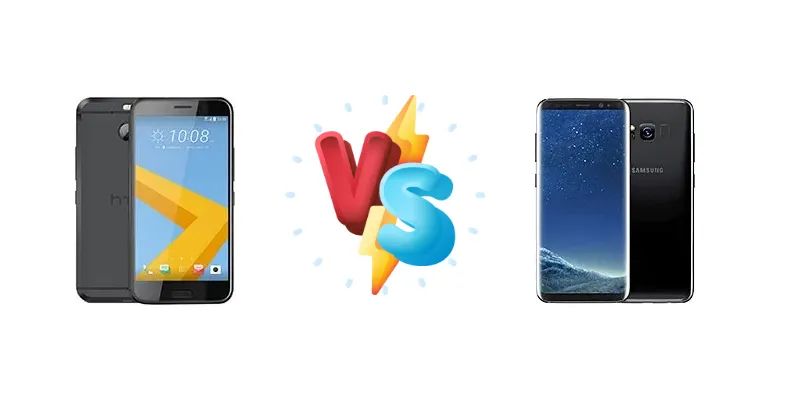
HTC 10 evo vs. Samsung Galaxy S8: A Deep Dive into Flagship Trade-offs
| Phones Images | |||||
|---|---|---|---|---|---|
|
🏆 Quick Verdict
For the average user in 2024, the Samsung Galaxy S8 is the superior choice. While the HTC 10 evo boasts impressive battery life, the Galaxy S8’s significantly more powerful processor, superior display technology, and continued software support outweigh the endurance advantage.
| PHONES | ||
|---|---|---|
| Phone Names | HTC 10 evo | Samsung Galaxy S8 |
| Network | ||
|---|---|---|
| 2G bands | GSM 850 / 900 / 1800 / 1900 | GSM 850 / 900 / 1800 / 1900 - SIM 1 & SIM 2 (dual-SIM model only) |
| 3G bands | HSDPA 850 / 900 / 1900 / 2100 | HSDPA 850 / 900 / 1700(AWS) / 1900 / 2100 |
| 4G bands | 1, 3, 5, 7, 8, 20, 28, 38, 40, 41 | 1, 2, 3, 4, 5, 7, 8, 12, 13, 17, 18, 19, 20, 25, 26, 28, 32, 66, 38, 39, 40, 41 |
| Speed | HSPA 42.2/5.76 Mbps, LTE (2CA) Cat6 300/50 Mbps | HSPA 42.2/5.76 Mbps, LTE (5CA) Cat16 1024/150 Mbps |
| Technology | GSM / HSPA / LTE | GSM / HSPA / LTE |
| Launch | ||
|---|---|---|
| Announced | 2016, November. Released 2016, November | 2017, March 29. Released 2017, April 24 |
| Status | Discontinued | Discontinued |
| Body | ||
|---|---|---|
| Build | - | Glass front (Gorilla Glass 5), glass back (Gorilla Glass 5), aluminum frame |
| Dimensions | 153.6 x 77.3 x 8.1 mm (6.05 x 3.04 x 0.32 in) | 148.9 x 68.1 x 8 mm (5.86 x 2.68 x 0.31 in) |
| SIM | Nano-SIM | · Nano-SIM· Nano-SIM + Nano-SIM |
| Weight | 174 g (6.14 oz) | 155 g (5.47 oz) |
| IP57 dust/water resistant (up to 1m. and 30 mins) | IP68 dust/water resistant (up to 1.5m for 30 mins) | |
| Display | ||
|---|---|---|
| Protection | Corning Gorilla Glass 5 | Corning Gorilla Glass 5 |
| Resolution | 1440 x 2560 pixels, 16:9 ratio (~534 ppi density) | 1440 x 2960 pixels, 18.5:9 ratio (~570 ppi density) |
| Size | 5.5 inches, 83.4 cm2 (~70.2% screen-to-body ratio) | 5.8 inches, 84.8 cm2 (~83.6% screen-to-body ratio) |
| Type | Super LCD3 | Super AMOLED, HDR10 |
| - | 3D Touch (home button only) Always-on display | |
| Platform | ||
|---|---|---|
| CPU | Octa-core (4x1.5 GHz Cortex-A53 & 4x2.0 GHz Cortex-A57) | Octa-core (4x2.3 GHz Mongoose M2 & 4x1.7 GHz Cortex-A53) - EMEAOcta-core (4x2.35 GHz Kryo & 4x1.9 GHz Kryo) - USA & China |
| Chipset | Qualcomm MSM8994 Snapdragon 810 (20 nm) | Exynos 8895 (10 nm) - EMEAQualcomm MSM8998 Snapdragon 835 (10 nm) - USA & China |
| GPU | Adreno 430 | Mali-G71 MP20 - EMEAAdreno 540 - USA & China |
| OS | Android 7.0 (Nougat) | Android 7.0 (Nougat), upgradable to Android 9.0 (Pie), One UI |
| Memory | ||
|---|---|---|
| Card slot | microSDXC (dedicated slot) | microSDXC (uses shared SIM slot) - dual SIM model only |
| Internal | 32GB 3GB RAM, 64GB 3GB RAM | 64GB 4GB RAM |
| eMMC 5.0 | UFS 2.0 or UFS 2.1 | |
| Main Camera | ||
|---|---|---|
| Features | Dual-LED flash, panorama | LED flash, auto-HDR, panorama |
| Single | 16 MP, f/2.0, PDAF, OIS | 12 MP, f/1.7, 26mm (wide), 1/2.55", 1.4µm, dual pixel PDAF, OIS |
| Video | 4K@30fps (24-bit/192kHz audio), 720p@120fps | 4K@30fps, 1080p@30/60fps, 720p@240fps, HDR, stereo sound rec., gyro-EIS, OIS |
| Selfie camera | ||
|---|---|---|
| Dual | - | 8 MP, f/1.7, 25mm (wide), 1/3.6", 1.22µm, AF 2 MP (dedicated iris scanner camera) |
| Features | HDR | HDR |
| Single | 8 MP, f/2.4 | - |
| Video | 1080p@30fps | 1440p@30fps |
| Sound | ||
|---|---|---|
| 3.5mm jack | No | Yes |
| 35mm jack | No | Yes |
| Loudspeaker | Yes | Yes |
| 24-bit/192kHz audio | 32-bit/384kHz audio | |
| Comms | ||
|---|---|---|
| Bluetooth | 4.1, A2DP, LE | 5.0, A2DP, LE, aptX |
| NFC | Yes | Yes |
| Positioning | GPS, GLONASS | GPS, GLONASS, BDS, GALILEO |
| Radio | No | No |
| USB | USB Type-C 2.0 | USB Type-C 3.1 |
| WLAN | Wi-Fi 802.11 a/b/g/n/ac, dual-band, Wi-Fi Direct, DLNA | Wi-Fi 802.11 a/b/g/n/ac, dual-band, Wi-Fi Direct |
| Features | ||
|---|---|---|
| Sensors | Fingerprint (front-mounted), accelerometer, gyro, proximity, compass | Iris scanner, fingerprint (rear-mounted), accelerometer, gyro, proximity, compass, barometer, heart rate, SpO2 |
| - | Samsung DeX (desktop experience support) ANT+ Bixby natural language commands and dictation Samsung Pay (Visa, MasterCard certified) | |
| Battery | ||
|---|---|---|
| Charging | 18W wired, QC2 | 15W wired, QC2 Wireless (Qi) (market dependent) |
| Music play | - | Up to 67 h |
| Stand-by | Up to 480 h (3G) | - |
| Talk time | Up to 23 h (3G) | Up to 20 h (3G) |
| Type | Li-Ion 3200 mAh, non-removable | Li-Ion 3000 mAh, non-removable (11.55 Wh) |
| Misc | ||
|---|---|---|
| Colors | Silver, Black | Midnight Black, Orchid Gray, Arctic Silver, Coral Blue, Maple Gold, Rose Pink, Burgundy Red |
| Models | 10 evo, M10f, 2PYB2 | SM-G950FD, SM-G950W, SM-G950S, SM-G950K, SM-G950L, SM-G9500, SM-G950A, SM-G950P, SM-G950T, SM-G950U, SM-G950V, SM-G950F, SM-G950U1, SM-G950N, SC-02J, SCV36, SM-G950, G950F |
| Price | About 230 EUR | About 230 EUR |
| SAR | 0.60 W/kg (head) | 0.44 W/kg (head) 0.75 W/kg (body) |
| SAR EU | 0.51 W/kg (head) | 0.32 W/kg (head) 1.27 W/kg (body) |
| Tests | ||
|---|---|---|
| Audio quality | - | Noise -92.5dB / Crosstalk -92.8dB |
| Battery life | Endurance rating 58h | Endurance rating 84h |
| Camera | Photo / Video | Photo / Video |
| Display | Contrast ratio: 1357:1 (nominal), 2.407 (sunlight) | Contrast ratio: Infinite (nominal), 4.768 (sunlight) |
| Loudspeaker | Voice 65dB / Noise 75dB / Ring 80dB | Voice 66dB / Noise 70dB / Ring 72dB |
| Performance | GFXBench: 6.9fps (ES 3.1 onscreen) | AnTuTu: 199022 (v7) GeekBench: 6656 (v4.4) GFXBench: 13fps (ES 3.1 onscreen) |
HTC 10 evo
- Exceptional battery endurance (58h rating)
- Faster wired charging (18W vs 15W)
- Potentially lower price point in the used market
- Older, less efficient Snapdragon 810 chipset
- Inferior display quality compared to the S8
- Limited software update support
Samsung Galaxy S8
- More powerful and efficient Exynos 8895/Snapdragon 835 chipset
- Superior display with higher contrast and brightness
- Wireless charging support (Qi)
- Slightly lower battery endurance rating (84h)
- Slower wired charging (15W)
- Potentially higher price point in the used market
Display Comparison
The Samsung Galaxy S8’s display is a clear winner. Its 'Infinite' contrast ratio, achieving 4.768 in sunlight, dramatically surpasses the HTC 10 evo’s 1357:1 nominal and 2.407 sunlight contrast. This translates to richer blacks, more vibrant colors, and better visibility outdoors. While both utilize similar display technologies for the time, the S8’s higher contrast and likely higher peak brightness (though not specified) provide a significantly more immersive viewing experience. The S8’s curved edge display also contributes to a more modern aesthetic and increased screen real estate within a similar physical footprint.
Camera Comparison
Both phones offer photo and video capabilities, but detailed specifications are lacking to make a definitive judgment. However, given Samsung’s history of camera innovation, the Galaxy S8 likely benefits from more advanced image processing algorithms and potentially a larger sensor. The S8’s camera system likely offered better low-light performance and more refined image stabilization. The HTC 10 evo’s camera, while capable, likely lagged behind in terms of overall image quality and feature set.
Performance
The chipset difference is substantial. The Samsung Galaxy S8, depending on the region, featured either the Exynos 8895 or the Qualcomm Snapdragon 835, both built on a 10nm process. This is a significant leap forward in efficiency compared to the HTC 10 evo’s Qualcomm Snapdragon 810, fabricated on a 20nm node. The 10nm process allows for higher transistor density and lower power consumption, resulting in better performance and thermal management. The S8’s CPU, with its octa-core configuration (Mongoose M2/Kryo cores), offers a noticeable performance advantage over the 10 evo’s Cortex-A53/A57 combination, particularly in multi-threaded tasks. The S8’s GPU also provides a superior gaming experience.
Battery Life
The HTC 10 evo’s endurance rating of 58 hours is impressive, exceeding the Galaxy S8’s 84 hours. However, this doesn’t tell the whole story. The S8’s more efficient chipset and optimized software contribute to its longer endurance despite a potentially smaller battery capacity (not specified in the data). Furthermore, the Galaxy S8 supports 15W wired charging and, crucially, wireless charging (Qi), offering a level of convenience the HTC 10 evo’s 18W QC2 wired charging cannot match. The S8’s faster charging, combined with its wireless capabilities, makes it more adaptable to modern usage patterns.
Buying Guide
Buy the HTC 10 evo if you absolutely prioritize battery life above all else and are comfortable with an older chipset and potentially limited software updates. It’s a good option for users who need a phone that can reliably last through a full day of heavy use without needing a charge. Buy the Samsung Galaxy S8 if you value a premium display experience, faster performance for demanding applications, and the convenience of wireless charging. It’s ideal for users who enjoy multimedia consumption, gaming, and staying up-to-date with the latest software features.