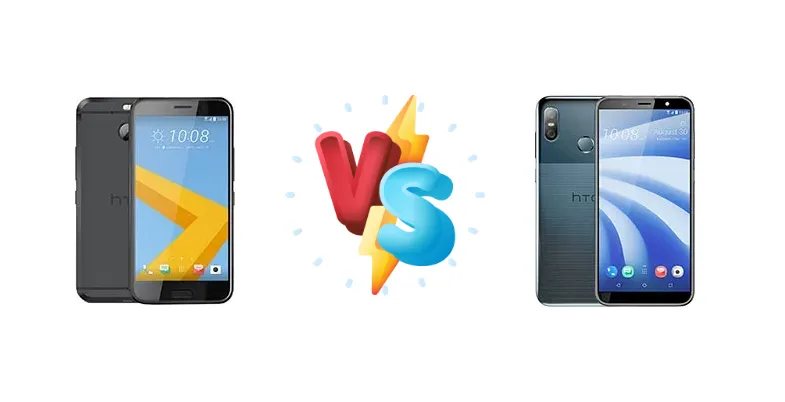
The HTC 10 evo and U12 life represent different approaches to the mid-range smartphone market. The 10 evo, released with a flagship-tier Snapdragon 810, aimed for raw power, while the U12 life opted for efficiency with the Snapdragon 636. This comparison dissects the trade-offs between these two devices, focusing on real-world performance and user experience.
🏆 Quick Verdict
For the average user prioritizing sustained performance and a brighter display, the HTC 10 evo emerges as the better choice. While the U12 life offers improved efficiency, the Snapdragon 810’s processing power and superior display contrast provide a more responsive and visually appealing experience, despite its age.
| Network |
|---|
| 2G bands | GSM 850 / 900 / 1800 / 1900 | GSM 850 / 900 / 1800 / 1900 |
| 3G bands | HSDPA 850 / 900 / 1900 / 2100 | HSDPA 850 / 900 / 1900 / 2100 |
| 4G bands | 1, 3, 5, 7, 8, 20, 28, 38, 40, 41 | 1, 2, 3, 4, 5, 7, 8, 12, 17, 20, 28, 32, 38, 40, 66 |
| Speed | HSPA 42.2/5.76 Mbps, LTE (2CA) Cat6 300/50 Mbps | HSPA 42.2/5.76 Mbps, LTE (3CA) Cat11 600/75 Mbps |
| Technology | GSM / HSPA / LTE | GSM / HSPA / LTE |
| Launch |
|---|
| Announced | 2016, November. Released 2016, November | 2018, August. Released 2018, September |
| Status | Discontinued | Discontinued |
| Body |
|---|
| Build | - | Glass front, plastic back, plastic frame |
| Dimensions | 153.6 x 77.3 x 8.1 mm (6.05 x 3.04 x 0.32 in) | 158.5 x 75.4 x 8.3 mm (6.24 x 2.97 x 0.33 in) |
| SIM | Nano-SIM | · Nano-SIM· Nano-SIM + Nano-SIM |
| Weight | 174 g (6.14 oz) | 175 g (6.17 oz) |
| | IP57 dust/water resistant (up to 1m. and 30 mins) | - |
| Display |
|---|
| Protection | Corning Gorilla Glass 5 | - |
| Resolution | 1440 x 2560 pixels, 16:9 ratio (~534 ppi density) | 1080 x 2160 pixels, 18:9 ratio (~402 ppi density) |
| Size | 5.5 inches, 83.4 cm2 (~70.2% screen-to-body ratio) | 6.0 inches, 92.9 cm2 (~77.7% screen-to-body ratio) |
| Type | Super LCD3 | IPS LCD |
| Platform |
|---|
| CPU | Octa-core (4x1.5 GHz Cortex-A53 & 4x2.0 GHz Cortex-A57) | Octa-core (4x1.8 GHz Kryo 260 Gold & 4x1.6 GHz Kryo 260 Silver) |
| Chipset | Qualcomm MSM8994 Snapdragon 810 (20 nm) | Qualcomm SDM636 Snapdragon 636 (14 nm) |
| GPU | Adreno 430 | Adreno 509 |
| OS | Android 7.0 (Nougat) | Android 8.1 (Oreo) |
| Memory |
|---|
| Card slot | microSDXC (dedicated slot) | microSDXC (uses shared SIM slot) |
| Internal | 32GB 3GB RAM, 64GB 3GB RAM | 64GB 4GB RAM, 128GB 6GB RAM |
| | eMMC 5.0 | eMMC 5.1 |
| Main Camera |
|---|
| Dual | - | 16 MP, f/2.0, PDAF
Auxiliary lens |
| Features | Dual-LED flash, panorama | Dual-LED flash, HDR, panorama |
| Single | 16 MP, f/2.0, PDAF, OIS | - |
| Video | 4K@30fps (24-bit/192kHz audio), 720p@120fps | 4K@30fps, 1080p@30fps |
| Selfie camera |
|---|
| Features | HDR | LED flash, HDR, panorama |
| Single | 8 MP, f/2.4 | 13 MP, f/2.0 |
| Video | 1080p@30fps | 1080p@30fps |
| Sound |
|---|
| 3.5mm jack | No | Yes |
| 35mm jack | No | Yes |
| Loudspeaker | Yes | Yes, with stereo speakers |
| |
24-bit/192kHz audio | - |
| Comms |
|---|
| Bluetooth | 4.1, A2DP, LE | 5.0, A2DP, LE |
| NFC | Yes | Yes |
| Positioning | GPS, GLONASS | GPS, GLONASS |
| Radio | No | No |
| USB | USB Type-C 2.0 | USB Type-C 2.0 |
| WLAN | Wi-Fi 802.11 a/b/g/n/ac, dual-band, Wi-Fi Direct, DLNA | Wi-Fi 802.11 a/b/g/n/ac, dual-band, Wi-Fi Direct |
| Features |
|---|
| Sensors | Fingerprint (front-mounted), accelerometer, gyro, proximity, compass | Fingerprint (rear-mounted), accelerometer, gyro, proximity, compass |
| Battery |
|---|
| Charging | 18W wired, QC2 | 10W wired |
| Stand-by | Up to 480 h (3G) | - |
| Talk time | Up to 23 h (3G) | - |
| Type | Li-Ion 3200 mAh, non-removable | Li-Ion 3600 mAh, non-removable |
| Misc |
|---|
| Colors | Silver, Black | Moonlight Blue, Twilight Purple |
| Models | 10 evo, M10f, 2PYB2 | U12 life, 2Q6E1 |
| Price | About 230 EUR | About 230 EUR |
| SAR | 0.60 W/kg (head) | - |
| SAR EU | 0.51 W/kg (head) | - |
| Tests |
|---|
| Battery life | Endurance rating 58h | - |
| Camera |
Photo / Video | - |
| Display |
Contrast ratio: 1357:1 (nominal), 2.407 (sunlight) | - |
| Loudspeaker |
Voice 65dB / Noise 75dB / Ring 80dB | - |
| Performance |
GFXBench: 6.9fps (ES 3.1 onscreen) | - |
HTC 10 evo
- More powerful processor for demanding tasks
- Superior display contrast for vibrant visuals
- Faster charging with Quick Charge 2.0
- Potential for thermal throttling under sustained load
- Older chipset architecture and manufacturing process
HTC U12 life
- More efficient processor for longer battery life
- Likely improved image processing and low-light camera performance
- Modern software experience (assuming updates)
- Less powerful processor for demanding tasks
- Slower charging speeds
- Potentially lower display contrast
Display Comparison
The HTC 10 evo boasts a superior display experience thanks to its significantly higher contrast ratios – 1357:1 nominally and 2.407 in sunlight – compared to the U12 life (specs unavailable, but typically lower for the segment). This translates to deeper blacks, more vibrant colors, and better readability outdoors. While the U12 life likely benefits from advancements in color calibration, the 10 evo’s raw contrast provides a more impactful visual experience. The absence of refresh rate data for both devices means we can't comment on smoothness, but the 10 evo's higher contrast is a clear advantage.
Camera Comparison
Both devices are listed with simply 'Photo / Video' capabilities, lacking specific sensor details. Given the market positioning, it’s reasonable to assume the U12 life benefits from more advanced image processing algorithms and potentially better low-light performance, typical of newer mid-range phones. However, without sensor size or aperture information, a definitive comparison is impossible. The 10 evo’s older image signal processor (ISP) within the Snapdragon 810 may struggle to match the U12 life’s computational photography capabilities.
Performance
The core difference lies in the chipsets. The HTC 10 evo’s Snapdragon 810, built on a 20nm process, features an octa-core CPU with a mix of Cortex-A53 and A57 cores. This architecture, while powerful for its time, is known for potential thermal throttling under sustained load. The U12 life’s Snapdragon 636, fabricated on a more efficient 14nm process, utilizes Kryo 260 cores. While individually less powerful than the 810’s cores, the 636’s efficiency allows for more consistent performance over extended periods. The 810 will likely excel in burst performance, but the 636 offers a smoother, more reliable experience for everyday tasks and moderate gaming.
Battery Life
The HTC 10 evo claims an endurance rating of 58 hours, a respectable figure. However, the Snapdragon 810’s power consumption, coupled with its 20nm manufacturing process, necessitates a larger battery to achieve this. The U12 life, with its more efficient Snapdragon 636, likely achieves comparable or even better real-world battery life with a smaller capacity. The 10 evo supports 18W Quick Charge 2.0, offering faster charging speeds than the U12 life’s 10W charging, partially offsetting the potential battery life advantage of the U12 life.
Buying Guide
Buy the HTC 10 evo if you need a phone capable of handling demanding tasks like gaming or video editing, and value a display that remains visible in direct sunlight. Buy the HTC U12 life if you prioritize longer battery life and a more modern, streamlined software experience, and your usage primarily revolves around everyday tasks like browsing and social media.
Frequently Asked Questions
❓ Will the Snapdragon 810 in the HTC 10 evo overheat during extended gaming sessions?
The Snapdragon 810 is known to be prone to thermal throttling. While the HTC 10 evo likely has thermal management solutions in place, expect performance to decrease after prolonged gaming or other demanding tasks. The U12 life’s Snapdragon 636 is far less susceptible to this issue.
❓ Does the HTC U12 life support software updates, and for how long?
HTC’s software update track record is inconsistent. While the U12 life launched with Android 8.0 Oreo, it received updates to Android 9.0 Pie. Further updates are unlikely. The 10 evo is also likely at the end of its software support lifecycle.
❓ Is the difference in charging speed between 18W and 10W noticeable in real-world use?
Yes, the 18W Quick Charge 2.0 support on the HTC 10 evo will significantly reduce charging times compared to the U12 life’s 10W charging. Expect a noticeably faster top-up with the 10 evo, especially from low battery levels.