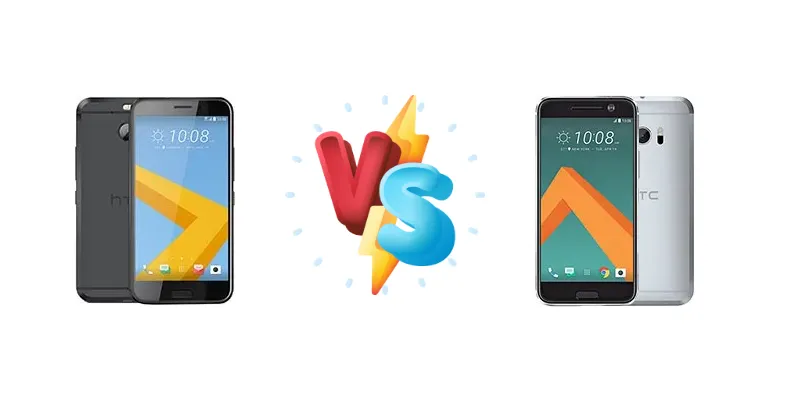
The HTC 10 and HTC 10 evo represent HTC's attempts to refine the flagship experience in 2016 and 2017. While both aimed for premium build quality and features, they diverged in key areas like chipset and battery optimization. This comparison dissects those differences to determine which device offers the best value and performance today.
🏆 Quick Verdict
For the average user prioritizing longevity and consistent performance, the HTC 10 emerges as the better choice. Its Snapdragon 820, built on a smaller 14nm process, delivers superior efficiency and sustained performance compared to the 20nm Snapdragon 810 in the HTC 10 evo, despite the latter's slightly higher endurance rating.
| Network |
|---|
| 2G bands | GSM 850 / 900 / 1800 / 1900 | GSM 850 / 900 / 1800 / 1900 |
| 3G bands | HSDPA 850 / 900 / 1900 / 2100 | HSDPA 850 / 900 / 1900 / 2100 |
| 4G bands | 1, 3, 5, 7, 8, 20, 28, 38, 40, 41 | 1, 3, 5, 7, 8, 20, 28, 38, 40, 41 |
| Speed | HSPA 42.2/5.76 Mbps, LTE (2CA) Cat6 300/50 Mbps | HSPA, LTE (3CA) Cat9 450/50 Mbps |
| Technology | GSM / HSPA / LTE | GSM / HSPA / LTE |
| Launch |
|---|
| Announced | 2016, November. Released 2016, November | 2016, April 12. Released 2016, April 12 |
| Status | Discontinued | Discontinued |
| Body |
|---|
| Build | - | Glass front (Gorilla Glass 3), aluminum back, aluminum frame |
| Dimensions | 153.6 x 77.3 x 8.1 mm (6.05 x 3.04 x 0.32 in) | 145.9 x 71.9 x 9 mm (5.74 x 2.83 x 0.35 in) |
| SIM | Nano-SIM | Nano-SIM |
| Weight | 174 g (6.14 oz) | 161 g (5.68 oz) |
| | IP57 dust/water resistant (up to 1m. and 30 mins) | - |
| Display |
|---|
| Protection | Corning Gorilla Glass 5 | Corning Gorilla Glass 3 |
| Resolution | 1440 x 2560 pixels, 16:9 ratio (~534 ppi density) | 1440 x 2560 pixels, 16:9 ratio (~565 ppi density) |
| Size | 5.5 inches, 83.4 cm2 (~70.2% screen-to-body ratio) | 5.2 inches, 74.5 cm2 (~71.1% screen-to-body ratio) |
| Type | Super LCD3 | Super LCD5 |
| Platform |
|---|
| CPU | Octa-core (4x1.5 GHz Cortex-A53 & 4x2.0 GHz Cortex-A57) | Quad-core (2x2.15 GHz Kryo & 2x1.6 GHz Kryo) |
| Chipset | Qualcomm MSM8994 Snapdragon 810 (20 nm) | Qualcomm MSM8996 Snapdragon 820 (14 nm) |
| GPU | Adreno 430 | Adreno 530 |
| OS | Android 7.0 (Nougat) | Android 6.0.1 (Marshmallow), upgradable to Android 8.0 (Oreo), Sense UI |
| Memory |
|---|
| Card slot | microSDXC (dedicated slot) | microSDXC (dedicated slot) |
| Internal | 32GB 3GB RAM, 64GB 3GB RAM | 32GB 4GB RAM, 64GB 4GB RAM |
| | eMMC 5.0 | - |
| Main Camera |
|---|
| Features | Dual-LED flash, panorama | Laser AF, Dual-LED dual-tone flash, HDR, panorama |
| Single | 16 MP, f/2.0, PDAF, OIS | 12 MP, f/1.8, 26mm (wide), 1/2.3", 1.55µm, OIS |
| Video | 4K@30fps (24-bit/192kHz audio), 720p@120fps | 4K@30fps, 720p@120fps, HDR, stereo sound rec. |
| Selfie camera |
|---|
| Features | HDR | HDR |
| Single | 8 MP, f/2.4 | 5 MP, f/1.8, 23mm (wide), 1/4.1", 1.34µm, OIS, AF |
| Video | 1080p@30fps | 1080p@30fps |
| Sound |
|---|
| 3.5mm jack | No | Yes |
| 35mm jack | No | Yes |
| Loudspeaker | Yes | Yes, with stereo speakers |
| |
24-bit/192kHz audio | 24-bit/192kHz audio
|
| Comms |
|---|
| Bluetooth | 4.1, A2DP, LE | 4.2, A2DP, aptX |
| NFC | Yes | Yes |
| Positioning | GPS, GLONASS | GPS, GLONASS/ BDS (region dependent) |
| Radio | No | No |
| USB | USB Type-C 2.0 | USB Type-C 3.1 |
| WLAN | Wi-Fi 802.11 a/b/g/n/ac, dual-band, Wi-Fi Direct, DLNA | Wi-Fi 802.11 a/b/g/n/ac, dual-band, Wi-Fi Direct, DLNA |
| Features |
|---|
| Sensors | Fingerprint (front-mounted), accelerometer, gyro, proximity, compass | Fingerprint (front-mounted), accelerometer, gyro, proximity, compass |
| Battery |
|---|
| Charging | 18W wired, QC2 | 18W wired, QC3, 50% in 30 min |
| Stand-by | Up to 480 h (3G) | Up to 456 h (3G) |
| Talk time | Up to 23 h (3G) | Up to 27 h (3G) |
| Type | Li-Ion 3200 mAh, non-removable | Li-Ion 3000 mAh, non-removable |
| Misc |
|---|
| Colors | Silver, Black | Carbon Gray, Topaz Gold, Glacier Silver, Camellia Red |
| Models | 10 evo, M10f, 2PYB2 | 10, M10h, HTC6545LVW, HTV32, 2PS64, 2PS6200 |
| Price | About 230 EUR | About 300 EUR |
| SAR | 0.60 W/kg (head) | 0.47 W/kg (head) 0.64 W/kg (body) |
| SAR EU | 0.51 W/kg (head) | - |
| Tests |
|---|
| Audio quality | - |
Noise -90.4dB / Crosstalk -87.3dB |
| Battery life | Endurance rating 58h |
Endurance rating 66h
|
| Camera |
Photo / Video |
Photo / Video |
| Display |
Contrast ratio: 1357:1 (nominal), 2.407 (sunlight) | - |
| Loudspeaker |
Voice 65dB / Noise 75dB / Ring 80dB |
Voice 65dB / Noise 62dB / Ring 63dB
|
| Performance |
GFXBench: 6.9fps (ES 3.1 onscreen) |
Basemark OS II 2.0: 1839Basemark X: 28882 |
HTC 10 evo
- Slightly better battery endurance rating (58h)
- Higher display contrast ratio for potentially better visuals
- Quick Charge 2.0 support
- Less efficient Snapdragon 810 chipset
- Potential for thermal throttling under sustained load
- Older 20nm manufacturing process
HTC 10
- More efficient Snapdragon 820 chipset
- Faster charging with Quick Charge 3.0 (50% in 30 min)
- Superior sustained performance due to 14nm process
- Lower battery endurance rating (66h)
- Display contrast ratio not specified
Display Comparison
Both devices feature similar display technologies, but the HTC 10 evo boasts a significantly higher contrast ratio – 1357:1 nominal and 2.407 in sunlight – compared to the HTC 10’s unspecified ratio. This suggests deeper blacks and improved visibility in bright conditions for the evo. However, without knowing the HTC 10’s specific contrast figures, it’s difficult to quantify the real-world difference. Both lack high refresh rate panels, common in modern smartphones.
Camera Comparison
Both phones offer photo and video capabilities, but detailed camera specs are lacking in the provided data. Without sensor size, aperture, or image processing details, a direct comparison is impossible. However, given the era, it’s reasonable to assume both phones delivered competitive image quality for their time, focusing on detail and color accuracy. The absence of specific camera features prevents a definitive winner.
Performance
The core difference lies in the chipsets. The HTC 10 utilizes the Qualcomm MSM8996 Snapdragon 820, fabricated on a 14nm process, while the HTC 10 evo features the older MSM8994 Snapdragon 810, built on a 20nm process. This process node difference is critical; the 14nm Snapdragon 820 is inherently more power-efficient, leading to less heat generation and reduced throttling during demanding tasks. The HTC 10’s quad-core Kryo architecture also offers a performance advantage over the Snapdragon 810’s octa-core configuration, despite the latter having more cores. The 820’s cores are more powerful individually.
Battery Life
The HTC 10 boasts an endurance rating of 66 hours, while the HTC 10 evo achieves 58 hours. While the evo’s 18W Quick Charge 2.0 is respectable, the HTC 10’s 18W Quick Charge 3.0 support, coupled with its 50% charge in 30 minutes capability, provides a faster and more convenient charging experience. The HTC 10’s more efficient chipset likely contributes to its superior endurance despite a potentially similar battery capacity.
Buying Guide
Buy the HTC 10 evo if you prioritize a slightly longer endurance rating and are comfortable with potential thermal throttling under sustained load. Buy the HTC 10 if you value consistent performance, faster charging with Quick Charge 3.0, and a more efficient chipset that will likely age better, offering a smoother experience over the long term.
Frequently Asked Questions
❓ Will the Snapdragon 810 in the HTC 10 evo overheat during gaming?
The Snapdragon 810 was known to suffer from thermal throttling under sustained load due to its 20nm manufacturing process. While casual gaming shouldn't be an issue, extended gaming sessions on the HTC 10 evo may result in reduced performance as the chip attempts to manage heat.
❓ Does the HTC 10's Quick Charge 3.0 offer a significant advantage over the HTC 10 evo's Quick Charge 2.0?
Yes, Quick Charge 3.0 is more efficient and can deliver power more intelligently than Quick Charge 2.0. The HTC 10's ability to reach 50% charge in just 30 minutes provides a noticeably faster charging experience compared to the HTC 10 evo.
❓ Which phone is likely to receive software updates for longer?
Given the age of both devices, neither is likely to receive official software updates anymore. However, the HTC 10, being the slightly newer model at launch, *might* have a marginally larger community support for custom ROMs, offering a path to continued software functionality.