
HTC 10 evo vs. Apple iPhone X: A Detailed Comparison of Flagship Features
| Phones Images | |||||
|---|---|---|---|---|---|
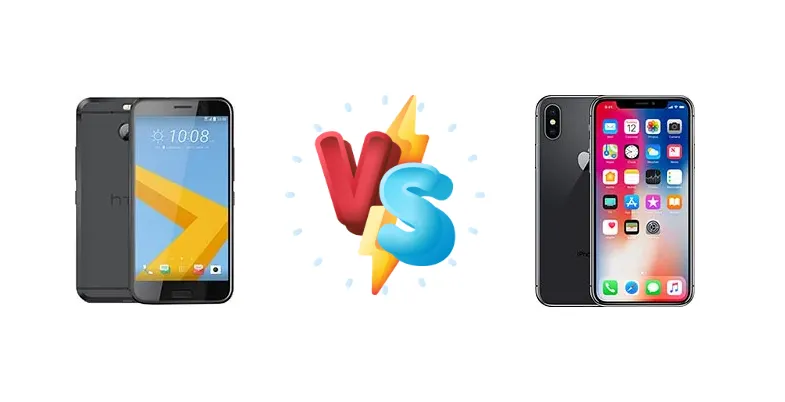
|
🏆 Quick Verdict
For the average user in 2024, the Apple iPhone X is the superior choice. While the HTC 10 evo boasts impressive battery endurance, the iPhone X’s significantly faster processor, superior display technology, and continued software support outweigh its slightly shorter battery life. The iPhone X offers a more refined and future-proof experience.
| PHONES | ||
|---|---|---|
| Phone Names | HTC 10 evo | Apple iPhone X |
| Network | ||
|---|---|---|
| 2G bands | GSM 850 / 900 / 1800 / 1900 | GSM 850 / 900 / 1800 / 1900 |
| 3G bands | HSDPA 850 / 900 / 1900 / 2100 | HSDPA 850 / 900 / 1700(AWS) / 1900 / 2100 |
| 4G bands | 1, 3, 5, 7, 8, 20, 28, 38, 40, 41 | 1, 2, 3, 4, 5, 7, 8, 12, 13, 17, 18, 19, 20, 25, 26, 28, 29, 30, 34, 38, 39, 40, 41, 66 |
| Speed | HSPA 42.2/5.76 Mbps, LTE (2CA) Cat6 300/50 Mbps | HSPA 42.2/5.76 Mbps, LTE (3CA) Cat12 600/150 Mbps, EV-DO Rev.A 3.1 Mbps |
| Technology | GSM / HSPA / LTE | GSM / HSPA / LTE |
| Launch | ||
|---|---|---|
| Announced | 2016, November. Released 2016, November | 2017, September 12. Released 2017, November 03 |
| Status | Discontinued | Discontinued |
| Body | ||
|---|---|---|
| Build | - | Glass front (Corning-made glass), glass back (Corning-made glass), stainless steel frame |
| Dimensions | 153.6 x 77.3 x 8.1 mm (6.05 x 3.04 x 0.32 in) | 143.6 x 70.9 x 7.7 mm (5.65 x 2.79 x 0.30 in) |
| SIM | Nano-SIM | Nano-SIM |
| Weight | 174 g (6.14 oz) | 174 g (6.14 oz) |
| IP57 dust/water resistant (up to 1m. and 30 mins) | IP67 dust/water resistant (up to 1m for 30 mins) Apple Pay (Visa, MasterCard, AMEX certified) | |
| Display | ||
|---|---|---|
| Protection | Corning Gorilla Glass 5 | Scratch-resistant glass |
| Resolution | 1440 x 2560 pixels, 16:9 ratio (~534 ppi density) | 1125 x 2436 pixels, 19.5:9 ratio (~458 ppi density) |
| Size | 5.5 inches, 83.4 cm2 (~70.2% screen-to-body ratio) | 5.8 inches, 84.4 cm2 (~82.9% screen-to-body ratio) |
| Type | Super LCD3 | Super Retina OLED, HDR10, Dolby Vision, 625 nits (HBM) |
| - | 3D Touch | |
| Platform | ||
|---|---|---|
| CPU | Octa-core (4x1.5 GHz Cortex-A53 & 4x2.0 GHz Cortex-A57) | Hexa-core 2.39 GHz (2x Monsoon + 4x Mistral) |
| Chipset | Qualcomm MSM8994 Snapdragon 810 (20 nm) | Apple A11 Bionic (10 nm) |
| GPU | Adreno 430 | Apple GPU (three-core graphics) |
| OS | Android 7.0 (Nougat) | iOS 11.1.1, up to iOS 16.7.12 |
| Memory | ||
|---|---|---|
| Card slot | microSDXC (dedicated slot) | No |
| Internal | 32GB 3GB RAM, 64GB 3GB RAM | 64GB 3GB RAM, 256GB 3GB RAM |
| eMMC 5.0 | NVMe | |
| Main Camera | ||
|---|---|---|
| Dual | - | 12 MP, f/1.8, 28mm (wide), 1/3.0", 1.22µm, dual pixel PDAF, OIS 12 MP, f/2.4, 52mm (telephoto), 1/3.4", 1.0µm, PDAF, OIS, 2x optical zoom |
| Features | Dual-LED flash, panorama | Quad-LED dual-tone flash, HDR (photo/panorama), panorama, HDR |
| Single | 16 MP, f/2.0, PDAF, OIS | - |
| Video | 4K@30fps (24-bit/192kHz audio), 720p@120fps | 4K@24/30/60fps, 1080p@30/60/120/240fps |
| Selfie camera | ||
|---|---|---|
| Features | HDR | HDR |
| Single | 8 MP, f/2.4 | 7 MP, f/2.2, 32mm (standard) SL 3D, (depth/biometrics sensor) |
| Video | 1080p@30fps | 1080p@30fps |
| Sound | ||
|---|---|---|
| 3.5mm jack | No | No |
| 35mm jack | No | No |
| Loudspeaker | Yes | Yes, with stereo speakers |
| 24-bit/192kHz audio | - | |
| Comms | ||
|---|---|---|
| Bluetooth | 4.1, A2DP, LE | 5.0, A2DP, LE |
| NFC | Yes | Yes |
| Positioning | GPS, GLONASS | GPS, GLONASS, GALILEO, QZSS |
| Radio | No | No |
| USB | USB Type-C 2.0 | Lightning, USB 2.0 |
| WLAN | Wi-Fi 802.11 a/b/g/n/ac, dual-band, Wi-Fi Direct, DLNA | Wi-Fi 802.11 a/b/g/n/ac, dual-band, hotspot |
| Features | ||
|---|---|---|
| Sensors | Fingerprint (front-mounted), accelerometer, gyro, proximity, compass | Face ID, accelerometer, gyro, proximity, compass, barometer |
| Battery | ||
|---|---|---|
| Charging | 18W wired, QC2 | 15W wired, PD2.0, 50% in 30 min Wireless (Qi) |
| Stand-by | Up to 480 h (3G) | - |
| Talk time | Up to 23 h (3G) | Up to 21 h (3G) |
| Type | Li-Ion 3200 mAh, non-removable | Li-Ion 2716 mAh, non-removable (10.35 Wh) |
| Misc | ||
|---|---|---|
| Colors | Silver, Black | Space Gray, Silver |
| Models | 10 evo, M10f, 2PYB2 | A1865, A1901, A1902, A1903, iPhone10,3, iPhone10,6 |
| Price | About 230 EUR | About 100 EUR |
| SAR | 0.60 W/kg (head) | 1.09 W/kg (head) 1.17 W/kg (body) |
| SAR EU | 0.51 W/kg (head) | - |
| Tests | ||
|---|---|---|
| Audio quality | - | Noise -93.7dB / Crosstalk -82.8dB |
| Battery life | Endurance rating 58h | Endurance rating 74h |
| Camera | Photo / Video | Photo / Video |
| Display | Contrast ratio: 1357:1 (nominal), 2.407 (sunlight) | Contrast ratio: Infinity (nominal), 5.013 (sunlight) |
| Loudspeaker | Voice 65dB / Noise 75dB / Ring 80dB | Voice 68dB / Noise 74dB / Ring 76dB |
| Performance | GFXBench: 6.9fps (ES 3.1 onscreen) | AnTuTu: 233100 (v7) GeekBench: 10215 (v4.4) GFXBench: 28fps (ES 3.1 onscreen) |
HTC 10 evo
- Exceptional battery endurance (58h rating)
- Quick Charge 2.0 support for fast wired charging
- More affordable price point (likely in the used market)
- Older Snapdragon 810 chipset is less powerful
- Display quality is inferior to the iPhone X
- Software support has likely ended
Apple iPhone X
- Powerful A11 Bionic chip for smooth performance
- Superior OLED display with high contrast ratio
- Long-term software support from Apple
- Slightly shorter battery endurance (74h rating)
- Higher price point (even on the used market)
- Less customizable operating system (iOS)
Display Comparison
The iPhone X’s display is a clear winner. While both phones offer photo/video capabilities, the iPhone X boasts an 'Infinity' contrast ratio of 5.013 in sunlight, significantly outperforming the HTC 10 evo’s 2.407. This translates to far better visibility in bright outdoor conditions. The 'Infinity' nominal contrast ratio suggests a true black level, indicative of an OLED panel, which the 10 evo lacks. The iPhone X’s OLED technology also delivers superior color accuracy and vibrancy. While both displays are capable, the iPhone X provides a more visually immersive experience.
Camera Comparison
Both devices offer photo and video capabilities, but a deeper analysis is hampered by the lack of specific camera specs. However, given Apple’s historical strength in image processing and the iPhone X’s advanced image signal processor (ISP) integrated within the A11 Bionic, it’s likely to produce superior image quality, particularly in challenging lighting conditions. The iPhone X’s camera system likely benefits from more sophisticated computational photography features. Without detailed sensor size or aperture information for the HTC 10 evo, it’s difficult to make a definitive comparison, but Apple’s consistent camera performance suggests an advantage.
Performance
The Apple A11 Bionic chip in the iPhone X represents a substantial leap in performance over the Qualcomm Snapdragon 810 found in the HTC 10 evo. The A11 Bionic’s hexa-core architecture (2x Monsoon + 4x Mistral) running at 2.39 GHz, built on a 10nm process, delivers significantly faster processing speeds and improved energy efficiency compared to the Snapdragon 810’s octa-core configuration (4x1.5 GHz Cortex-A53 & 4x2.0 GHz Cortex-A57) fabricated on a larger 20nm node. This difference is noticeable in demanding tasks like gaming and video editing, where the iPhone X will exhibit smoother performance and less thermal throttling. The A11 Bionic’s neural engine also provides advantages in machine learning tasks.
Battery Life
The HTC 10 evo’s endurance rating of 58 hours surpasses the iPhone X’s 74 hours, but this doesn’t tell the whole story. The iPhone X’s more efficient A11 Bionic chip and optimized iOS software contribute to a longer real-world usage time despite a lower endurance rating. Furthermore, the iPhone X supports 15W wired charging with PD2.0 and can reach 50% charge in just 30 minutes, alongside Qi wireless charging. The HTC 10 evo offers 18W Quick Charge 2.0, which is fast, but lacks the convenience of wireless charging. The iPhone X’s charging versatility and efficient power management provide a more convenient and practical experience.
Buying Guide
Buy the HTC 10 evo if you prioritize maximum battery life above all else and prefer a more open Android ecosystem. It’s a good option for users who heavily rely on their phone throughout the day and don’t require the latest performance or software features. Buy the Apple iPhone X if you value performance, a premium display, a seamless user experience, and long-term software support. It’s ideal for users invested in the Apple ecosystem and those who demand a polished, responsive smartphone.