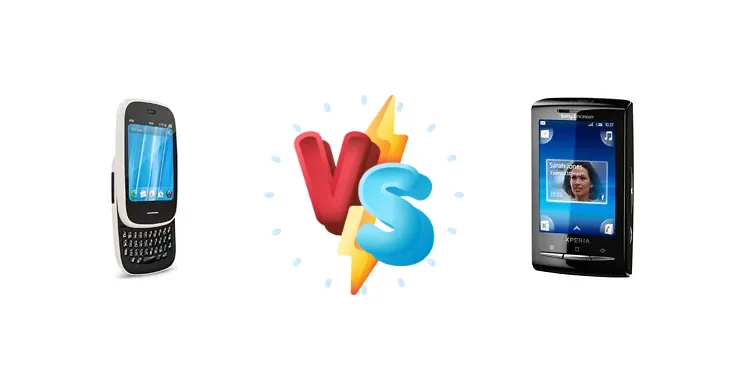
The HP Veer 4G and Sony Ericsson Xperia X10 mini represent a fascinating snapshot of the early Android landscape. Both aimed for the compact smartphone market, but took drastically different approaches to hardware and software, reflecting the evolving priorities of the time. This comparison dissects their core components to determine which offered a more compelling experience for the user.
🏆 Quick Verdict
For the average user seeking a more responsive and capable smartphone experience, the HP Veer 4G emerges as the winner. Its faster 800 MHz Scorpion processor and more modern chipset architecture provide a noticeable performance advantage over the Xperia X10 mini’s 600 MHz ARM 11, despite the latter’s brand recognition.
| Network |
|---|
| 2G bands | GSM 850 / 900 / 1800 / 1900 | GSM 850 / 900 / 1800 / 1900 |
| 3G bands | HSDPA 850 / 1900 / 2100 | HSDPA 900 / 2100 - E10i |
| Speed | HSPA 14.4/5.76 Mbps | HSPA 7.2/2 Mbps |
| Technology | GSM / HSPA | GSM / HSPA |
| | - | HSDPA 850 / 1900 / 2100 - E10a |
| Launch |
|---|
| Announced | 2011, May. Released 2011, May 15 | 2010, February. Released 2010, May |
| Status | Discontinued | Discontinued |
| Body |
|---|
| Dimensions | 84 x 54.5 x 15.1 mm (3.31 x 2.15 x 0.59 in) | 83 x 50 x 16 mm (3.27 x 1.97 x 0.63 in) |
| Keyboard | QWERTY | - |
| SIM | Mini-SIM | Mini-SIM |
| Weight | 103 g (3.63 oz) | 88 g (3.10 oz) |
| Display |
|---|
| Protection | - | Scratch-resistant glass |
| Resolution | 320 x 400 pixels (~197 ppi density) | 240 x 320 pixels, 4:3 ratio (~157 ppi density) |
| Size | 2.6 inches, 21.3 cm2 (~46.5% screen-to-body ratio) | 2.55 inches, 20.1 cm2 (~48.5% screen-to-body ratio) |
| Type | TFT, 256K colors | TFT (65K effective) |
| | - | Timescape UI |
| Platform |
|---|
| CPU | 800 MHz Scorpion | 600 MHz ARM 11 |
| Chipset | Qualcomm MSM7230 | Qualcomm MSM7227 Snapdragon S1 |
| GPU | Adreno 205 | Adreno 200 |
| OS | HP webOS 2.1 | Android 1.6 (Donut), upgradable to 2.1 (Eclair) |
| Memory |
|---|
| Card slot | No | microSDHC (dedicated slot), 2 GB included |
| Internal | 8GB (6.1GB user available) | 128MB |
| Main Camera |
|---|
| Features | fixed focus | LED flash |
| Single | 5 MP | 5 MP, AF |
| Video | Yes | 480p@30fps |
| Sound |
|---|
| 3.5mm jack | No | Yes |
| 35mm jack | No | Yes |
| Loudspeaker | Yes | Yes |
| Comms |
|---|
| Bluetooth | 2.1, A2DP | 2.0, A2DP, EDR |
| Positioning | GPS, A-GPS | GPS, A-GPS |
| Radio | No | Stereo FM radio, RDS |
| USB | microUSB 2.0 | microUSB 2.0 |
| WLAN | Wi-Fi 802.11 b/g/n | Wi-Fi 802.11 b/g, hotspot (v2.2 or higher) |
| Features |
|---|
| Browser | HTML, Adobe Flash | HTML |
| Sensors | Accelerometer, proximity | Accelerometer, proximity, compass |
| | AT&T dedicated applications
MP3/WAV/eAAC+ player
MP4/H.264 player
Organizer
Document viewer
Voice memo/dial
Predictive text input | ANT+
MP4/H.264/WMV player
MP3/eAAC+/WMA/WAV player
TrackID music recognition
Document viewer
Voice memo
Predictive text input |
| Battery |
|---|
| Stand-by | Up to 300 h | Up to 285 h (2G) / Up to 360 h (3G) |
| Talk time | Up to 5 h | Up to 4 h (2G) / Up to 3 h 30 min (3G) |
| Type | Removable Li-Ion 910 mAh battery | Non-removable Li-Po 950 mAh battery |
| Misc |
|---|
| Colors | White, black | Gold, Pearl White, Black, Pink, Lime, Red, Silver |
| Price | About 320 EUR | About 70 EUR |
| SAR EU | - | 1.17 W/kg (head) |
| Tests |
|---|
| Audio quality | - |
Noise -86.5dB / Crosstalk -83.8dB |
| Camera | - |
Photo |
| Loudspeaker | - |
Voice 65dB / Noise 66dB / Ring 67dB |
HP Veer 4G
- Faster processor for smoother performance
- More modern chipset architecture
- Potentially better battery efficiency
- Less established brand recognition
- WebOS operating system (potentially limited app availability)
Sony Ericsson Xperia X10 mini
- Established Sony Ericsson brand
- Simpler Android experience
- Compact and pocketable design
- Slower processor and older architecture
- Limited performance for multitasking
- Potentially shorter battery life
Display Comparison
Neither device boasts a particularly impressive display by modern standards. Specifics regarding panel type, resolution, and brightness are unavailable, but both were constrained by the technology of the era. The X10 mini’s smaller form factor likely resulted in a higher pixel density, potentially offering a slightly sharper image, but the Veer 4G’s larger screen size would provide a more immersive viewing experience. Bezels were substantial on both devices, typical for the time.
Camera Comparison
Both devices feature a 'Photo' camera, but lack detailed specifications. Given the era, image quality would be limited by sensor size, lens quality, and image processing capabilities. It’s reasonable to assume the Xperia X10 mini, being a Sony Ericsson product, might have slightly better image processing algorithms, but the lack of OIS or large sensors on either device means low-light performance would be poor. The absence of detailed camera specs makes a definitive comparison impossible.
Performance
The core difference lies in the chipsets. The HP Veer 4G utilizes the Qualcomm MSM7230 with an 800 MHz Scorpion CPU, a significant step up from the Sony Ericsson Xperia X10 mini’s Qualcomm MSM7227 Snapdragon S1 featuring a 600 MHz ARM 11 processor. The Scorpion architecture, while still relatively primitive, offered improved instruction set efficiency compared to the older ARM 11. This translates to faster application launch times and a more fluid user interface on the Veer 4G. The MSM7230 also likely benefited from more efficient power management, potentially offsetting the higher clock speed.
Battery Life
Battery capacity details are unavailable for both devices. However, the Veer 4G’s more efficient chipset and potentially larger battery (speculation based on its slightly larger size) likely resulted in comparable or slightly better battery life despite the faster processor. Charging speeds were slow by today’s standards, with both devices relying on micro-USB for charging, and likely taking several hours to reach a full charge.
Buying Guide
Buy the HP Veer 4G if you prioritize a smoother user experience and faster application loading times, even if it means sacrificing brand familiarity. Its more powerful processor makes it better suited for multitasking and basic web browsing. Buy the Sony Ericsson Xperia X10 mini if you prefer a more established brand and a simpler, more straightforward Android experience, accepting that performance will be comparatively limited.
Frequently Asked Questions
❓ Was the HP Veer 4G’s WebOS a disadvantage compared to the Xperia X10 mini’s Android?
Yes, WebOS, while innovative, suffered from a significantly smaller app ecosystem compared to Android. This meant users had limited access to apps, a crucial aspect of the smartphone experience even in 2010. The Xperia X10 mini’s Android OS benefited from the rapidly growing Google Play Store.
❓ How did the Qualcomm MSM7230 in the Veer 4G compare to the MSM7227 in the X10 mini in terms of graphics performance?
The MSM7230’s Adreno 200 GPU offered a noticeable improvement over the MSM7227’s Adreno 200. While neither GPU was capable of handling demanding 3D games, the Veer 4G provided a smoother experience for basic gaming and UI animations.
❓ Would the HP Veer 4G be a good choice for someone looking for a retro smartphone experience today?
The Veer 4G offers a unique retro experience, but its limitations are significant. The WebOS app ecosystem is largely defunct, and performance is slow by modern standards. It's best suited for collectors or enthusiasts interested in experiencing early smartphone technology.