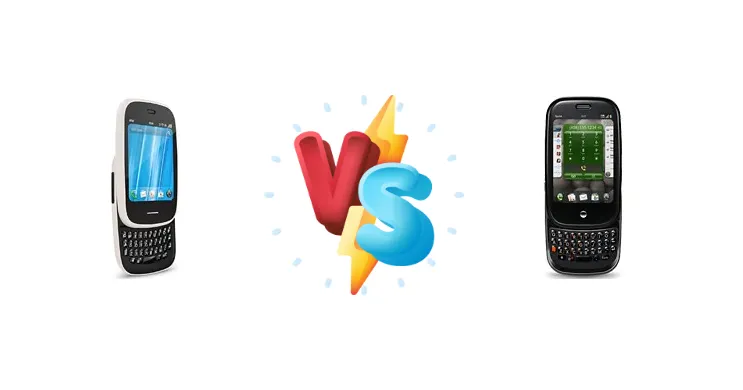
The Palm Pre and HP Veer 4G represent a fascinating period in smartphone history – a time when webOS offered a compelling alternative to iOS and Android. Both devices prioritized a compact form factor and innovative multitasking, but significant hardware differences shaped their user experience. This comparison dissects those differences, focusing on performance, features, and the legacy of webOS.
🏆 Quick Verdict
For the average user seeking a functional, albeit dated, smartphone experience, the HP Veer 4G edges out the Palm Pre. Its faster 800 MHz Qualcomm MSM7230 processor provides a noticeable performance boost over the Pre’s 600 MHz Cortex-A8, making everyday tasks smoother. However, the Pre’s wireless charging remains a unique and appealing feature.
| Network |
|---|
| 2G bands | GSM 850 / 900 / 1800 / 1900 | GSM 850 / 900 / 1800 / 1900 |
| 3G bands | HSDPA 850 / 1900 / 2100 | HSDPA 850 / 1900 / 2100 |
| Speed | HSPA 14.4/5.76 Mbps | HSPA 3.6/0.384 Mbps |
| Technology | GSM / HSPA | GSM / HSPA |
| Launch |
|---|
| Announced | 2011, May. Released 2011, May 15 | 2009, Februray. Released 2009, October |
| Status | Discontinued | Discontinued |
| Body |
|---|
| Dimensions | 84 x 54.5 x 15.1 mm (3.31 x 2.15 x 0.59 in) | 100.5 x 59.5 x 16.9 mm (3.96 x 2.34 x 0.67 in) |
| Keyboard | QWERTY | QWERTY |
| SIM | Mini-SIM | Mini-SIM |
| Weight | 103 g (3.63 oz) | 133 g (4.69 oz) |
| Display |
|---|
| Resolution | 320 x 400 pixels (~197 ppi density) | 320 x 480 pixels, 3:2 ratio (~186 ppi density) |
| Size | 2.6 inches, 21.3 cm2 (~46.5% screen-to-body ratio) | 3.1 inches, 28.6 cm2 (~47.9% screen-to-body ratio) |
| Type | TFT, 256K colors | TFT |
| Platform |
|---|
| CPU | 800 MHz Scorpion | 600 MHz Cortex-A8 |
| Chipset | Qualcomm MSM7230 | - |
| GPU | Adreno 205 | PowerVR SGX |
| OS | HP webOS 2.1 | Palm webOS |
| Memory |
|---|
| Card slot | No | No |
| Internal | 8GB (6.1GB user available) | 8GB 256MB RAM |
| Main Camera |
|---|
| Features | fixed focus | LED flash |
| Single | 5 MP | 3.15 MP |
| Video | Yes | No |
| Sound |
|---|
| 3.5mm jack | No | Yes |
| 35mm jack | No | Yes |
| Loudspeaker | Yes | Yes |
| Comms |
|---|
| Bluetooth | 2.1, A2DP | 2.1, A2DP (headset support only) |
| Positioning | GPS, A-GPS | GPS |
| Radio | No | No |
| USB | microUSB 2.0 | microUSB |
| WLAN | Wi-Fi 802.11 b/g/n | Wi-Fi 802.11 b/g |
| Features |
|---|
| Browser | HTML, Adobe Flash | WAP 2.0 / HTML |
| Sensors | Accelerometer, proximity | Accelerometer |
| | AT&T dedicated applications
MP3/WAV/eAAC+ player
MP4/H.264 player
Organizer
Document viewer
Voice memo/dial
Predictive text input | - |
| Battery |
|---|
| Charging | - | Wireless |
| Stand-by | Up to 300 h | Up to 300 h |
| Talk time | Up to 5 h | Up to 5 h |
| Type | Removable Li-Ion 910 mAh battery | Removable Li-Ion 1150 mAh battery |
| Misc |
|---|
| Colors | White, black | Black |
| Price | About 320 EUR | About 180 EUR |
| SAR | - | 0.92 W/kg (head) 0.94 W/kg (body) |
| Tests |
|---|
| Audio quality | - |
Noise -95.7dB / Crosstalk -53.9dB |
| Camera | - |
Photo |
| Loudspeaker | - |
Voice 71dB / Noise 68dB / Ring 80dB |
HP Veer 4G
- Faster processor (800 MHz Scorpion)
- Potentially better battery efficiency
- More responsive user experience
- Lacks wireless charging
- Limited RAM (likely)
- Basic camera capabilities
Palm Pre
- Wireless charging convenience
- Iconic design
- Unique webOS multitasking
- Slower processor (600 MHz Cortex-A8)
- Potentially shorter battery life
- Less responsive user experience
Display Comparison
Neither device boasts a particularly impressive display by modern standards. Specifics regarding panel type, resolution, or brightness are unavailable, but both were constrained by the technology of the time. The focus was on compactness, not screen real estate. Bezels were substantial on both, maximizing screen usage within the limited footprint. Color accuracy and viewing angles would have been adequate for the era, but pale in comparison to current OLED or high-refresh-rate LCD panels.
Camera Comparison
Both devices feature a 'Photo' camera, but details regarding resolution or image quality are scarce. Given the era, image quality would be basic, suitable for casual snapshots but lacking the detail and dynamic range of modern smartphone cameras. The absence of any mention of advanced features like optical image stabilization (OIS) or multiple lenses suggests a focus on basic functionality rather than photographic prowess. The camera was likely included for convenience, not as a primary selling point.
Performance
The core difference lies in the chipset. The HP Veer 4G’s Qualcomm MSM7230, featuring an 800 MHz Scorpion CPU, represents a clear upgrade over the Palm Pre’s 600 MHz Cortex-A8. While both are single-core processors, the Scorpion architecture generally offered better performance per clock cycle. This translates to faster app loading times and smoother multitasking on the Veer 4G. The Cortex-A8 in the Pre, while capable, would struggle more with demanding web pages or applications. RAM specifications are unavailable for either device, but likely limited, further impacting multitasking capabilities.
Battery Life
Battery capacity details are unavailable for either device. However, given their compact size, battery life would have been a significant concern. The HP Veer 4G’s more efficient processor *could* translate to slightly better battery endurance, but heavy usage would likely necessitate daily charging for both. The Palm Pre’s inclusion of wireless charging offers a convenience factor, allowing for easy top-ups without the need for cables, potentially mitigating some battery anxiety.
Buying Guide
Buy the HP Veer 4G if you prioritize responsiveness and a slightly more modern (though still very old) processor for basic smartphone tasks like web browsing and email. Buy the Palm Pre if you value the convenience of wireless charging and appreciate a slightly more iconic design, understanding that performance will be comparatively slower. Both are collector's items, so nostalgia plays a large role.
Frequently Asked Questions
❓ Is the webOS multitasking on either device still useful today?
While innovative for its time, the webOS multitasking system, with its card-based interface, feels dated compared to modern Android and iOS multitasking. However, it remains a functional system for managing a limited number of apps, and its unique approach is still appreciated by webOS enthusiasts.
❓ Can I install modern apps on the Palm Pre or HP Veer 4G?
Officially, no. webOS development ceased years ago, and the app ecosystem is severely limited. While some community efforts exist to sideload apps or run alternative operating systems, compatibility is limited and requires significant technical expertise. Expect a largely app-less experience.
❓ How does the performance of the MSM7230 compare to other processors of its era?
The Qualcomm MSM7230 was a mid-range processor in 2010. It offered a noticeable improvement over earlier ARM processors, but was quickly surpassed by dual-core and faster single-core chips. It was competitive with the TI OMAP3620 found in some early Android devices, but lagged behind the faster Cortex-A9 based processors.