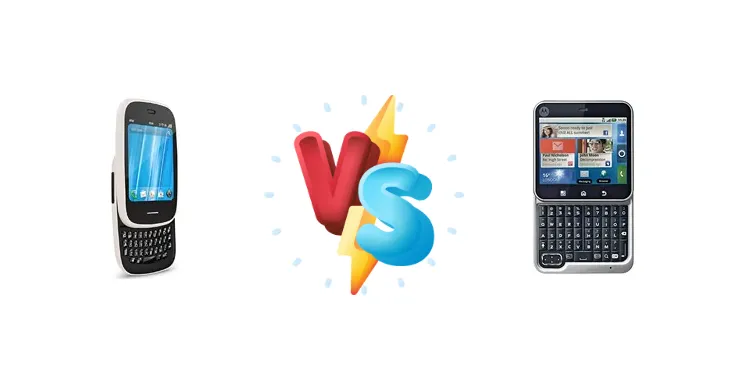
In the early days of smartphone diversification, both HP and Motorola attempted to carve out niches with uniquely compact devices. The HP Veer 4G, running webOS, aimed for a streamlined, connected experience. The Motorola FlipOut, meanwhile, doubled down on physical interaction with its unconventional rotating design. This comparison dissects their core hardware to determine which offered the better experience, and for whom.
🏆 Quick Verdict
For the average user seeking a responsive and capable smartphone experience, the HP Veer 4G emerges as the stronger choice. Its 800 MHz Scorpion processor provides a noticeable performance advantage over the FlipOut’s 600 MHz Cortex-A8, making everyday tasks smoother. However, the FlipOut’s novelty design may appeal to those prioritizing a unique aesthetic.
| Network |
|---|
| 2G bands | GSM 850 / 900 / 1800 / 1900 | GSM 850 / 900 / 1800 / 1900 |
| 3G bands | HSDPA 850 / 1900 / 2100 | HSDPA 900 / 2100 |
| Speed | HSPA 14.4/5.76 Mbps | HSPA 7.2/2 Mbps |
| Technology | GSM / HSPA | GSM / HSPA |
| | - | HSDPA 850 / 1900 |
| Launch |
|---|
| Announced | 2011, May. Released 2011, May 15 | 2010, June. Released 2010, June |
| Status | Discontinued | Discontinued |
| Body |
|---|
| Dimensions | 84 x 54.5 x 15.1 mm (3.31 x 2.15 x 0.59 in) | 67 x 67 x 17 mm, 76 cc (2.64 x 2.64 x 0.67 in) |
| Keyboard | QWERTY | QWERTY |
| SIM | Mini-SIM | Mini-SIM |
| Weight | 103 g (3.63 oz) | 120 g (4.23 oz) |
| Display |
|---|
| Resolution | 320 x 400 pixels (~197 ppi density) | 320 x 240 pixels, 4:3 ratio (~143 ppi density) |
| Size | 2.6 inches, 21.3 cm2 (~46.5% screen-to-body ratio) | 2.8 inches, 24.3 cm2 (~54.1% screen-to-body ratio) |
| Type | TFT, 256K colors | TFT, 256K colors |
| | - | MOTOBLUR UI v1.5 with Live Widgets |
| Platform |
|---|
| CPU | 800 MHz Scorpion | 600 MHz Cortex-A8 |
| Chipset | Qualcomm MSM7230 | TI OMAP 3410 |
| GPU | Adreno 205 | PowerVR SGX530 |
| OS | HP webOS 2.1 | Android 2.1 (Eclair) |
| Memory |
|---|
| Card slot | No | microSDHC (dedicated slot), 2 GB included |
| Internal | 8GB (6.1GB user available) | 512MB 512MB RAM |
| Main Camera |
|---|
| Features | fixed focus | - |
| Single | 5 MP | 3.15 MP |
| Video | Yes | CIF@26-30fps |
| Sound |
|---|
| 3.5mm jack | No | Yes |
| 35mm jack | No | Yes |
| Loudspeaker | Yes | Yes |
| Comms |
|---|
| Bluetooth | 2.1, A2DP | 2.1, A2DP |
| Positioning | GPS, A-GPS | GPS, A-GPS |
| Radio | No | Stereo FM radio, RDS |
| USB | microUSB 2.0 | microUSB 2.0 |
| WLAN | Wi-Fi 802.11 b/g/n | Wi-Fi 802.11 b/g/n |
| Features |
|---|
| Browser | HTML, Adobe Flash | WAP 2.0/xHTML, HTML |
| Sensors | Accelerometer, proximity | Accelerometer, proximity, compass |
| | AT&T dedicated applications
MP3/WAV/eAAC+ player
MP4/H.264 player
Organizer
Document viewer
Voice memo/dial
Predictive text input | MP3/eAAC+/WAV player
MP4/WMV/H.264/XviD player
Organizer
Document viewer
Voice memo/dial
Predictive text input |
| Battery |
|---|
| Stand-by | Up to 300 h | Up to 365 h (2G) / Up to 380 h (3G) |
| Talk time | Up to 5 h | Up to 6 h (2G) / Up to 4 h 30 min (3G) |
| Type | Removable Li-Ion 910 mAh battery | Removable Li-Ion 1130 mAh battery |
| Misc |
|---|
| Colors | White, black | White, Fairway Green, Poppy Red, Raspberry Crush, Brilliant Blue, Licorice, Saffron |
| Price | About 320 EUR | About 90 EUR |
| SAR | - | 1.16 W/kg (head) 1.09 W/kg (body) |
| SAR EU | - | 0.62 W/kg (head) |
| Tests |
|---|
| Audio quality | - |
Noise -89.0dB / Crosstalk -89.9dB |
| Camera | - |
Photo |
| Loudspeaker | - |
Voice 69dB / Noise 64dB / Ring 69dB |
HP Veer 4G
- Faster processor for smoother performance
- More modern operating system (webOS)
- Potentially larger battery capacity
- webOS ecosystem was limited
- Display details are unknown
Motorola FlipOut
- Unique and compact rotating design
- Physical keyboard access
- Novelty factor
- Slower processor
- Small screen size
- Limited camera capabilities
Display Comparison
Neither device boasts a standout display. Both likely utilized LCD panels common to the era, and specific details like resolution and brightness are unavailable. However, the Veer’s slightly larger form factor likely afforded a marginally more comfortable viewing experience. The FlipOut’s small screen, necessitated by its rotating design, would have been significantly constrained. Color accuracy and viewing angles were likely similar, representing the limitations of LCD technology at the time.
Camera Comparison
Both devices are listed as having a 'Photo' camera, offering minimal detail. Given the era, both likely featured low-resolution sensors (likely around 3-5 megapixels) with limited features. Image quality would have been subpar by modern standards. The FlipOut’s rotating design *might* have offered a slightly more convenient camera angle for self-portraits, but the lack of optical image stabilization or advanced image processing on either device renders this advantage minimal. The absence of detailed camera specifications makes a definitive comparison impossible.
Performance
The HP Veer 4G’s Qualcomm MSM7230 chipset, featuring an 800 MHz Scorpion CPU, represents a clear advantage over the Motorola FlipOut’s TI OMAP 3410 with its 600 MHz Cortex-A8 processor. The Scorpion architecture, while not a powerhouse, offered better per-clock performance than the Cortex-A8. This translates to snappier application loading times and a more fluid user interface on the Veer. While both devices would struggle with modern demands, the Veer would have felt noticeably more responsive during everyday tasks. The Veer’s chipset also likely benefited from more efficient power management.
Battery Life
Battery capacity details are unavailable for either device. However, the Veer’s larger overall size suggests a potentially larger battery. The FlipOut’s compact form factor likely necessitated a smaller battery, potentially leading to shorter battery life under similar usage conditions. Charging speeds were also limited by the technology of the time, with both devices likely relying on micro-USB charging with relatively slow charging rates. The Veer’s more efficient processor could contribute to better battery endurance despite potentially similar battery capacities.
Buying Guide
Buy the HP Veer 4G if you need a more responsive smartphone experience for web browsing, email, and basic app usage, and value a relatively modern (for its time) operating system. Buy the Motorola FlipOut if you prioritize a truly unique and compact design, and are willing to trade performance for a distinctive form factor and physical keyboard access.
Frequently Asked Questions
❓ Was webOS on the HP Veer 4G a viable alternative to Android and iOS?
While webOS was innovative with its card-based multitasking and gesture navigation, it ultimately failed to gain significant market share. HP’s inconsistent support and eventual discontinuation of webOS limited its long-term viability. The app ecosystem was significantly smaller than Android’s or iOS’s, hindering its appeal.
❓ How practical was the rotating design of the Motorola FlipOut for everyday use?
The FlipOut’s rotating design was primarily a novelty. While it offered a unique aesthetic and provided access to a physical keyboard, the small screen size and limited functionality of the keyboard made it less practical than traditional smartphone designs. The rotating mechanism also introduced potential durability concerns.
❓ Could the HP Veer 4G handle modern web browsing or apps?
No. The HP Veer 4G’s 800 MHz processor and limited RAM would struggle significantly with modern web browsing and apps. Websites are far more complex now, and apps demand significantly more processing power and memory. It would be extremely slow and frustrating to use for contemporary tasks.