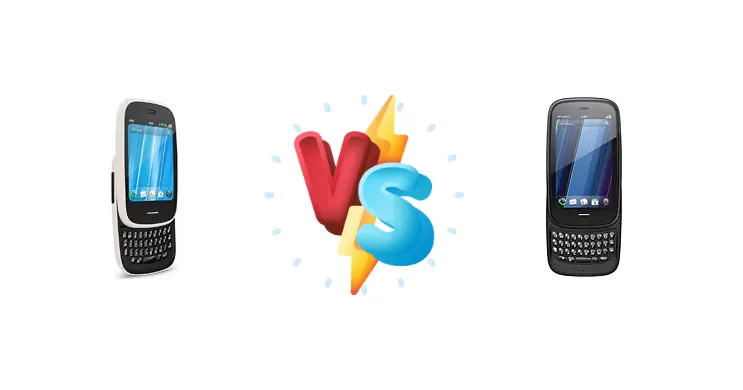
The HP Veer 4G and HP Pre 3 represent a fascinating period in smartphone history – a time when webOS offered a compelling alternative to iOS and Android. Both devices prioritized a compact form factor, but differed significantly in their internal hardware. This comparison dissects those differences, focusing on how the chipset choices impact real-world performance and usability.
🏆 Quick Verdict
For the average user prioritizing responsiveness and multitasking, the HP Pre 3 is the clear winner. Its 1.4 GHz Snapdragon S2 processor provides a substantial performance uplift over the Veer 4G’s 800 MHz chip. However, the Veer 4G remains a viable option for those seeking the smallest possible webOS experience and aren't demanding users.
| Network |
|---|
| 2G bands | GSM 850 / 900 / 1800 / 1900 | GSM 850 / 900 / 1800 / 1900 |
| 3G bands | HSDPA 850 / 1900 / 2100 | HSDPA 900 / 1900 / 2100 |
| Speed | HSPA 14.4/5.76 Mbps | HSPA 7.2/5.76 Mbps |
| Technology | GSM / HSPA | GSM / HSPA |
| Launch |
|---|
| Announced | 2011, May. Released 2011, May 15 | 2011, February. Released 2011, August |
| Status | Discontinued | Discontinued |
| Body |
|---|
| Dimensions | 84 x 54.5 x 15.1 mm (3.31 x 2.15 x 0.59 in) | 111 x 64 x 16 mm (4.37 x 2.52 x 0.63 in) |
| Keyboard | QWERTY | QWERTY |
| SIM | Mini-SIM | Mini-SIM |
| Weight | 103 g (3.63 oz) | 156 g (5.50 oz) |
| Display |
|---|
| Resolution | 320 x 400 pixels (~197 ppi density) | 480 x 800 pixels, 5:3 ratio (~261 ppi density) |
| Size | 2.6 inches, 21.3 cm2 (~46.5% screen-to-body ratio) | 3.58 inches, 36.5 cm2 (~51.4% screen-to-body ratio) |
| Type | TFT, 256K colors | TFT |
| Platform |
|---|
| CPU | 800 MHz Scorpion | 1.4 GHz Scorpion |
| Chipset | Qualcomm MSM7230 | Qualcomm MSM8255 Snapdragon S2 |
| GPU | Adreno 205 | Adreno 205 |
| OS | HP webOS 2.1 | HP webOS 2.2 |
| Memory |
|---|
| Card slot | No | No |
| Internal | 8GB (6.1GB user available) | 8GB 512MB RAM |
| Main Camera |
|---|
| Features | fixed focus | LED flash |
| Single | 5 MP | 5 MP, AF |
| Video | Yes | 720p |
| Selfie camera |
|---|
| Single | - | VGA |
| | No | - |
| Sound |
|---|
| 3.5mm jack | No | Yes |
| 35mm jack | No | Yes |
| Loudspeaker | Yes | Yes |
| Comms |
|---|
| Bluetooth | 2.1, A2DP | 2.1, A2DP, EDR |
| Positioning | GPS, A-GPS | GPS, A-GPS |
| Radio | No | No |
| USB | microUSB 2.0 | microUSB 2.0 |
| WLAN | Wi-Fi 802.11 b/g/n | Wi-Fi 802.11 a/b/g/n, dual-band |
| Features |
|---|
| Browser | HTML, Adobe Flash | HTML, Adobe Flash |
| Sensors | Accelerometer, proximity | Accelerometer, proximity, compass |
| | AT&T dedicated applications
MP3/WAV/eAAC+ player
MP4/H.264 player
Organizer
Document viewer
Voice memo/dial
Predictive text input | MP3/WAV/eAAC+ player
MP4/H.264 player
Organizer
Document viewer
Voice memo/dial
Predictive text input |
| Battery |
|---|
| Stand-by | Up to 300 h | Up to 300 h |
| Talk time | Up to 5 h | Up to 5 h |
| Type | Removable Li-Ion 910 mAh battery | Removable Li-Ion 1230 mAh battery |
| Misc |
|---|
| Colors | White, black | Black |
| Price | About 320 EUR | About 350 EUR |
HP Veer 4G
- Most compact webOS device
- Potentially longer battery life due to lower power consumption
- Simple and straightforward user experience
- Significantly slower processor
- Limited multitasking capabilities
- Less responsive user interface
HP Pre 3
- Faster 1.4 GHz Snapdragon S2 processor
- Improved multitasking and application performance
- Better GPU performance for graphics-intensive tasks
- Slightly larger form factor
- Potentially shorter battery life
- Higher price point (at launch)
Display Comparison
Neither device boasts a particularly impressive display by modern standards. Specifics regarding panel technology (IPS, TFT) and resolution are missing, but both likely featured relatively low-resolution displays given the era. The Veer 4G’s smaller size (assumed, based on marketing) would result in a higher pixel density, potentially offering a sharper image, but the Pre 3’s larger screen would be more comfortable for media consumption. Brightness and color accuracy are unknown, but likely similar given the shared manufacturing timeframe and target market.
Camera Comparison
Details regarding camera specifications are limited. Both devices likely featured basic rear-facing cameras suitable for casual snapshots. Without sensor size or aperture information, a direct comparison is difficult. However, the Pre 3’s more powerful processor could potentially enable faster image processing and better low-light performance, even with a similar sensor. It's unlikely either camera would compete with modern smartphone cameras.
Performance
The core difference lies in the chipsets. The HP Veer 4G utilizes the Qualcomm MSM7230 with an 800 MHz Scorpion CPU, while the HP Pre 3 steps up to the MSM8255 Snapdragon S2 with a significantly faster 1.4 GHz Scorpion CPU. This 75% clock speed increase translates directly to noticeable performance gains in application loading times, web browsing, and multitasking. The Snapdragon S2 also benefits from improved GPU performance, making the Pre 3 the better choice for any graphical tasks. While both use the same Scorpion architecture, the higher clock speed and potential architectural refinements in the S2 provide a substantial advantage.
Battery Life
Battery capacity details are unavailable. However, the HP Pre 3’s more powerful processor will inherently consume more power. The Veer 4G, with its slower processor, would likely offer longer battery life under similar usage conditions. Charging wattage is also unknown, but given the era, both devices likely supported relatively slow charging speeds. The trade-off is performance versus longevity; the Pre 3 offers more power but at the cost of potentially reduced battery life.
Buying Guide
Buy the HP Veer 4G if you absolutely need the most compact webOS device available and primarily use it for basic communication and light web browsing. Its smaller size makes it ideal for one-handed operation and pocketability. Buy the HP Pre 3 if you value a smoother, more responsive user experience, especially when multitasking or running more demanding applications. The performance boost justifies the slightly larger footprint for users who want a more capable device.
Frequently Asked Questions
❓ Will the HP Pre 3 run modern web apps smoothly, or is the processor too dated?
While the Pre 3’s Snapdragon S2 was a capable processor for its time, modern web apps are significantly more demanding. Expect some lag and slowdown when running complex web applications. It's best suited for lighter web browsing and webOS-native applications.
❓ Is the difference in performance between the Veer 4G and Pre 3 noticeable for everyday tasks like email and calls?
Yes, the difference is noticeable. While both phones can handle basic tasks like email and calls, the Pre 3 will feel significantly more responsive and fluid. App switching and opening new applications will be much faster on the Pre 3.
❓ Can either of these phones be upgraded to a newer version of webOS?
Officially, no. HP discontinued support for webOS on these devices long ago. However, the open-source community has made efforts to port newer versions of webOS to these devices, but this requires technical expertise and may not be fully stable.