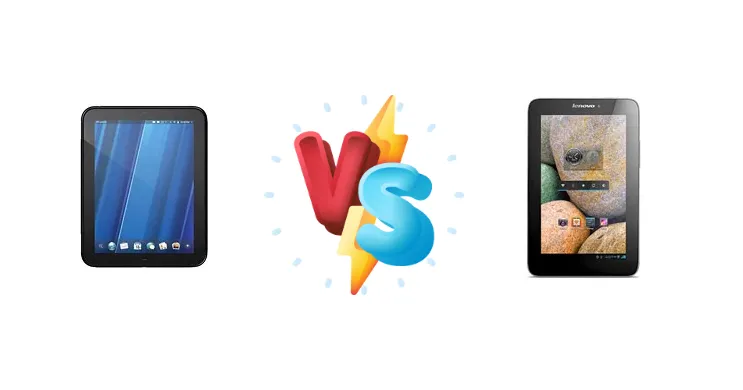
Released in the early days of affordable Android tablets, the HP TouchPad and Lenovo IdeaTab A2107 represent different approaches to the burgeoning market. The TouchPad, initially designed for webOS, was repurposed for Android after HP’s abrupt exit, while the A2107 aimed to deliver a low-cost Android experience. This comparison dissects their core hardware – Qualcomm’s Snapdragon S3 versus MediaTek’s Cortex-A9 – to determine which tablet offered the better experience.
🏆 Quick Verdict
For the average user seeking a functional, if somewhat dated, tablet experience, the HP TouchPad edges out the Lenovo IdeaTab A2107. The Snapdragon S3, despite its age, provides a smoother overall experience due to its architectural advantages and better-optimized software support, even if the A2107 offers slightly longer battery life.
| Network |
|---|
| 2G bands | N/A | GSM 850 / 900 / 1800 / 1900 - SIM 1 & SIM 2 (dual-SIM model only) |
| 3G bands | - | HSDPA 850 / 1900 - for AT&T |
| EDGE | No | - |
| GPRS | No | - |
| Speed | - | HSPA |
| Technology | No cellular connectivity | GSM / HSPA |
| | - | HSDPA 2100 - SIM 1 only |
| Launch |
|---|
| Announced | 2011, February. Released 2011, July | 2013, January. Released 2013, January |
| Status | Discontinued | Discontinued |
| Body |
|---|
| Dimensions | 240 x 190 x 13.7 mm (9.45 x 7.48 x 0.54 in) | 195.1 x 125 x 11.9 mm (7.68 x 4.92 x 0.47 in) |
| SIM | No | Single SIM (Mini-SIM) or Dual SIM (Mini-SIM, dual stand-by) |
| Weight | 740 g (1.63 lb) | 400 g (14.11 oz) |
| Display |
|---|
| Resolution | 768 x 1024 pixels, 4:3 ratio (~132 ppi density) | 600 x 1024 pixels, 16:9 ratio (~170 ppi density) |
| Size | 9.7 inches, 291.4 cm2 (~63.9% screen-to-body ratio) | 7.0 inches, 137.9 cm2 (~56.5% screen-to-body ratio) |
| Type | LED-backlit LCD, | TFT |
| Platform |
|---|
| CPU | Dual-core 1.2 GHz Scorpion | 1.0 GHz Cortex-A9 |
| Chipset | Qualcomm APQ8060 Snapdragon S3 | Mediatek MT6575 (40 nm) |
| GPU | Adreno 220 | PowerVR SGX531 |
| OS | HP webOS 3.0 | Android 4.0.3 (Ice Cream Sandwich) |
| Memory |
|---|
| Card slot | No | microSDHC (dedicated slot) |
| Internal | 16GB 1GB RAM, 32GB 1GB RAM | 16GB 1GB RAM |
| Main Camera |
|---|
| Single | 1.3 MP | 3.15 MP |
| Video | No | 720p |
| Selfie camera |
|---|
| Single | - | VGA |
| | No | - |
| Sound |
|---|
| 3.5mm jack | Yes | Yes |
| 35mm jack | Yes | Yes |
| Loudspeaker | Yes, with stereo speakers | Yes |
| Comms |
|---|
| Bluetooth | 2.1, A2DP, EDR | 3.0 |
| NFC | - | No |
| Positioning | No | - |
| Radio | No | No |
| USB | microUSB 2.0 | microUSB 2.0 |
| WLAN | Wi-Fi 802.11 a/b/g/n, dual-band | Wi-Fi 802.11 b/g/n, hotspot |
| Features |
|---|
| Browser | HTML, Adobe Flash | - |
| Sensors | Accelerometer, gyro | Accelerometer, proximity |
| | Touchstone technology
SNS applications
MP3/WAV/eAAC+ player
MP4/H.264 player
Organizer
Document viewer/editor
Predictive text input | - |
| Battery |
|---|
| Stand-by | Up to 300 h | Up to 500 h |
| Talk time | Up to 9 h | Up to 7 h |
| Type | Non-removable Li-Ion 6300 mAh battery | Li-Ion 3550 mAh, non-removable |
| Misc |
|---|
| Colors | Black | Black |
| Price | About 280 EUR | About 150 EUR |
HP TouchPad
- Faster processor due to Snapdragon S3 architecture
- Potentially smoother Android experience
- Better software optimization (initially for webOS)
- Likely shorter battery life compared to A2107
- HP’s initial abandonment created software uncertainty
Lenovo IdeaTab A2107
- Longer battery life due to Cortex-A9 efficiency
- Lower price point at launch
- More readily available Android updates (potentially)
- Slower processor and less responsive UI
- Potential for software bloat from Lenovo
- Less optimized app compatibility
Display Comparison
Neither device boasts a particularly impressive display by modern standards. Specifics regarding panel technology (IPS, TFT) and resolution are missing, but both likely featured standard LCD panels for the price point. The focus here is on performance, not visual fidelity. Bezels were substantial on both, typical of the era. Without detailed specs, a direct comparison is difficult, but the TouchPad’s initial webOS optimization *may* have resulted in slightly better color calibration, though this is speculative.
Camera Comparison
Both tablets featured cameras intended for basic video calls, not photography. Specific camera specs are unavailable, but it’s safe to assume both utilized low-resolution sensors. Image quality would have been poor on both devices, making this a non-factor in the buying decision. Focusing on the CPU and overall system responsiveness is far more important.
Performance
The core difference lies in the chipsets. The HP TouchPad’s Qualcomm APQ8060 Snapdragon S3, with its dual-core 1.2 GHz Scorpion CPU, benefits from a more modern architecture than the Lenovo IdeaTab A2107’s 1.0 GHz Cortex-A9 based Mediatek MT6575. While clock speed favors the TouchPad, the architectural advantage is more significant. The Scorpion cores, built on a 40nm process, offer better instructions-per-clock (IPC) than the Cortex-A9. The A2107’s MT6575, also on a 40nm node, is a more power-efficient design, but sacrifices raw processing power. This translates to snappier app launches and smoother multitasking on the TouchPad, while the A2107 may struggle with more demanding applications.
Battery Life
The Mediatek MT6575’s power efficiency gives the Lenovo IdeaTab A2107 an edge in battery life. While specific battery capacities are unknown, the Cortex-A9’s lower power draw, combined with the slower clock speed, would result in longer runtimes for tasks like video playback and web browsing. The Snapdragon S3, while efficient for its time, consumes more power under load. However, the TouchPad’s faster processing speeds might complete tasks quicker, potentially offsetting some of the battery life difference in real-world usage.
Buying Guide
Buy the HP TouchPad if you prioritize a more responsive user interface and a potentially wider range of compatible Android applications, benefiting from Qualcomm’s more established driver support. Buy the Lenovo IdeaTab A2107 if your primary concern is maximizing battery life and you’re willing to accept some performance compromises for extended usage, particularly for basic tasks like reading and video playback.
Frequently Asked Questions
❓ Does the Snapdragon S3 in the TouchPad struggle with modern Android apps?
While the Snapdragon S3 was a capable processor for its time, it will struggle with many modern Android applications. Expect slowdowns and compatibility issues with newer, resource-intensive apps. The TouchPad is best suited for lighter tasks and older Android versions.
❓ Is the Mediatek MT6575 in the A2107 powerful enough for basic web browsing and video playback?
Yes, the Mediatek MT6575 is sufficient for basic web browsing, video playback, and reading. However, multitasking and demanding applications will likely result in noticeable lag and slowdowns. It's a functional processor for simple tasks.
❓ Which tablet is more likely to receive software updates?
Historically, the Lenovo IdeaTab A2107 likely received more consistent Android updates than the HP TouchPad, due to HP’s initial abandonment of the device and subsequent community-driven efforts to maintain software support for the TouchPad. However, both are now quite outdated.