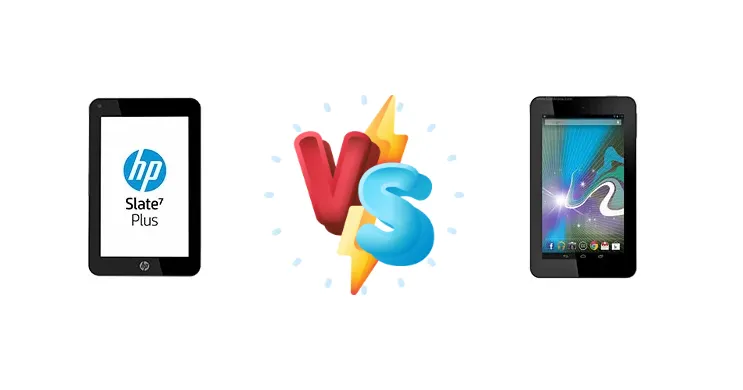
The HP Slate7 and Slate7 Plus represent a fascinating snapshot of the early Android tablet landscape. While both aimed for affordability, they took different approaches to performance. The Slate7 Plus leveraged Nvidia's Tegra 3, a relatively powerful chip for its time, while the Slate7 opted for a dual-core Cortex-A9 processor. This comparison dissects the implications of these choices for everyday use and beyond.
🏆 Quick Verdict
For users prioritizing responsiveness and the ability to handle more demanding tasks, the HP Slate7 Plus is the clear winner. Its Nvidia Tegra 3 processor provides a significant performance advantage over the Slate 7’s dual-core CPU, making it better suited for gaming and multitasking. However, the Slate 7 remains a viable option for basic tasks.
| Network |
|---|
| 2G bands | N/A | N/A |
| EDGE | No | No |
| GPRS | No | No |
| Technology | No cellular connectivity | No cellular connectivity |
| Launch |
|---|
| Announced | 2013, December. Released 2013, December | 2013, February. Released 2013, April |
| Status | Discontinued | Discontinued |
| Body |
|---|
| Dimensions | 194.7 x 122.7 x 10.7 mm (7.67 x 4.83 x 0.42 in) | 197.1 x 116.1 x 10.7 mm (7.76 x 4.57 x 0.42 in) |
| SIM | No | No |
| Weight | 340.2 (11.99 oz) | 372 g (13.12 oz) |
| Display |
|---|
| Resolution | 800 x 1280 pixels, 16:10 ratio (~216 ppi density) | 600 x 1024 pixels, 16:9 ratio (~170 ppi density) |
| Size | 7.0 inches, 142.1 cm2 (~59.5% screen-to-body ratio) | 7.0 inches, 137.9 cm2 (~60.3% screen-to-body ratio) |
| Type | IPS LCD | FFS+ LCD |
| Platform |
|---|
| CPU | Quad-core 1.3 GHz Cortex-A9 | Dual-core 1.6 GHz Cortex-A9 |
| Chipset | Nvidia Tegra 3 | - |
| OS | Android 4.2.2 (Jelly Bean) | Android 4.1 (Jelly Bean) |
| Memory |
|---|
| Card slot | microSDHC (dedicated slot) | microSDHC (dedicated slot) |
| Internal | 8GB 1GB RAM | 8GB 1GB RAM |
| Main Camera |
|---|
| Single | 5 MP, AF | 3.15 MP |
| Video | 720p | 720p@30fps |
| Selfie camera |
|---|
| Single | VGA | VGA |
| Sound |
|---|
| 3.5mm jack | Yes | Yes |
| 35mm jack | Yes | Yes |
| Loudspeaker | Yes, with stereo speakers | Yes, with stereo speakers |
| Comms |
|---|
| Bluetooth | 3.0 | 2.1, A2DP, EDR |
| NFC | No | No |
| Positioning | GPS | No |
| Radio | No | No |
| USB | microUSB 2.0 | microUSB 2.0 |
| WLAN | Wi-Fi 802.11 b/g/n | Wi-Fi 802.11 b/g/n, DLNA |
| Features |
|---|
| Sensors | Accelerometer, compass | Accelerometer |
| Battery |
|---|
| Talk time | Up to 7 h 30 min (multimedia) | Up to 5 h (multimedia) |
| Type | Li-Po 4000 mAh, non-removable | Li-Ion, non-removable |
| Misc |
|---|
| Colors | Black/Silver | Black/Silver, Red |
| Price | About 110 EUR | About 130 EUR |
HP Slate7 Plus
- Significantly faster processor (Tegra 3)
- Better graphics performance
- More responsive multitasking
- Potential for better power efficiency with companion core
- Potentially higher price point
- Tegra 3 may generate more heat under sustained load
HP Slate 7
- Lower price point
- Simpler user experience
- Potentially longer battery life during light use
- Slightly higher CPU clock speed
- Slower processor
- Limited multitasking capabilities
- Poor gaming performance
- Less future-proof
Display Comparison
Unfortunately, detailed display specifications are unavailable. However, given the market segment, both tablets likely featured similar 7-inch IPS LCD panels with resolutions around 1024x600. The key difference isn't likely in panel quality, but in how well the processors can drive the UI smoothly. The Tegra 3 in the Slate7 Plus should provide a more fluid experience when scrolling and navigating the interface.
Camera Comparison
Given the context of these devices, camera performance is unlikely to be a major distinguishing factor. Both likely featured basic cameras suitable for casual snapshots. Without specific sensor details, it’s difficult to make a definitive comparison. However, the Tegra 3’s image processing capabilities *could* offer slightly better image quality, but this is speculative.
Performance
The core differentiator is the chipset. The HP Slate7 Plus boasts an Nvidia Tegra 3, featuring a quad-core 1.3 GHz Cortex-A9 CPU. This architecture includes a fifth 'companion' core designed for power efficiency during light tasks. The HP Slate 7, in contrast, utilizes a dual-core 1.6 GHz Cortex-A9 CPU. While the Slate 7’s cores are clocked higher, the Tegra 3’s quad-core configuration and architectural advantages provide a substantial performance boost in multi-threaded applications and gaming. The Tegra 3’s GPU is also significantly more powerful, offering a better graphics experience. The Slate7 Plus will exhibit less lag when switching between apps and handle graphically intensive games with greater ease.
Battery Life
Battery capacity details are missing. However, the Tegra 3’s companion core is designed to improve power efficiency during less demanding tasks. While the quad-core configuration will draw more power under heavy load, the Slate7 Plus’s ability to offload simple tasks to the companion core could result in comparable, or even slightly better, battery life in typical usage scenarios. The higher clock speed of the Slate 7’s CPU might consume more power during sustained operation.
Buying Guide
Buy the HP Slate7 Plus if you need a tablet capable of handling moderate gaming, smoother multitasking, and future-proofing against increasingly demanding apps. This is the choice for users who want a more responsive experience. Buy the HP Slate 7 if you prioritize simplicity and are primarily focused on basic tasks like web browsing, email, and light media consumption. It’s a good option for those on a very tight budget who don’t require significant processing power.
Frequently Asked Questions
❓ Will the HP Slate7 Plus run modern Android apps smoothly?
While the Slate7 Plus is significantly more powerful than the Slate 7, it's important to remember that both devices are several years old. Modern, resource-intensive apps may still experience lag or performance issues. However, the Tegra 3 provides a better chance of running these apps than the Slate 7’s dual-core processor.
❓ Is the Nvidia Tegra 3 chip known for overheating in the HP Slate7 Plus?
The Tegra 3 can generate heat under sustained load, particularly during gaming. However, the HP Slate7 Plus’s thermal design should be adequate for typical usage. Prolonged, demanding tasks may cause the device to warm up, but it’s unlikely to cause significant performance throttling unless the device is used in a very hot environment.
❓ Can I expect a noticeable difference in web browsing speed between the two tablets?
Yes, you should experience a noticeable difference. The Tegra 3’s faster processor and GPU will render web pages more quickly and smoothly, especially those with complex layouts or multimedia content. The Slate 7 may exhibit some lag when loading heavier websites.