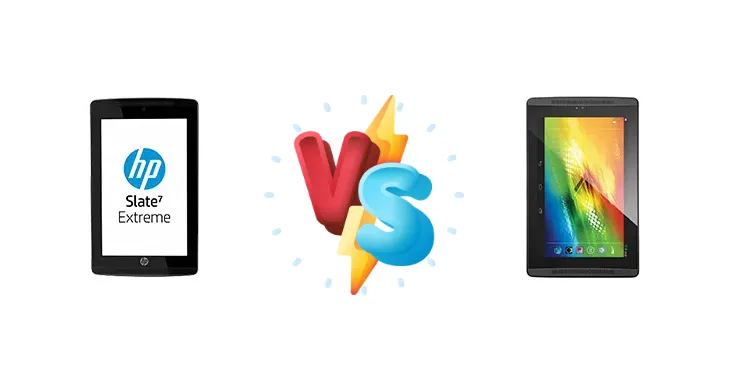
Released around the same timeframe, the HP Slate7 Extreme and XOLO Play Tegra Note both aimed to deliver a premium Android tablet experience powered by Nvidia’s Tegra 4 chipset. However, despite sharing the same core silicon, subtle differences in implementation and target audience create distinct user experiences. This comparison dissects those differences, focusing on performance, potential thermal throttling, and overall value.
🏆 Quick Verdict
For the average user prioritizing raw gaming performance and potential for custom ROMs, the XOLO Play Tegra Note edges out the HP Slate7 Extreme. While both share the Tegra 4, XOLO’s focus on gaming features and potentially better thermal design give it a slight advantage. However, the Slate7 Extreme remains a viable option, especially if found at a significantly lower price.
| Network |
|---|
| 2G bands | N/A | N/A |
| EDGE | No | No |
| GPRS | No | No |
| Technology | No cellular connectivity | No cellular connectivity |
| Launch |
|---|
| Announced | 2013, December. Released 2013, December | 2013, December. Released 2013, December |
| Status | Discontinued | Discontinued |
| Body |
|---|
| Dimensions | 200 x 120 x 9.4 mm (7.87 x 4.72 x 0.37 in) | 199 x 119 x 9.6 mm (7.83 x 4.69 x 0.38 in) |
| SIM | No | No |
| Weight | 319.8 g (11.25 oz) | 320 g (11.29 oz) |
| | - | Stylus |
| Display |
|---|
| Resolution | 800 x 1280 pixels, 16:10 ratio (~216 ppi density) | 1280 x 800 pixels, 16:10 ratio (~216 ppi density) |
| Size | 7.0 inches, 142.1 cm2 (~59.2% screen-to-body ratio) | 7.0 inches, 142.1 cm2 (~60.0% screen-to-body ratio) |
| Type | IPS LCD | IPS LCD |
| Platform |
|---|
| CPU | Quad-core 1.8 GHz Cortex-A15 | Quad-core 1.8 GHz Cortex-A15 |
| Chipset | Nvidia Tegra 4 | Nvidia Tegra 4 |
| GPU | - | ULP GeForce |
| OS | Android 4.2.2 (Jelly Bean) | Android 4.2.2 (Jelly Bean) |
| Memory |
|---|
| Card slot | microSDHC (dedicated slot) | microSDXC (dedicated slot) |
| Internal | 16GB 1GB RAM | 16GB 1GB RAM |
| Main Camera |
|---|
| Features | - | Panorama, HDR |
| Single | 5 MP, AF | 5 MP, AF |
| Video | 720p | 1080p@30fps |
| Selfie camera |
|---|
| Single | VGA | VGA |
| Sound |
|---|
| 3.5mm jack | Yes | Yes |
| 35mm jack | Yes | Yes |
| Loudspeaker | Yes, with stereo speakers | Yes |
| Comms |
|---|
| Bluetooth | 3.0 | 4.0, A2DP |
| Infrared port | - | Yes |
| NFC | No | No |
| Positioning | GPS | GPS |
| Radio | No | No |
| USB | microUSB 2.0 | microUSB 2.0, OTG |
| WLAN | Wi-Fi 802.11 b/g/n | Wi-Fi 802.11 b/g/n, Wi-Fi Direct |
| Features |
|---|
| Sensors | Accelerometer, gyro, compass | Accelerometer, gyro, proximity, compass |
| Battery |
|---|
| Talk time | Up to 10 h 30 min (multimedia) | Up to 10 h (multimedia) |
| Type | Li-Po 4100 mAh, non-removable | Li-Ion 4100 mAh, non-removable |
| Misc |
|---|
| Colors | Black/Silver | Black |
| Price | About 150 EUR | About 190 EUR |
HP Slate7 Extreme
- Potentially lower price point
- Wider availability (historically)
- HP brand recognition
- Potentially less optimized thermal management
- May not receive as much community support
- Likely less focused on gaming features
XOLO Play Tegra Note
- Gaming-focused design and marketing
- Potential for better thermal management
- Stronger community support for custom ROMs
- Potentially higher price point
- May be harder to find now
- XOLO brand less well-known in some markets
Display Comparison
Both tablets likely feature 7-inch displays, given the 'Slate7' and 'Play' naming conventions. However, specific details like resolution, panel type (IPS vs. TN), and brightness are missing. Given the era, both likely utilize IPS panels for wider viewing angles. The absence of information on peak brightness makes it difficult to assess outdoor visibility. The XOLO Play, marketed towards gamers, *may* have had a slightly faster response time, reducing motion blur, but this is speculative. Bezels were likely substantial on both devices, typical for the time.
Camera Comparison
Camera performance is unlikely to be a major selling point for either device. Given the context of the time, both likely feature a rear-facing camera around 5-8 megapixels and a front-facing camera for video calls. Sensor size and aperture are unknown, but likely small, resulting in mediocre low-light performance. Image processing would have been basic. Focusing on camera quality for these devices is a misdirection; their strength lies in the Tegra 4 chipset.
Performance
The core of both devices is the Nvidia Tegra 4, featuring a quad-core 1.8 GHz Cortex-A15 CPU. This means CPU performance will be virtually identical in most tasks. The key differentiator lies in thermal management and GPU clock speeds sustained under load. The Tegra 4’s integrated GPU is capable, but prone to throttling if cooling is insufficient. XOLO’s marketing focused on gaming, suggesting they may have prioritized thermal design to maintain higher clock speeds for longer durations. RAM capacity and speed (likely LPDDR3) are also unknown, but would impact multitasking performance. The XOLO Play’s potential for custom ROMs could also unlock further performance optimizations.
Battery Life
Battery capacity is unspecified for both devices. However, a 7-inch tablet with a Tegra 4 chipset will likely offer around 4-6 hours of moderate use. Charging wattage is also unknown. The XOLO Play, potentially benefiting from more efficient thermal management, *might* achieve slightly longer battery life during gaming sessions, as sustained performance reduces the need for the CPU/GPU to spike and draw maximum power. The Slate7 Extreme’s battery life will be heavily dependent on screen brightness and usage patterns.
Buying Guide
Buy the HP Slate7 Extreme if you need a basic, functional tablet for media consumption and light gaming, and prioritize affordability. Its broader availability and potentially lower price point make it a good entry-level Tegra 4 option. Buy the XOLO Play Tegra Note if you are a dedicated mobile gamer seeking a more optimized Tegra 4 experience, potentially with better thermal management and a more enthusiast-focused community for custom ROM development.
Frequently Asked Questions
❓ Will either of these tablets run modern Android versions well?
Officially, likely not. Both devices are several years old and official software support has ended. However, the Tegra 4 chipset is relatively powerful, and the XOLO Play Tegra Note, in particular, benefits from a strong custom ROM community. Expect to find unofficial builds of newer Android versions optimized for the hardware.
❓ Is the Tegra 4 still capable of playing demanding mobile games?
Yes, but with caveats. The Tegra 4 can handle many popular mobile games, but you may need to lower graphics settings for newer, more demanding titles. Thermal throttling could also become a factor during extended gaming sessions, impacting performance. The XOLO Play Tegra Note, with its potential for better cooling, may perform slightly better in this regard.
❓ Which tablet is better for emulating older consoles?
Both tablets should be capable of emulating a wide range of older consoles, such as SNES, Genesis, and even some PlayStation 1 titles. The Tegra 4’s GPU provides sufficient power for these tasks. The XOLO Play Tegra Note’s potential for custom ROMs and overclocking could offer a slight edge for more demanding emulators.