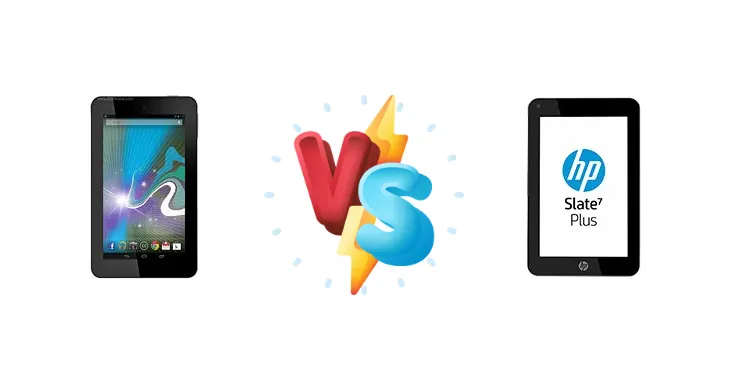
The HP Slate 7 and Slate7 Plus represent HP's early forays into the affordable Android tablet market. While both aimed to deliver a tablet experience at a competitive price, they differed significantly under the hood. The key distinction lies in their processors: the Slate 7 utilizes a dual-core Cortex-A9, while the Slate7 Plus boasts the more powerful Nvidia Tegra 3. This comparison will dissect these differences, revealing which tablet offers the best value for today's user.
🏆 Quick Verdict
For the average user prioritizing responsiveness and gaming, the HP Slate7 Plus is the clear winner. The Nvidia Tegra 3 chipset provides a substantial performance uplift over the Slate 7’s dual-core processor, making it better suited for multitasking, demanding applications, and a smoother overall experience. While the Slate 7 remains functional, the Plus offers a significantly improved user experience.
| Network |
|---|
| 2G bands | N/A | N/A |
| EDGE | No | No |
| GPRS | No | No |
| Technology | No cellular connectivity | No cellular connectivity |
| Launch |
|---|
| Announced | 2013, February. Released 2013, April | 2013, December. Released 2013, December |
| Status | Discontinued | Discontinued |
| Body |
|---|
| Dimensions | 197.1 x 116.1 x 10.7 mm (7.76 x 4.57 x 0.42 in) | 194.7 x 122.7 x 10.7 mm (7.67 x 4.83 x 0.42 in) |
| SIM | No | No |
| Weight | 372 g (13.12 oz) | 340.2 (11.99 oz) |
| Display |
|---|
| Resolution | 600 x 1024 pixels, 16:9 ratio (~170 ppi density) | 800 x 1280 pixels, 16:10 ratio (~216 ppi density) |
| Size | 7.0 inches, 137.9 cm2 (~60.3% screen-to-body ratio) | 7.0 inches, 142.1 cm2 (~59.5% screen-to-body ratio) |
| Type | FFS+ LCD | IPS LCD |
| Platform |
|---|
| CPU | Dual-core 1.6 GHz Cortex-A9 | Quad-core 1.3 GHz Cortex-A9 |
| Chipset | - | Nvidia Tegra 3 |
| OS | Android 4.1 (Jelly Bean) | Android 4.2.2 (Jelly Bean) |
| Memory |
|---|
| Card slot | microSDHC (dedicated slot) | microSDHC (dedicated slot) |
| Internal | 8GB 1GB RAM | 8GB 1GB RAM |
| Main Camera |
|---|
| Single | 3.15 MP | 5 MP, AF |
| Video | 720p@30fps | 720p |
| Selfie camera |
|---|
| Single | VGA | VGA |
| Sound |
|---|
| 3.5mm jack | Yes | Yes |
| 35mm jack | Yes | Yes |
| Loudspeaker | Yes, with stereo speakers | Yes, with stereo speakers |
| Comms |
|---|
| Bluetooth | 2.1, A2DP, EDR | 3.0 |
| NFC | No | No |
| Positioning | No | GPS |
| Radio | No | No |
| USB | microUSB 2.0 | microUSB 2.0 |
| WLAN | Wi-Fi 802.11 b/g/n, DLNA | Wi-Fi 802.11 b/g/n |
| Features |
|---|
| Sensors | Accelerometer | Accelerometer, compass |
| Battery |
|---|
| Talk time | Up to 5 h (multimedia) | Up to 7 h 30 min (multimedia) |
| Type | Li-Ion, non-removable | Li-Po 4000 mAh, non-removable |
| Misc |
|---|
| Colors | Black/Silver, Red | Black/Silver |
| Price | About 130 EUR | About 110 EUR |
HP Slate 7
- Potentially lower price point
- Simpler user experience for basic tasks
- May have slightly longer battery life during very light use
- Significantly slower performance
- Poor multitasking capabilities
- Limited gaming potential
HP Slate7 Plus
- Superior performance thanks to the Tegra 3 chipset
- Improved multitasking and app loading times
- Better gaming experience
- More responsive user interface
- Likely higher price point
- Potentially slightly shorter battery life under heavy load
Display Comparison
Both tablets feature a 7-inch display, but detailed specifications regarding resolution, panel type (IPS vs. TN), and brightness are unavailable. Given the market segment, it's reasonable to assume both utilize TN panels to keep costs down. The lack of detailed display specs means a direct comparison is difficult, but the focus should be on the performance difference rather than visual fidelity. Bezels were likely substantial on both devices, typical for tablets of this era.
Camera Comparison
Neither tablet was known for its camera prowess. Detailed camera specifications are scarce, but it’s safe to assume both feature basic cameras suitable for casual snapshots. The focus should not be on image quality, as both likely deliver subpar results compared to modern smartphones. Any differences in camera performance would likely be minimal and overshadowed by the processor disparity.
Performance
The core difference lies in the chipset. The HP Slate 7’s dual-core 1.6 GHz Cortex-A9 processor is significantly outmatched by the HP Slate7 Plus’s Nvidia Tegra 3. The Tegra 3 features a quad-core 1.3 GHz Cortex-A9 configuration, offering superior multi-tasking capabilities and a substantial boost in graphics performance. The Tegra 3’s architecture also includes a fifth ‘companion’ core for power-efficient tasks, potentially extending battery life during lighter use. This translates to faster app loading times, smoother web browsing, and a more enjoyable gaming experience on the Slate7 Plus.
Battery Life
Battery capacity details are unavailable for either device. However, the Nvidia Tegra 3’s power-efficient fifth core in the Slate7 Plus could potentially offset the increased power draw of the quad-core processor, resulting in comparable battery life to the Slate 7. Real-world battery performance would depend heavily on usage patterns, with demanding games and applications draining the battery faster on both devices. Charging times are also unknown, but likely similar given the likely use of standard micro-USB charging.
Buying Guide
Buy the HP Slate 7 if you need a basic tablet for light tasks like web browsing, email, and simple media consumption, and your budget is extremely limited. It's a functional device for those with minimal computing needs. Buy the HP Slate7 Plus if you prioritize performance, enjoy mobile gaming, or anticipate multitasking between applications. The Tegra 3 chipset delivers a noticeably smoother and more responsive experience, justifying the likely price premium.
Frequently Asked Questions
❓ Will the HP Slate7 Plus run modern Android apps smoothly?
While the Slate7 Plus is more capable than the Slate 7, it's important to remember that both devices are quite old. Modern Android apps have become increasingly demanding. The Slate7 Plus will handle many apps adequately, but you may experience slowdowns or compatibility issues with newer, resource-intensive applications. Expect a less polished experience than on a modern tablet.
❓ Is the Nvidia Tegra 3 in the Slate7 Plus good for gaming?
The Nvidia Tegra 3 was a capable mobile processor for its time, and it significantly outperforms the dual-core processor in the Slate 7. You'll be able to play many older Android games on the Slate7 Plus with reasonable frame rates. However, don't expect to run demanding modern titles at high settings. The Tegra 3’s GPU provides a noticeable advantage over the Slate 7 for gaming.
❓ Can I upgrade the storage on either the HP Slate 7 or Slate7 Plus?
Both the HP Slate 7 and Slate7 Plus likely feature limited or no expandable storage options via microSD card. The internal storage capacity is likely fixed. This is a common limitation for tablets in this price range and era. Consider this when choosing a model, as you may be limited in the amount of apps, photos, and videos you can store.