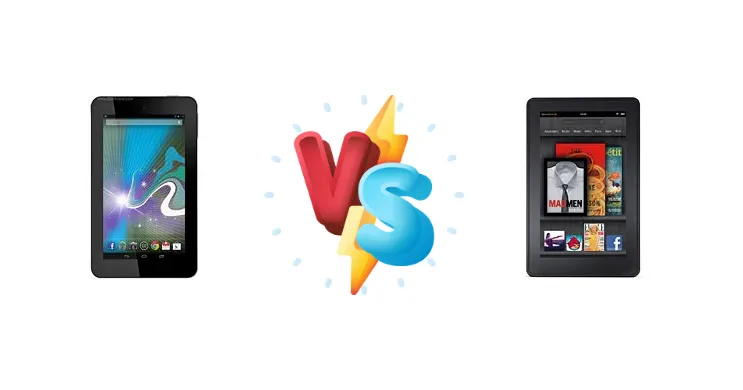
In the early days of affordable tablets, the HP Slate 7 and Amazon Kindle Fire represented competing visions of what a sub-$200 tablet could be. Both devices aimed to deliver a portable media consumption experience, but they took different approaches to hardware and software. This comparison dissects their core specifications to determine which tablet offered the better value proposition.
🏆 Quick Verdict
For users prioritizing raw processing power, the HP Slate 7 emerges as the winner. Its 1.6 GHz dual-core Cortex-A9 CPU provides a noticeable performance edge over the Kindle Fire’s 1.0 GHz processor, making it better suited for light gaming and multitasking. However, the Kindle Fire’s optimized software experience and ecosystem integration remain compelling.
| Network |
|---|
| 2G bands | N/A | N/A |
| EDGE | No | No |
| GPRS | No | No |
| Technology | No cellular connectivity | No cellular connectivity |
| Launch |
|---|
| Announced | 2013, February. Released 2013, April | 2011, September. Released 2011, November |
| Status | Discontinued | Discontinued |
| Body |
|---|
| Dimensions | 197.1 x 116.1 x 10.7 mm (7.76 x 4.57 x 0.42 in) | 190 x 120 x 11.4 mm (7.48 x 4.72 x 0.45 in) |
| SIM | No | No |
| Weight | 372 g (13.12 oz) | 413 g (14.57 oz) |
| Display |
|---|
| Resolution | 600 x 1024 pixels, 16:9 ratio (~170 ppi density) | 600 x 1024 pixels, 16:9 ratio (~170 ppi density) |
| Size | 7.0 inches, 137.9 cm2 (~60.3% screen-to-body ratio) | 7.0 inches, 137.9 cm2 (~60.5% screen-to-body ratio) |
| Type | FFS+ LCD | IPS LCD |
| Platform |
|---|
| CPU | Dual-core 1.6 GHz Cortex-A9 | Dual-core 1.0 GHz Cortex-A9 |
| Chipset | - | TI OMAP 4430 |
| GPU | - | PowerVR SGX540 |
| OS | Android 4.1 (Jelly Bean) | Android 2.3 (customized) |
| Memory |
|---|
| Card slot | microSDHC (dedicated slot) | No |
| Internal | 8GB 1GB RAM | 8GB 512MB RAM |
| Main Camera |
|---|
| Single | 3.15 MP | - |
| Video | 720p@30fps | - |
| Sound |
|---|
| 3.5mm jack | Yes | Yes |
| 35mm jack | Yes | Yes |
| Loudspeaker | Yes, with stereo speakers | Yes |
| Comms |
|---|
| Bluetooth | 2.1, A2DP, EDR | No |
| NFC | No | - |
| Positioning | No | No |
| Radio | No | No |
| USB | microUSB 2.0 | Proprietary |
| WLAN | Wi-Fi 802.11 b/g/n, DLNA | Wi-Fi 802.11 b/g/n |
| Features |
|---|
| Sensors | Accelerometer | Accelerometer |
| | - | MP4/VP8 player
MP3/WAV/AAC/OGG/MIDI player
Organizer
Predictive text input |
| Battery |
|---|
| Talk time | Up to 5 h (multimedia) | - |
| Type | Li-Ion, non-removable | Non-removable Li-Ion 4400 mAh battery |
| Misc |
|---|
| Colors | Black/Silver, Red | Black |
| Price | About 130 EUR | About 120 EUR |
| Tests |
|---|
| Audio quality | - |
Noise -87.8dB / Crosstalk -83.2dB |
| Display | - |
Contrast ratio: 896:1 (nominal) |
| Loudspeaker | - |
Voice 66dB / Noise 63dB / Ring 66dB
|
HP Slate 7
- Faster CPU for improved performance
- More open Android experience
- Potentially better multitasking capabilities
- Lack of ecosystem integration
- Unknown battery capacity
Amazon Kindle Fire
- Seamless Amazon ecosystem integration
- Optimized software for media consumption
- Good contrast ratio for the price
- Slower CPU performance
- Limited app availability outside Amazon Appstore
Display Comparison
Both the HP Slate 7 and Kindle Fire share a nominal contrast ratio of 896:1, suggesting similar black levels and color depth. However, the context data lacks specifics on panel technology (IPS vs. TN) or resolution. Given the price point, it’s likely both utilize TN panels, which typically have narrower viewing angles. The absence of brightness data makes it difficult to assess outdoor visibility, but the Kindle Fire’s software optimizations may offer better readability in bright conditions. Bezels were substantial on both devices, typical for tablets of this era.
Camera Comparison
Neither device was intended as a photography powerhouse, and the context data doesn’t provide camera specifications beyond the CPU. It’s safe to assume both feature low-resolution front and rear cameras suitable for basic video calls and occasional snapshots. Image quality would be limited by sensor size, lens quality, and image processing capabilities, making camera performance a negligible factor in the buying decision.
Performance
The HP Slate 7’s 1.6 GHz dual-core Cortex-A9 CPU represents a significant advantage over the Kindle Fire’s 1.0 GHz Cortex-A9. While both are based on the same ARM architecture, the higher clock speed translates to faster application loading times and smoother multitasking. The Kindle Fire utilizes the Texas Instruments OMAP 4430 chipset, which integrates the CPU and GPU. The Slate 7’s chipset is not specified, but the CPU difference is the primary performance differentiator. Users will experience quicker responsiveness with the HP Slate 7, particularly when navigating the user interface or switching between apps.
Battery Life
Battery capacity and charging wattage are not provided in the context data. However, given the similar screen sizes and processor architectures, battery life is likely comparable. The Kindle Fire’s software optimizations for media consumption may result in slightly longer playback times for video content. Without specific charging data, it’s impossible to determine 0-100% charging times, but both devices likely relied on micro-USB charging, which would be slower than modern USB-C standards.
Buying Guide
Buy the HP Slate 7 if you need a tablet capable of handling slightly more demanding tasks, such as basic web browsing with multiple tabs or running simple Android games. It’s the better choice for users who want a more open Android experience. Buy the Amazon Kindle Fire if you prioritize seamless access to Amazon’s content ecosystem – books, movies, and music – and prefer a tightly integrated, curated experience. It’s ideal for media consumption within the Amazon ecosystem.
Frequently Asked Questions
❓ Will the Kindle Fire’s OMAP 4430 chipset struggle with modern web browsing?
The TI OMAP 4430, paired with its 1.0 GHz Cortex-A9 CPU, will exhibit noticeable slowdowns when handling complex websites with heavy JavaScript or numerous images. While basic web browsing is possible, users should expect longer loading times and occasional lag compared to the HP Slate 7.
❓ Can I sideload apps onto the Kindle Fire if they aren't available in the Amazon Appstore?
Sideloading apps onto the Kindle Fire is possible, but it's not officially supported by Amazon and requires enabling developer options. Compatibility isn't guaranteed, and some apps may not function correctly due to differences in the Android versions and underlying system libraries.
❓ Is the HP Slate 7 a good choice for playing Android games?
The HP Slate 7’s 1.6 GHz Cortex-A9 CPU offers a modest improvement for gaming compared to the Kindle Fire. However, it’s still a relatively low-powered processor, and demanding 3D games will likely require reduced graphics settings and may still experience frame rate drops. It’s best suited for casual gaming.