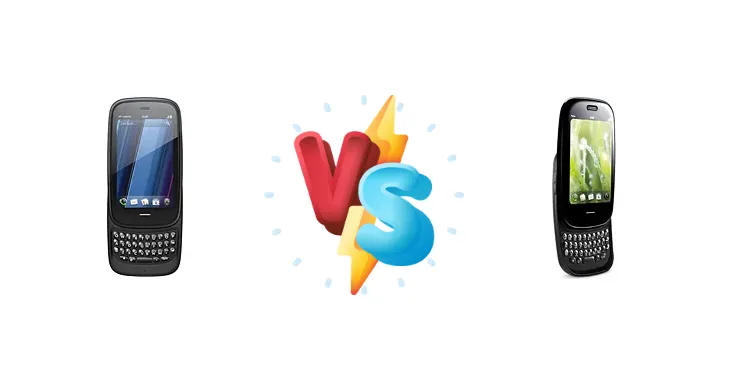
The HP Pre 3 and Palm Pre Plus represent distinct points in webOS's history. The Pre Plus aimed to refine the original Pre experience, while the Pre 3, under HP's ownership, attempted a more substantial hardware upgrade. This comparison dissects the core differences, focusing on the significant leap in processing power offered by the Pre 3's Snapdragon S2 chipset versus the Pre Plus's convenience-focused wireless charging.
🏆 Quick Verdict
For the average user seeking a responsive and capable smartphone experience, the HP Pre 3 is the clear winner. Its 1.4 GHz Snapdragon S2 processor delivers significantly higher performance than the Palm Pre Plus's 600 MHz Cortex-A8, making it better suited for multitasking and demanding applications. While the Pre Plus offers wireless charging, the performance gap is too substantial to ignore.
| Network |
|---|
| 2G bands | GSM 850 / 900 / 1800 / 1900 | GSM 850 / 900 / 1800 / 1900 |
| 3G bands | HSDPA 900 / 1900 / 2100 | HSDPA 2100 |
| Speed | HSPA 7.2/5.76 Mbps | HSPA 3.6/0.384 Mbps |
| Technology | GSM / HSPA | GSM / HSPA |
| | - | HSDPA 850 / 1900 - for AT&T |
| Launch |
|---|
| Announced | 2011, February. Released 2011, August | 2010, March. Released 2010, May |
| Status | Discontinued | Discontinued |
| Body |
|---|
| Dimensions | 111 x 64 x 16 mm (4.37 x 2.52 x 0.63 in) | 100.5 x 59.5 x 16.9 mm (3.96 x 2.34 x 0.67 in) |
| Keyboard | QWERTY | QWERTY |
| SIM | Mini-SIM | Mini-SIM |
| Weight | 156 g (5.50 oz) | 138 g (4.87 oz) |
| Display |
|---|
| Resolution | 480 x 800 pixels, 5:3 ratio (~261 ppi density) | 320 x 480 pixels, 3:2 ratio (~186 ppi density) |
| Size | 3.58 inches, 36.5 cm2 (~51.4% screen-to-body ratio) | 3.1 inches, 28.6 cm2 (~47.9% screen-to-body ratio) |
| Type | TFT | TFT |
| Platform |
|---|
| CPU | 1.4 GHz Scorpion | 600 MHz Cortex-A8 |
| Chipset | Qualcomm MSM8255 Snapdragon S2 | - |
| GPU | Adreno 205 | PowerVR SGX |
| OS | HP webOS 2.2 | Palm webOS 1.3.5 |
| Memory |
|---|
| Card slot | No | No |
| Internal | 8GB 512MB RAM | 16GB 512MB RAM |
| Main Camera |
|---|
| Features | LED flash | LED flash |
| Single | 5 MP, AF | 3.15 MP |
| Video | 720p | Yes |
| Selfie camera |
|---|
| Single | VGA | - |
| | - | No |
| Sound |
|---|
| 3.5mm jack | Yes | Yes |
| 35mm jack | Yes | Yes |
| Loudspeaker | Yes | Yes |
| Comms |
|---|
| Bluetooth | 2.1, A2DP, EDR | 2.1, A2DP |
| Positioning | GPS, A-GPS | GPS, A-GPS |
| Radio | No | No |
| USB | microUSB 2.0 | microUSB 2.0 |
| WLAN | Wi-Fi 802.11 a/b/g/n, dual-band | Wi-Fi 802.11 b/g |
| Features |
|---|
| Browser | HTML, Adobe Flash | WAP 2.0 / HTML |
| Sensors | Accelerometer, proximity, compass | Accelerometer |
| | MP3/WAV/eAAC+ player
MP4/H.264 player
Organizer
Document viewer
Voice memo/dial
Predictive text input | - |
| Battery |
|---|
| Charging | - | Wireless |
| Stand-by | Up to 300 h | Up to 350 h (2G) / - (3G) |
| Talk time | Up to 5 h | Up to 4 h (2G) / Up to 4 h (3G) |
| Type | Removable Li-Ion 1230 mAh battery | Removable Li-Ion 1150 mAh battery |
| Misc |
|---|
| Colors | Black | Black |
| Price | About 350 EUR | About 170 EUR |
HP Pre 3
- Significantly faster processor (Snapdragon S2)
- Improved graphics performance (Adreno 205)
- Potentially more responsive user experience
- Lacks wireless charging
- No detailed specs available for display or camera
Palm Pre Plus
- Convenient wireless charging
- Refined webOS experience (over original Pre)
- Potentially more compact design
- Significantly slower processor (Cortex-A8)
- Limited performance for demanding applications
- Outdated GPU
Display Comparison
Context data lacks display specifications for both devices. However, given the Pre Plus was an iterative update, it likely retained a similar display size and resolution to the original Pre. The Pre 3, being a later model, *may* have benefited from slight improvements in color accuracy or brightness, but without specific data, this remains speculative. Both devices likely utilized LCD panels common for the era, and neither is expected to feature high refresh rates or advanced technologies like LTPO.
Camera Comparison
Context data does not provide camera specifications. Based on the market segment, both devices likely featured modest camera capabilities for the time, likely around 3-5 megapixels. Image quality would have been heavily reliant on software processing, and neither device is expected to excel in low-light conditions. The absence of optical image stabilization (OIS) on either device would further limit their photographic capabilities.
Performance
The performance disparity is the most significant difference. The HP Pre 3’s Qualcomm MSM8255 Snapdragon S2, featuring a 1.4 GHz Scorpion CPU, represents a substantial architectural and clock speed upgrade over the Palm Pre Plus’s 600 MHz Cortex-A8. The Scorpion core, while older, benefits from Qualcomm’s optimizations and a higher clock speed, resulting in significantly faster application loading times and smoother multitasking. The Snapdragon S2 also includes an Adreno 205 GPU, offering a more capable graphics experience than the Pre Plus’s integrated GPU. This translates to better performance in games and graphically intensive applications. The Pre 3 likely utilized LPDDR2 RAM, a step up from the Pre Plus, further contributing to its performance advantage.
Battery Life
Battery capacity data is unavailable. However, the Pre Plus’s inclusion of wireless charging suggests a focus on convenience. Wireless charging, while convenient, is typically less efficient than wired charging, potentially requiring longer charging times to achieve a full charge. The Pre 3, lacking wireless charging, would likely rely on a micro-USB connection. The Snapdragon S2’s power consumption, while higher than the Cortex-A8, is offset by Qualcomm’s power management features. Real-world battery life would depend heavily on usage patterns, but the Pre 3’s more efficient processor architecture could potentially deliver comparable or even better battery life despite its higher performance.
Buying Guide
Buy the HP Pre 3 if you prioritize performance and responsiveness for web browsing, app usage, and future-proofing within the webOS ecosystem. Its Snapdragon S2 chipset provides a noticeable advantage for users who demand a smoother experience. Buy the Palm Pre Plus if wireless charging is a non-negotiable feature and you primarily use your phone for basic tasks like calls, texts, and light web browsing. The Pre Plus caters to users who value convenience over raw power.
Frequently Asked Questions
❓ Will the HP Pre 3 run modern web applications smoothly?
While the Snapdragon S2 was a capable processor for its time, modern web applications have become significantly more demanding. The Pre 3 will likely struggle with complex websites and web apps, experiencing noticeable lag and slowdowns. It's best suited for simpler web browsing and webOS-native applications.
❓ Is the wireless charging on the Palm Pre Plus compatible with modern Qi chargers?
The Palm Pre Plus utilized the Palm Touchstone wireless charging standard, which is *not* compatible with the widely adopted Qi standard. You will need a Palm Touchstone charging dock to utilize the wireless charging feature.
❓ Can I expect a significant gaming experience on either of these devices?
Gaming on both devices will be limited. The Pre 3’s Adreno 205 GPU offers a slight advantage, allowing for basic 3D games at low settings. However, neither device is capable of running modern, graphically intensive games.