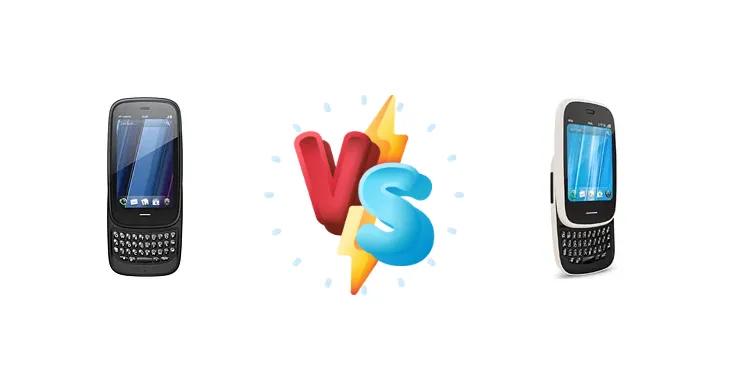
The HP Pre 3 and Veer 4G represent a fascinating, if ultimately short-lived, chapter in smartphone history. Both devices ran webOS, but targeted slightly different users. The Pre 3 aimed for a more robust experience, while the Veer 4G prioritized extreme portability. This comparison dissects the core hardware differences to determine which device delivers the better overall experience, especially considering their age and current use cases.
🏆 Quick Verdict
For the average user seeking a functional webOS experience, the HP Pre 3 is the clear winner. Its 1.4 GHz Snapdragon S2 processor provides a substantial performance advantage over the Veer 4G’s 800 MHz MSM7230, resulting in smoother multitasking and app loading. While the Veer 4G is smaller, the performance trade-off isn't worth it.
| Network |
|---|
| 2G bands | GSM 850 / 900 / 1800 / 1900 | GSM 850 / 900 / 1800 / 1900 |
| 3G bands | HSDPA 900 / 1900 / 2100 | HSDPA 850 / 1900 / 2100 |
| Speed | HSPA 7.2/5.76 Mbps | HSPA 14.4/5.76 Mbps |
| Technology | GSM / HSPA | GSM / HSPA |
| Launch |
|---|
| Announced | 2011, February. Released 2011, August | 2011, May. Released 2011, May 15 |
| Status | Discontinued | Discontinued |
| Body |
|---|
| Dimensions | 111 x 64 x 16 mm (4.37 x 2.52 x 0.63 in) | 84 x 54.5 x 15.1 mm (3.31 x 2.15 x 0.59 in) |
| Keyboard | QWERTY | QWERTY |
| SIM | Mini-SIM | Mini-SIM |
| Weight | 156 g (5.50 oz) | 103 g (3.63 oz) |
| Display |
|---|
| Resolution | 480 x 800 pixels, 5:3 ratio (~261 ppi density) | 320 x 400 pixels (~197 ppi density) |
| Size | 3.58 inches, 36.5 cm2 (~51.4% screen-to-body ratio) | 2.6 inches, 21.3 cm2 (~46.5% screen-to-body ratio) |
| Type | TFT | TFT, 256K colors |
| Platform |
|---|
| CPU | 1.4 GHz Scorpion | 800 MHz Scorpion |
| Chipset | Qualcomm MSM8255 Snapdragon S2 | Qualcomm MSM7230 |
| GPU | Adreno 205 | Adreno 205 |
| OS | HP webOS 2.2 | HP webOS 2.1 |
| Memory |
|---|
| Card slot | No | No |
| Internal | 8GB 512MB RAM | 8GB (6.1GB user available) |
| Main Camera |
|---|
| Features | LED flash | fixed focus |
| Single | 5 MP, AF | 5 MP |
| Video | 720p | Yes |
| Selfie camera |
|---|
| Single | VGA | - |
| | - | No |
| Sound |
|---|
| 3.5mm jack | Yes | No |
| 35mm jack | Yes | No |
| Loudspeaker | Yes | Yes |
| Comms |
|---|
| Bluetooth | 2.1, A2DP, EDR | 2.1, A2DP |
| Positioning | GPS, A-GPS | GPS, A-GPS |
| Radio | No | No |
| USB | microUSB 2.0 | microUSB 2.0 |
| WLAN | Wi-Fi 802.11 a/b/g/n, dual-band | Wi-Fi 802.11 b/g/n |
| Features |
|---|
| Browser | HTML, Adobe Flash | HTML, Adobe Flash |
| Sensors | Accelerometer, proximity, compass | Accelerometer, proximity |
| | MP3/WAV/eAAC+ player
MP4/H.264 player
Organizer
Document viewer
Voice memo/dial
Predictive text input | AT&T dedicated applications
MP3/WAV/eAAC+ player
MP4/H.264 player
Organizer
Document viewer
Voice memo/dial
Predictive text input |
| Battery |
|---|
| Stand-by | Up to 300 h | Up to 300 h |
| Talk time | Up to 5 h | Up to 5 h |
| Type | Removable Li-Ion 1230 mAh battery | Removable Li-Ion 910 mAh battery |
| Misc |
|---|
| Colors | Black | White, black |
| Price | About 350 EUR | About 320 EUR |
HP Pre 3
- Significantly faster processor for smoother performance
- Potentially better camera image processing
- Larger screen size for improved usability
- Larger size makes it less pocketable
- Higher power consumption potentially leading to shorter battery life during heavy use
HP Veer 4G
- Extremely compact and portable design
- Potentially longer standby battery life
- Unique sliding keyboard design
- Slow processor results in sluggish performance
- Limited multitasking capabilities
- Smaller screen size can be restrictive
Display Comparison
Detailed display specifications are unavailable, but both devices featured relatively small screens typical of the era. The Pre 3 likely benefited from the slightly larger canvas afforded by its overall size. Given the era, neither display is expected to have high brightness or color accuracy by modern standards. The Veer 4G’s smaller size likely resulted in a higher pixel density, potentially offering a sharper image, but this is offset by the overall smaller viewing area. Both would have used LCD technology.
Camera Comparison
Camera details are sparse. Both devices likely featured basic rear-facing cameras suitable for casual snapshots. Without specific megapixel counts or sensor sizes, it’s difficult to make a definitive comparison. However, the Pre 3’s more powerful processor could potentially enable faster image processing and better low-light performance, even with a similar sensor. The Veer 4G’s smaller size might have limited the camera module’s capabilities.
Performance
The core difference lies in the chipsets. The HP Pre 3’s Qualcomm MSM8255 Snapdragon S2, with its 1.4 GHz Scorpion CPU, represents a significant leap over the Veer 4G’s Qualcomm MSM7230 running at 800 MHz. The Snapdragon S2 benefits from a more advanced architecture and higher clock speed, translating to faster app launches, smoother web browsing, and improved multitasking. While both use the same Scorpion architecture, the 600 MHz clock speed difference is substantial. The Pre 3 would have handled webOS’s animations and transitions with greater fluidity. RAM specifications are unknown, but the Pre 3’s superior processor would be the primary bottleneck for performance, not RAM capacity.
Battery Life
Battery capacity details are unavailable for either device. However, the Veer 4G’s smaller form factor likely necessitated a smaller battery. The Pre 3, with its more powerful processor, would consume more power during intensive tasks. In real-world usage, the Veer 4G might offer slightly longer standby time due to its lower power consumption, but the Pre 3 would likely provide a more usable experience during active use, as its faster processor would complete tasks quicker, reducing overall screen-on time. Charging speeds were likely similar, utilizing standard micro-USB connections.
Buying Guide
Buy the HP Pre 3 if you need a more responsive webOS experience, plan to run multiple applications simultaneously, or appreciate a slightly larger screen for media consumption. Buy the HP Veer 4G if extreme portability is your absolute priority and you primarily need a device for basic communication tasks – calls, texts, and light email – and are willing to accept significantly slower performance. Both are collector's items now, so condition and rarity will also play a role.
Frequently Asked Questions
❓ Will the HP Pre 3 run modern web applications smoothly?
No. While the Pre 3 was relatively powerful for its time, its Snapdragon S2 processor and limited RAM are insufficient to handle the demands of modern web applications. Expect significant lag and compatibility issues. Its strength lies in running webOS applications designed for the platform.
❓ Is the sliding keyboard on the HP Veer 4G practical for everyday use?
The Veer 4G’s sliding keyboard is a unique feature, but its small size and limited key travel make it less practical than a full-sized keyboard. It’s usable for short messages, but typing longer emails or documents will be a frustrating experience. It's more of a novelty than a productivity tool.
❓ Can either of these phones be upgraded to a more modern operating system?
No. HP discontinued webOS development long ago, and there are no viable paths to upgrade either the Pre 3 or Veer 4G to a modern operating system like Android or iOS. They are locked into the original webOS version they shipped with.