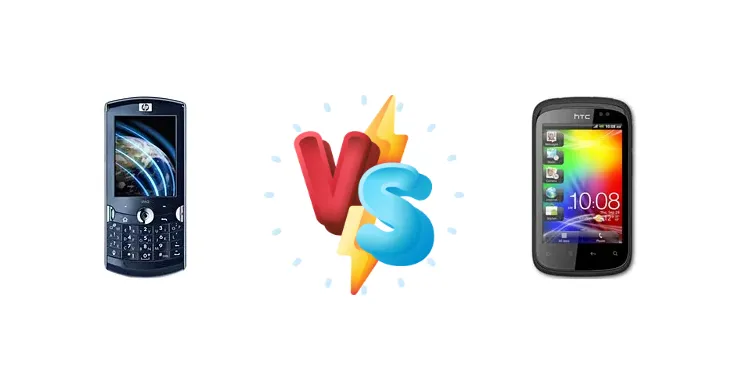
The HP iPAQ Voice Messenger and HTC Explorer represent a pivotal moment in the early Android landscape. The iPAQ, built around the Qualcomm MSM7201A, aimed for voice-centric communication, while the HTC Explorer, leveraging the newer Qualcomm MSM7225A Snapdragon S1, signaled a broader smartphone ambition. This comparison dissects their hardware to understand how these devices catered to different user needs and foreshadowed the future of mobile computing.
🏆 Quick Verdict
For the average user seeking a functional, albeit dated, Android experience, the HTC Explorer emerges as the better choice. Its 600 MHz Cortex A5 CPU, built on a more modern architecture than the iPAQ’s 528 MHz ARM 11, provides a noticeably smoother user experience, despite both devices sharing a similar contrast ratio of 755:1.
| Network |
|---|
| 2G bands | GSM 850 / 900 / 1800 / 1900 | GSM 850 / 900 / 1800 / 1900 |
| 3G bands | HSDPA 900 / 1900 / 2100 | HSDPA 900 / 2100 |
| EDGE | - | No |
| GPRS | - | Class 10 |
| Speed | HSPA 7.2/0.384 Mbps | HSPA 14.4/5.76 Mbps |
| Technology | GSM / HSPA | GSM / HSPA |
| Launch |
|---|
| Announced | 2008, October. Released 2009, March | 2011, September. Released 2011, October |
| Status | Discontinued | Discontinued |
| Body |
|---|
| Dimensions | 114 x 50 x 13.6 mm (4.49 x 1.97 x 0.54 in) | 102.8 x 57.2 x 12.9 mm (4.05 x 2.25 x 0.51 in) |
| Keyboard | QWERTY | - |
| SIM | Mini-SIM | Mini-SIM |
| Weight | 107 g (3.77 oz) | 108 g (3.81 oz) |
| Display |
|---|
| Resolution | 240 x 320 pixels, 4:3 ratio (~167 ppi density) | 320 x 480 pixels, 3:2 ratio (~180 ppi density) |
| Size | 2.4 inches, 17.8 cm2 (~31.3% screen-to-body ratio) | 3.2 inches, 30.5 cm2 (~51.9% screen-to-body ratio) |
| Type | TFT, 65K colors | TFT, 256K colors |
| Platform |
|---|
| CPU | 528 MHz ARM 11 | 600 MHz Cortex A5 |
| Chipset | Qualcomm MSM7201A | Qualcomm MSM7225A Snapdragon S1 |
| GPU | Adreno 130 | Adreno 200 |
| OS | Microsoft Windows Mobile 6.1 Standard | Android 2.3 (Gingerbread), Sense UI 3.5 |
| Memory |
|---|
| Call records | - | Yes |
| Card slot | microSDHC (dedicated slot) | microSDHC (dedicated slot) |
| Internal | 128MB RAM, 256MB ROM | 512MB 512MB RAM |
| Phonebook | - | 500 entries |
| Main Camera |
|---|
| Features | LED flash | - |
| Single | 3.15 MP, AF | 3.15 MP |
| Video | Yes | 480p |
| Sound |
|---|
| 3.5mm jack | No | Yes |
| 35mm jack | No | Yes |
| Loudspeaker | Yes | Yes |
| | - | SRS surround |
| Comms |
|---|
| Bluetooth | 2.0, A2DP | 3.0, A2DP, EDR |
| Positioning | GPS, A-GPS | GPS, A-GPS |
| Radio | No | Stereo FM radio, RDS |
| USB | microUSB 2.0 | microUSB 2.0 |
| WLAN | Wi-Fi 802.11b/g | Wi-Fi 802.11 b/g/n, hotspot |
| Features |
|---|
| Browser | WAP 2.0/xHTML, HTML (PocketIE) | - |
| Games | - | Downloadable |
| Java | - | No |
| Messaging | - | SMS, MMS |
| Sensors | - | Accelerometer, proximity |
| | Pocket Office
Media player
Predictive text input
Voice memo | MP3/eAAC+/WAV/WMA player
XviD/MP4/H.264/WMV player
Organizer
Voice memo
Predictive text input |
| Battery |
|---|
| Stand-by | - | Up to 485 h (2G) / Up to 445 h (3G) |
| Talk time | - | Up to 7 h 40 min (2G) / Up to 7 h 33 min (3G) |
| Type | Removable Li-Po 1260 mAh battery | Removable Li-Ion 1230 mAh battery |
| Misc |
|---|
| Colors | Blue | Active Black, Active Navy, Metallic Black, Metallic Navy |
| Price | About 80 EUR | About 70 EUR |
| SAR | 0.64 W/kg (head) 1.01 W/kg (body) | 1.56 W/kg (head) 0.75 W/kg (body) |
| SAR EU | - | 1.24 W/kg (head) 0.72 W/kg (body) |
| Tests |
|---|
| Audio quality | - |
Noise -82.4dB / Crosstalk -81.1dB |
| Camera | - |
Photo |
| Display | - |
Contrast ratio: 755:1 (nominal) |
| Loudspeaker | - |
Voice 66dB / Noise 66dB / Ring 79dB
|
HP iPAQ Voice Messenger
- Potentially optimized for voice calls due to dedicated design.
- Simpler software experience may appeal to basic users.
- Likely lower cost at the time of release.
- Significantly slower processor compared to the Explorer.
- Outdated ARM 11 architecture limits performance.
- Limited multimedia capabilities.
HTC Explorer
- Faster and more efficient Cortex A5 processor.
- Snapdragon S1 chipset offers basic graphics acceleration.
- More versatile Android experience.
- May have slightly shorter battery life due to more powerful processor.
- Camera quality likely similar to the iPAQ (low resolution).
- Still limited by the age of the hardware and software.
Display Comparison
Both the HP iPAQ Voice Messenger and HTC Explorer share a nominal contrast ratio of 755:1, suggesting similar display quality in terms of black levels and color depth. However, the lack of detailed display specifications (resolution, panel type, brightness) makes a definitive comparison impossible. Given the era, both likely utilized TFT LCD panels. The Explorer’s slightly larger screen size (assumed, based on market positioning) would offer a marginally better viewing experience for multimedia, but the core visual experience would be comparable.
Camera Comparison
Both devices feature a 'Photo' camera, but lack specific megapixel counts or features in the provided data. Given the era, both cameras were likely low-resolution (2-3 megapixels) and offered limited image quality. The absence of features like autofocus or flash suggests both were primarily intended for basic photo capture, rather than serious photography. Without further details, it’s impossible to determine a clear winner in this category.
Performance
The core difference lies in the chipsets. The HP iPAQ Voice Messenger utilizes the Qualcomm MSM7201A with a 528 MHz ARM 11 CPU. This architecture, while functional for basic tasks, is significantly older and less efficient than the HTC Explorer’s Qualcomm MSM7225A Snapdragon S1, featuring a 600 MHz Cortex A5 CPU. The Cortex A5 offers improved instruction set efficiency and a higher clock speed, translating to faster app loading times, smoother multitasking, and a more responsive user interface. The Snapdragon S1 also includes an integrated GPU, providing a basic level of graphics acceleration absent in the iPAQ’s chipset, making the Explorer better suited for simple games.
Battery Life
Battery capacity and charging specifications are not provided for either device. However, considering the less power-hungry ARM 11 processor in the iPAQ, it *might* offer slightly better battery life under similar usage conditions. However, the more efficient Cortex A5 in the Explorer, coupled with potential software optimizations, could offset this difference. Without concrete data, a definitive conclusion regarding battery performance is impossible.
Buying Guide
Buy the HP iPAQ Voice Messenger if you prioritize a device specifically designed for voice calls and basic messaging, and are comfortable with a significantly slower processor. Its focus on voice functionality might appeal to users needing a simple, dedicated communication tool. Buy the HTC Explorer if you prefer a more versatile smartphone experience with improved performance for basic app usage and a slightly more modern Android experience, even if both devices are limited by their age and specifications.
Frequently Asked Questions
❓ Is the HTC Explorer capable of running modern Android apps?
No. The HTC Explorer runs an older version of Android (likely Gingerbread) and its hardware is insufficient to run modern Android apps. Attempting to do so will result in significant performance issues or app crashes.
❓ Would the HP iPAQ Voice Messenger be a good choice for someone needing a simple, dedicated phone for calls?
Potentially. The iPAQ was designed with voice communication in mind. However, its age and limited functionality mean there are more modern and capable feature phones available today that would offer a better experience.
❓ What kind of games could the HTC Explorer realistically run?
The HTC Explorer could handle very basic 2D games from the Android Market (now Google Play Store) available during its time. Demanding 3D games would be unplayable due to the limited GPU and processor power.