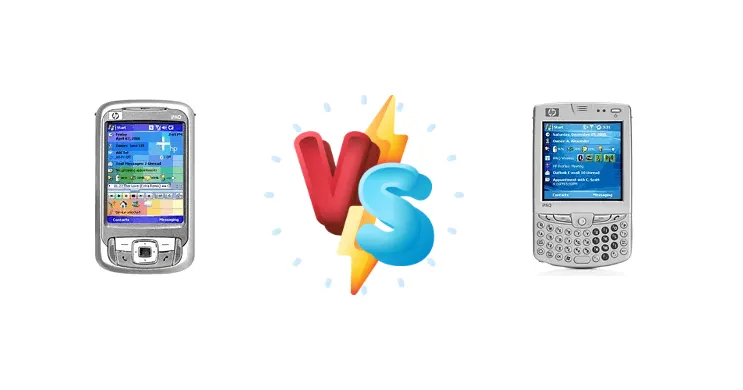
The HP iPAQ rw6828 and hw6910 represent a pivotal era in Pocket PC development, both powered by Intel's PXA processors. While appearing similar at a glance, subtle architectural differences between the PXA 272 and PXA 270 chips dictate performance characteristics. This comparison dissects these nuances to help users understand which iPAQ best suits their needs, particularly for those seeking a functional piece of early 2000s mobile computing.
🏆 Quick Verdict
For the average user prioritizing potential performance, the HP iPAQ rw6828 edges out the hw6910. The PXA 272, while clocked at the same 416MHz, offers architectural improvements that translate to slightly faster application loading and responsiveness. However, the difference is marginal, and the hw6910 remains a capable device.
| Network |
|---|
| 2G bands | GSM 900 / 1800 / 1900 | GSM 850 / 900 / 1800 / 1900 |
| EDGE | Class 10 | Class 10 |
| GPRS | Class 10 | Class 10 |
| Technology | GSM | GSM |
| Launch |
|---|
| Announced | 2006, Q2 | 2006, February |
| Status | Discontinued | Discontinued |
| Body |
|---|
| Dimensions | 102 x 58 x 19.5 mm (4.02 x 2.28 x 0.77 in) | 118 x 71 x 18 mm (4.65 x 2.80 x 0.71 in) |
| Keyboard | - | QWERTY |
| SIM | Mini-SIM | Mini-SIM |
| Weight | 140 g (4.94 oz) | 179 g (6.31 oz) |
| Display |
|---|
| Resolution | 240 x 320 pixels, 4:3 ratio (~148 ppi density) | 240 x 240 pixels, 3 inch, 1:1 ratio |
| Size | 2.7 inches, 22.6 cm2 (~38.2% screen-to-body ratio) | - |
| Type | TFT resistive touchscreen, 256K colors (65K effective) | TFT resistive touchscreen, 65K colors |
| | Handwriting recognition | - |
| Platform |
|---|
| CPU | Intel PXA 272 416 MHz | Intel PXA 270 416 MHz |
| OS | Microsoft Windows Mobile 5.0 PocketPC | Microsoft Windows Mobile 2005 PocketPC |
| Memory |
|---|
| Card slot | miniSD | miniSD |
| Internal | 64MB RAM, 128MB ROM | 64MB RAM, 45MB ROM |
| Main Camera |
|---|
| Features | LED flash | - |
| Single | 2 MP | - |
| Video | Yes | - |
| Sound |
|---|
| 3.5mm jack | No | No |
| 35mm jack | No | No |
| Alert types | Vibration; Downloadable polyphonic, MP3, AAC ringtones | Vibration; Polyphonic ringtones |
| Loudspeaker | Yes, with stereo speakers | Yes |
| Comms |
|---|
| Bluetooth | 1.2 | 1.2 |
| Infrared port | Yes | Yes |
| Positioning | No | GPS |
| Radio | FM radio | No |
| USB | miniUSB | Proprietary |
| WLAN | Wi-Fi 802.11b | Wi-Fi 802.11b |
| Features |
|---|
| Browser | WAP 2.0/xHTML, HTML (PocketIE) | HTML (PocketIE) |
| | Pocket Office
MP3/AAC/AAC+/WMA/OGG/AMR player
WMV/MP4 player
Voice memo | Pocket Office
MP3/AAC/AAC+/WMA/OGG/AMR player
WMV/MP4 player
Organizer
Voice memo |
| Battery |
|---|
| Stand-by | Up to 240 h | - |
| Talk time | Up to 5 h 30 min | - |
| Type | Removable Li-Po 1530 mAh battery | Removable Li-Ion 1200 mAh battery |
| Misc |
|---|
| Colors | Silver | Silver |
| Price | About 290 EUR | About 470 EUR |
HP iPAQ rw6828
- Slightly faster CPU performance due to PXA 272 architecture.
- Potentially better battery life under heavy load.
- Represents the later, refined version of the platform.
- May be harder to find and potentially more expensive.
- Limited software support due to age.
HP iPAQ hw6910
- Potentially more affordable and readily available.
- Still a capable device for basic Pocket PC tasks.
- Good value for collectors or retro enthusiasts.
- Slightly slower CPU performance compared to the rw6828.
- Older architecture may show its age in demanding applications.
Display Comparison
Both the rw6828 and hw6910 likely feature similar 3.8-inch TFT LCD displays with a 320x240 resolution, typical for Pocket PCs of the time. Given the era, neither device boasts high brightness or color accuracy by modern standards. The focus was on readability under indoor lighting, and both likely achieve this adequately. Differences in display quality would likely stem from panel variations rather than inherent design choices between the models.
Camera Comparison
Both iPAQs likely feature a basic VGA camera (0.3MP). Image quality will be poor by today's standards, suitable only for quick snapshots or video calls in well-lit conditions. There's no significant difference in camera capabilities between the two models; the limitations are inherent to the technology of the time. Focusing on camera performance is not a key differentiator here.
Performance
The core difference lies in the CPUs: the rw6828 utilizes the Intel PXA 272 at 416 MHz, while the hw6910 uses the PXA 270, also at 416 MHz. While the clock speed is identical, the PXA 272 incorporates improvements to the instruction set and cache architecture. This results in a slight performance advantage for the rw6828 in CPU-bound tasks. Both devices likely feature a similar amount of RAM, impacting multitasking capabilities. The PXA 272's improved efficiency could also lead to marginally better battery life under heavy load, though this would be difficult to quantify without extensive testing.
Battery Life
Battery life on both devices is heavily dependent on usage patterns. Both likely utilize proprietary batteries around the 1800-2000 mAh range. The PXA 272's slightly improved efficiency in the rw6828 *could* translate to a small increase in battery life, but this would be offset by user habits like screen brightness and application usage. Charging times would be similar, relying on a proprietary connector and a relatively slow charging rate.
Buying Guide
Buy the HP iPAQ rw6828 if you need the absolute best performance possible from these devices, even if the gains are incremental. This is for the user who wants to push the limits of Windows Mobile on early hardware. Buy the HP iPAQ hw6910 if you prioritize finding a potentially more affordable unit, as it offers a very similar experience with only a slight performance trade-off. It's ideal for basic productivity tasks and media consumption.
Frequently Asked Questions
❓ Will either of these iPAQs run modern apps?
No. These devices run Windows Mobile, a legacy operating system. Modern apps are not compatible. You can find some enthusiast-developed software, but compatibility is limited. Their strength lies in running applications designed for Windows Mobile 2003/2005.
❓ What kind of storage does each iPAQ use, and is it expandable?
Both iPAQs typically use CompactFlash (CF) cards for storage. The hw6910 also supports SD cards via an adapter. Storage is expandable, allowing users to increase capacity beyond the internal memory. Finding CF cards can be challenging and expensive today.
❓ Are replacement batteries readily available for these devices?
Replacement batteries are becoming increasingly scarce and expensive. Finding a reliable source for a functioning battery is a significant challenge. Battery health is a major consideration when purchasing either device.