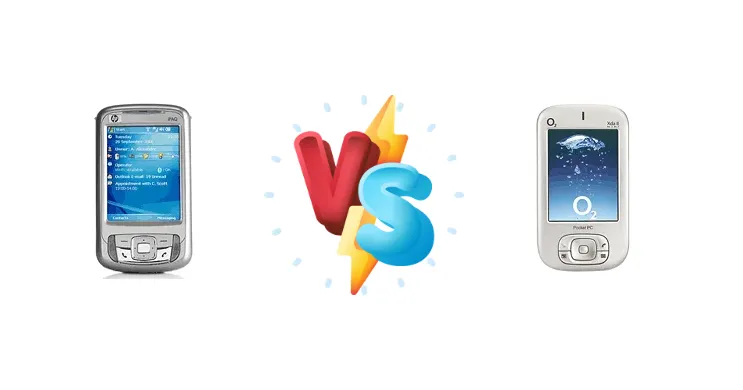
The HP iPAQ rw6815 and O2 XDA II mini represent a pivotal moment in mobile computing – the transition from simple PDAs to more fully-featured 'smart' devices. Both devices, powered by the same Intel PXA272 processor, aimed to deliver Windows Mobile functionality in a pocketable form factor, but they approached this goal with distinct design philosophies and feature sets. This comparison examines their similarities and differences, offering insight into the early days of mobile convergence.
🏆 Quick Verdict
For the user seeking a more refined, arguably more polished experience, the HP iPAQ rw6815 edges out the O2 XDA II mini. While both share the same processor, the iPAQ’s focus on a streamlined PDA experience and potentially better build quality make it the slightly preferable choice for those interested in collecting or experiencing early Windows Mobile.
| Network |
|---|
| 2G bands | GSM 900 / 1800 / 1900 | GSM 900 / 1800 / 1900 |
| EDGE | Class 10 | No |
| GPRS | Class 10 | Class 10 |
| Technology | GSM | GSM |
| Launch |
|---|
| Announced | 2006, October | 2004, Q4 |
| Status | Discontinued | Discontinued |
| Body |
|---|
| Dimensions | 102 x 58 x 19.5 mm (4.02 x 2.28 x 0.77 in) | 108 x 58 x 18 mm (4.25 x 2.28 x 0.71 in) |
| SIM | Mini-SIM | Mini-SIM |
| Weight | 140 g (4.94 oz) | 150 g (5.29 oz) |
| Display |
|---|
| Resolution | 240 x 320 pixels, 4:3 ratio (~148 ppi density) | 240 x 320 pixels, 4:3 ratio (~143 ppi density) |
| Size | 2.7 inches, 22.6 cm2 (~38.2% screen-to-body ratio) | 2.8 inches, 42 x 57 mm, 24.3 cm2 (~38.8% screen-to-body ratio) |
| Type | TFT resistive touchscreen, 256K colors (65K effective) | TFT resistive touchscreen, 65K colors |
| | Handwriting recognition | Handwriting recognition
|
| Platform |
|---|
| CPU | Intel PXA272 416 MHz | Intel PXA272 416 MHz |
| OS | Microsoft Windows Mobile 5.0 PocketPC | Microsoft Windows Mobile 2003 SE PocketPC |
| Memory |
|---|
| Card slot | miniSD | MMC/SDIO |
| Internal | 64MB RAM, 128MB ROM | 64MB RAM, 64MB ROM |
| Main Camera |
|---|
| Features | LED flash | - |
| Single | 2 MP | 1.3 MP |
| Video | Yes | Yes |
| Sound |
|---|
| 3.5mm jack | No | No |
| 35mm jack | No | No |
| Alert types | Vibration; Downloadable polyphonic, MP3, AAC ringtones | Vibration; Downloadable polyphonic ringtones |
| Loudspeaker | Yes, with stereo speakers | Yes |
| | 2.5 mm audio jack | - |
| Comms |
|---|
| Bluetooth | 1.2 | Yes |
| Infrared port | Yes | Yes |
| Positioning | No | No |
| Radio | No | No |
| USB | miniUSB | Proprietary |
| WLAN | Wi-Fi 802.11b | No |
| Features |
|---|
| Browser | WAP 2.0/xHTML, HTML (PocketIE) | WAP 2.0/xHTML, HTML (PocketIE) |
| | Pocket Office
MP3/AAC/AAC+/WMA/OGG/AMR player
WMV/MP4 player
Voice memo | Pocket Office
Voice memo
MP3/AAC player |
| Battery |
|---|
| Stand-by | Up to 240 h | Up to 180 h |
| Talk time | Up to 5 h 30 min | Up to 5 h |
| Type | Removable Li-Ion 1530 mAh battery | Removable Li-Ion 1200 mAh battery |
| Misc |
|---|
| Colors | Silver | Stylish black, silver |
| Price | About 150 EUR | - |
HP iPAQ rw6815
- Classic PDA design for efficient organization.
- Potentially more refined software experience.
- Likely better build quality and durability.
- Limited smartphone functionality.
- Rudimentary camera capabilities.
- Proprietary connector for charging and data transfer.
O2 XDA II mini
- Integrated phone functionality.
- More versatile software features.
- Potential for broader carrier compatibility.
- Potentially shorter battery life.
- More complex user interface.
- May feel less polished as a PDA.
Display Comparison
Both the iPAQ rw6815 and XDA II mini likely featured resistive touchscreens, common for the era, with resolutions around 320x240 pixels. Given the shared target market, display quality was likely similar, prioritizing legibility over vibrant colors. The iPAQ, being a more 'pure' PDA, may have had a slightly more optimized display for text readability, while the XDA II mini’s screen was likely designed to accommodate a more complex UI including phone functions. Bezels were substantial on both devices, a characteristic of the time.
Camera Comparison
Camera capabilities were rudimentary on both devices, likely featuring low-resolution CMOS sensors (potentially around 1.3 megapixels or less). Image quality would have been poor by modern standards, suitable only for basic documentation. The XDA II mini, aiming for smartphone functionality, may have included software features for sending photos via email or MMS, while the iPAQ’s camera was likely more of an afterthought. The aperture and sensor size were likely small on both, resulting in poor low-light performance.
Performance
The shared Intel PXA272 416 MHz processor forms the core of both devices. Performance, therefore, would have been largely comparable for basic tasks like contact management, calendar scheduling, and note-taking. However, the XDA II mini’s attempt to function as a phone may have introduced more demanding background processes, potentially leading to slightly slower responsiveness in certain scenarios. RAM capacity, a critical factor in Windows Mobile performance, is not specified, but likely fell within the 64-128MB range for devices of this generation. Thermal management was less of a concern given the low-power processor.
Battery Life
Battery life on both devices would have been heavily dependent on usage patterns. The iPAQ, focused on PDA tasks, likely offered slightly better battery endurance due to its less demanding software profile. The XDA II mini’s cellular radio and phone functionality would have significantly impacted battery life. Charging was likely accomplished via a proprietary connector, with charge times measured in hours rather than minutes. Actual mAh capacity is unknown, but likely in the 1000-1500 mAh range.
Buying Guide
Buy the HP iPAQ rw6815 if you prioritize a classic PDA experience with a focus on organization and basic productivity tasks. Its design leans towards a more traditional handheld computer. Buy the O2 XDA II mini if you prefer a device that more aggressively attempts to blend PDA functionality with early smartphone features, including a more prominent phone interface and potentially broader carrier support (depending on region).
Frequently Asked Questions
❓ Is it possible to upgrade the Windows Mobile version on either the iPAQ rw6815 or the O2 XDA II mini?
Upgrading the Windows Mobile version was possible on some devices of this era, but often risky and dependent on carrier support or custom ROMs. Finding compatible updates for these specific models is challenging, and attempting an upgrade without proper knowledge could brick the device. It's generally not recommended.
❓ What kind of connectivity options did these devices offer beyond cellular (for the XDA II mini)?
Both devices likely included IrDA (infrared) for short-range data transfer. The iPAQ rw6815 and XDA II mini also likely featured a cradle for synchronization with a desktop computer via USB or serial port. Wi-Fi (802.11b) was becoming increasingly common in devices of this generation, and may have been included in some variants of the XDA II mini.
❓ Can these devices run modern apps?
No. These devices run Windows Mobile, a legacy operating system that is no longer supported. Modern apps are not compatible. While some enthusiasts have attempted to port Linux distributions to these devices, it requires significant technical expertise and is not a straightforward process.