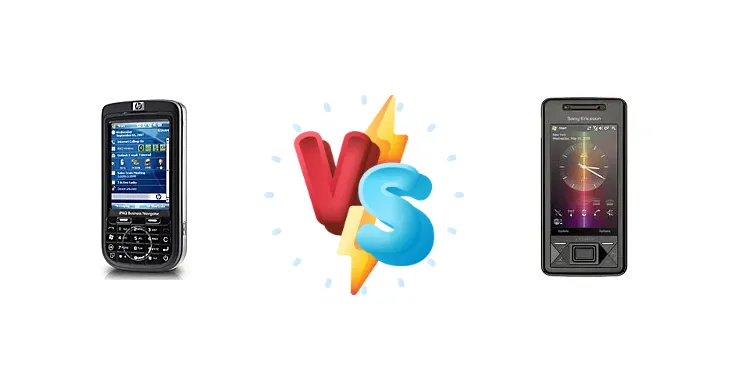
The HP iPAQ 610c and Sony Ericsson Xperia X1 represent a pivotal moment in smartphone history – the rise of Windows Mobile. Both devices aimed to deliver a full-fledged PC experience in your pocket, but they approached this goal with different hardware and design philosophies. This comparison revisits these devices, analyzing their strengths and weaknesses in a modern context.
🏆 Quick Verdict
For the average user seeking a functional piece of smartphone history, the Sony Ericsson Xperia X1 edges out the HP iPAQ 610c. Its Qualcomm MSM7200 chipset offers a slight performance advantage, and the slide-out keyboard provides a significantly better typing experience, crucial for a Windows Mobile device.
| Network |
|---|
| 2G bands | GSM 850 / 900 / 1800 / 1900 | GSM 850 / 900 / 1800 / 1900 |
| 3G bands | HSDPA 850 / 1900 / 2100 | HSDPA 900 / 1900 / 2100 |
| Speed | HSPA 7.2/0.384 Mbps | HSPA 7.2/2 Mbps |
| Technology | GSM / HSPA | GSM / HSPA |
| | - | HSDPA 850 / 1900 / 2100 - XPERIA X1a |
| Launch |
|---|
| Announced | 2007, September | 2008, February. Released 2008, October |
| Status | Discontinued | Discontinued |
| Body |
|---|
| Dimensions | 117 x 60.3 x 17.5 mm (4.61 x 2.37 x 0.69 in) | 110.5 x 52.6 x 17 mm (4.35 x 2.07 x 0.67 in) |
| Keyboard | - | QWERTY |
| SIM | Mini-SIM | Mini-SIM |
| Weight | 145 g (5.11 oz) | 145 g (5.11 oz) |
| | - | Optical trackpad |
| Display |
|---|
| Resolution | 240 x 320 pixels, 4:3 ratio (~143 ppi density) | 480 x 800 pixels, 5:3 ratio (~311 ppi density) |
| Size | 2.8 inches, 24.3 cm2 (~34.4% screen-to-body ratio) | 3.0 inches, 25.6 cm2 (~44.1% screen-to-body ratio) |
| Type | TFT resistive touchscreen, 65K colors | TFT resistive touchscreen, 65K colors |
| | Smart Touch navigation wheel
3-way thumb wheel | - |
| Platform |
|---|
| CPU | Marvell PXA270 520 MHz | 528 MHz ARM 11 |
| Chipset | - | Qualcomm MSM7200 |
| OS | Microsoft Windows Mobile 6 Professional | Microsoft Windows Mobile 6.1 Professional |
| Memory |
|---|
| Card slot | microSD (dedicated slot) | microSD (dedicated slot) |
| Internal | 128MB RAM, 256MB ROM | 256MB RAM, 512MB ROM |
| Main Camera |
|---|
| Features | LED flash | LED flash |
| Single | 3.15 MP, AF | 3.15 MP, AF |
| Video | QCIF | 480p@30fps |
| Selfie camera |
|---|
| Single | - | Videocall camera |
| | No | - |
| Sound |
|---|
| 3.5mm jack | No | Yes |
| 35mm jack | No | Yes |
| Alert types | Vibration; Downloadable polyphonic, MP3, AAC ringtones | Vibration; Downloadable polyphonic, MP3 ringtones, composer |
| Loudspeaker | Yes | Yes |
| Comms |
|---|
| Bluetooth | 2.0, A2DP | 2.0, A2DP |
| Positioning | GPS, A-GPS | GPS, A-GPS |
| Radio | No | Stereo FM radio, RDS |
| USB | 2.0 | miniUSB 2.0 |
| WLAN | Wi-Fi 802.11b/g | Wi-Fi 802.11b/g |
| Features |
|---|
| Browser | WAP 2.0/xHTML, HTML (PocketIE) | WAP 2.0/HTML (IE), RSS feeds |
| | Pocket Office
MP3/AAC/AAC+/WMA/OGG/AMR player
WMV/MP4 player
Predictive text input
Voice memo | MP3/AAC/MP4 player
Pocket Office
Photo editor
Organizer
Predictive text input
Voice memo/dial |
| Battery |
|---|
| Stand-by | Up to 250 h | Up to 833 h (2G) / Up to 640 h (3G) |
| Talk time | Up to 4 h | Up to 10 h (2G) / Up to 6 h (3G) |
| Type | Removable Li-Po 1590 mAh battery | Removable Li-Po 1500 mAh battery (BST-41) |
| Misc |
|---|
| Colors | Black | Solid Black, Steel Silver |
| Price | About 170 EUR | About 220 EUR |
| SAR EU | - | 0.57 W/kg (head) |
| Tests |
|---|
| Audio quality | - |
Noise -93.2dB / Crosstalk -96.3dB |
| Loudspeaker | - |
Voice 75dB / Noise 66dB / Ring 82dB |
HP iPAQ 610c
- More compact form factor
- Classic iPAQ design
- Potentially lower cost of entry (depending on condition)
- Slower processor
- Less responsive touchscreen experience
- Limited multitasking capabilities
Sony Ericsson Xperia X1
- Slide-out keyboard for improved typing
- Slightly more powerful processor
- Potentially better battery life
- Larger and heavier form factor
- Keyboard mechanism may be fragile with age
- Resistive touchscreen still a limitation
Display Comparison
Both devices feature relatively small displays typical of the era. The iPAQ 610c utilizes a 3.2-inch resistive touchscreen, while the Xperia X1 boasts a 3-inch resistive touchscreen. Resistive technology inherently lacks the brightness and viewing angles of modern displays. Neither device will impress with color accuracy or peak brightness, but the slightly smaller screen on the Xperia X1 might offer marginally better pixel density. The key difference lies in usability; resistive touchscreens require more pressure and are less responsive than capacitive displays, impacting the overall user experience on both.
Camera Comparison
Both devices feature cameras that are largely irrelevant by today’s standards. Details on sensor size and aperture are scarce, but both likely feature 2-3 megapixel sensors. Image quality will be poor in anything other than ideal lighting conditions. The cameras were primarily intended for basic documentation, not photography. The Xperia X1 may have a slight edge due to Sony’s image processing expertise, but the difference will be negligible.
Performance
The core difference lies in the processors. The HP iPAQ 610c is powered by a 520 MHz Marvell PXA270, while the Sony Ericsson Xperia X1 utilizes a 528 MHz ARM 11-based Qualcomm MSM7200. While the clock speed difference is minimal, the MSM7200 benefits from Qualcomm’s more efficient architecture. This translates to slightly snappier application loading times and better multitasking performance on the Xperia X1. Both devices are limited by the amount of RAM available (specs not provided, but typical for the time), making heavy multitasking a challenge. The MSM7200’s architecture is more scalable, hinting at better long-term performance potential within the Windows Mobile environment.
Battery Life
Battery life is difficult to assess without specific mAh ratings. However, the Qualcomm MSM7200 chipset in the Xperia X1 is generally more power-efficient than the Marvell PXA270. This, combined with potentially optimized power management in the Sony Ericsson software, likely results in slightly longer battery life for the Xperia X1. Both devices will require daily charging with moderate use, and battery degradation is a significant concern given their age.
Buying Guide
Buy the HP iPAQ 610c if you prioritize a more compact form factor and are comfortable with a resistive touchscreen-centric experience. It’s ideal for collectors focused on the iPAQ lineage. Buy the Sony Ericsson Xperia X1 if you value a more robust typing experience thanks to the physical keyboard and a slightly more responsive processor for running Windows Mobile applications. It’s better suited for those wanting to actually *use* the device for productivity tasks.
Frequently Asked Questions
❓ Is the Windows Mobile operating system on these devices still secure?
No. Windows Mobile is no longer supported by Microsoft and is highly vulnerable to security threats. Connecting these devices to the internet is strongly discouraged. They are best used as offline curiosities.
❓ Can I install modern apps on the HP iPAQ 610c or Sony Ericsson Xperia X1?
No. These devices run Windows Mobile, which is incompatible with modern Android or iOS applications. While some enthusiasts have attempted to port alternative operating systems, it's a complex process with limited success.
❓ How durable are the slide-out keyboards on the Xperia X1 after all these years?
The slide-out keyboard mechanism is a common point of failure. Many Xperia X1 units suffer from sticky or broken keyboards due to age and wear. Finding a replacement keyboard can be challenging.
❓ What kind of connectivity options do these devices offer?
Both devices offer basic connectivity options for their time, including Wi-Fi (802.11b/g), Bluetooth, and cellular data (depending on the model). However, these standards are outdated and offer significantly slower speeds than modern networks.