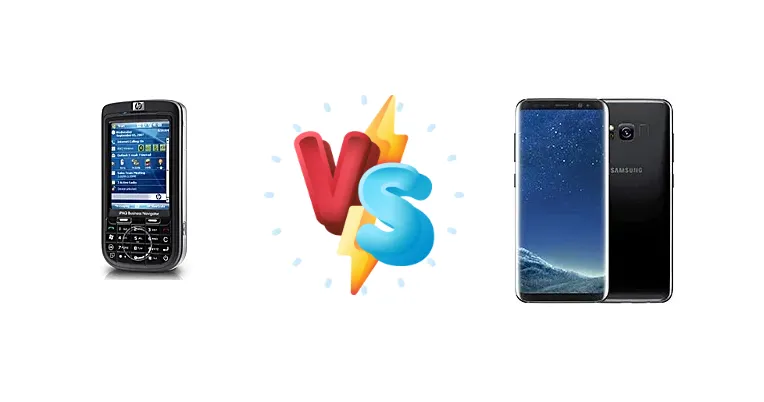
Comparing the HP iPAQ 610c, a representative of the early 2000s PDA era, to the 2017 Samsung Galaxy S8 is a study in mobile evolution. The iPAQ 610c, focused on productivity and basic connectivity, represents a pre-smartphone world. The Galaxy S8, with its expansive display and powerful chipset, embodies the modern smartphone experience. This comparison isn't about declaring a 'winner' in the traditional sense, but understanding the dramatic advancements in mobile computing over a decade and a half.
🏆 Quick Verdict
For the average user in 2024, the Samsung Galaxy S8 is the unequivocally superior device. Its Exynos 8895 (or Snapdragon 835) chipset delivers performance orders of magnitude beyond the iPAQ 610c’s Marvell PXA270, and its modern features like a high-resolution display, capable camera, and extensive app ecosystem make it far more versatile.
| Network |
|---|
| 2G bands | GSM 850 / 900 / 1800 / 1900 | GSM 850 / 900 / 1800 / 1900 - SIM 1 & SIM 2 (dual-SIM model only) |
| 3G bands | HSDPA 850 / 1900 / 2100 | HSDPA 850 / 900 / 1700(AWS) / 1900 / 2100 |
| 4G bands | - | 1, 2, 3, 4, 5, 7, 8, 12, 13, 17, 18, 19, 20, 25, 26, 28, 32, 66, 38, 39, 40, 41 |
| Speed | HSPA 7.2/0.384 Mbps | HSPA 42.2/5.76 Mbps, LTE (5CA) Cat16 1024/150 Mbps |
| Technology | GSM / HSPA | GSM / HSPA / LTE |
| Launch |
|---|
| Announced | 2007, September | 2017, March 29. Released 2017, April 24 |
| Status | Discontinued | Discontinued |
| Body |
|---|
| Build | - | Glass front (Gorilla Glass 5), glass back (Gorilla Glass 5), aluminum frame |
| Dimensions | 117 x 60.3 x 17.5 mm (4.61 x 2.37 x 0.69 in) | 148.9 x 68.1 x 8 mm (5.86 x 2.68 x 0.31 in) |
| SIM | Mini-SIM | · Nano-SIM· Nano-SIM + Nano-SIM |
| Weight | 145 g (5.11 oz) | 155 g (5.47 oz) |
| | - | IP68 dust/water resistant (up to 1.5m for 30 mins) |
| Display |
|---|
| Protection | - | Corning Gorilla Glass 5 |
| Resolution | 240 x 320 pixels, 4:3 ratio (~143 ppi density) | 1440 x 2960 pixels, 18.5:9 ratio (~570 ppi density) |
| Size | 2.8 inches, 24.3 cm2 (~34.4% screen-to-body ratio) | 5.8 inches, 84.8 cm2 (~83.6% screen-to-body ratio) |
| Type | TFT resistive touchscreen, 65K colors | Super AMOLED, HDR10 |
| | Smart Touch navigation wheel
3-way thumb wheel | 3D Touch (home button only)
Always-on display |
| Platform |
|---|
| CPU | Marvell PXA270 520 MHz | Octa-core (4x2.3 GHz Mongoose M2 & 4x1.7 GHz Cortex-A53) - EMEAOcta-core (4x2.35 GHz Kryo & 4x1.9 GHz Kryo) - USA & China |
| Chipset | - | Exynos 8895 (10 nm) - EMEAQualcomm MSM8998 Snapdragon 835 (10 nm) - USA & China |
| GPU | - | Mali-G71 MP20 - EMEAAdreno 540 - USA & China |
| OS | Microsoft Windows Mobile 6 Professional | Android 7.0 (Nougat), upgradable to Android 9.0 (Pie), One UI |
| Memory |
|---|
| Card slot | microSD (dedicated slot) | microSDXC (uses shared SIM slot) - dual SIM model only |
| Internal | 128MB RAM, 256MB ROM | 64GB 4GB RAM |
| | - | UFS 2.0 or UFS 2.1 |
| Main Camera |
|---|
| Features | LED flash | LED flash, auto-HDR, panorama |
| Single | 3.15 MP, AF | 12 MP, f/1.7, 26mm (wide), 1/2.55", 1.4µm, dual pixel PDAF, OIS |
| Video | QCIF | 4K@30fps, 1080p@30/60fps, 720p@240fps, HDR, stereo sound rec., gyro-EIS, OIS |
| Selfie camera |
|---|
| Dual | - | 8 MP, f/1.7, 25mm (wide), 1/3.6", 1.22µm, AF
2 MP (dedicated iris scanner camera) |
| Features | - | HDR |
| Video | - | 1440p@30fps |
| | No | - |
| Sound |
|---|
| 3.5mm jack | No | Yes |
| 35mm jack | No | Yes |
| Alert types | Vibration; Downloadable polyphonic, MP3, AAC ringtones | - |
| Loudspeaker | Yes | Yes |
| | - | 32-bit/384kHz audio
|
| Comms |
|---|
| Bluetooth | 2.0, A2DP | 5.0, A2DP, LE, aptX |
| NFC | - | Yes |
| Positioning | GPS, A-GPS | GPS, GLONASS, BDS, GALILEO |
| Radio | No | No |
| USB | 2.0 | USB Type-C 3.1 |
| WLAN | Wi-Fi 802.11b/g | Wi-Fi 802.11 a/b/g/n/ac, dual-band, Wi-Fi Direct |
| Features |
|---|
| Browser | WAP 2.0/xHTML, HTML (PocketIE) | - |
| Sensors | - | Iris scanner, fingerprint (rear-mounted), accelerometer, gyro, proximity, compass, barometer, heart rate, SpO2 |
| | Pocket Office
MP3/AAC/AAC+/WMA/OGG/AMR player
WMV/MP4 player
Predictive text input
Voice memo | Samsung DeX (desktop experience support)
ANT+
Bixby natural language commands and dictation
Samsung Pay (Visa, MasterCard certified) |
| Battery |
|---|
| Charging | - | 15W wired, QC2
Wireless (Qi) (market dependent) |
| Music play | - | Up to 67 h |
| Stand-by | Up to 250 h | - |
| Talk time | Up to 4 h | Up to 20 h (3G) |
| Type | Removable Li-Po 1590 mAh battery | Li-Ion 3000 mAh, non-removable (11.55 Wh) |
| Misc |
|---|
| Colors | Black | Midnight Black, Orchid Gray, Arctic Silver, Coral Blue, Maple Gold, Rose Pink, Burgundy Red |
| Models | - | SM-G950FD, SM-G950W, SM-G950S, SM-G950K, SM-G950L, SM-G9500, SM-G950A, SM-G950P, SM-G950T, SM-G950U, SM-G950V, SM-G950F, SM-G950U1, SM-G950N, SC-02J, SCV36, SM-G950, G950F |
| Price | About 170 EUR | About 230 EUR |
| SAR | - | 0.44 W/kg (head) 0.75 W/kg (body) |
| SAR EU | - | 0.32 W/kg (head) 1.27 W/kg (body) |
| Tests |
|---|
| Audio quality | - |
Noise -92.5dB / Crosstalk -92.8dB |
| Battery life | - | Endurance rating 84h |
| Camera | - |
Photo / Video |
| Display | - |
Contrast ratio: Infinite (nominal), 4.768 (sunlight) |
| Loudspeaker | - |
Voice 66dB / Noise 70dB / Ring 72dB |
| Performance | - |
AnTuTu: 199022 (v7)
GeekBench: 6656 (v4.4)
GFXBench: 13fps (ES 3.1 onscreen) |
HP iPAQ 610c
- Compact and lightweight design
- Simple and focused user interface
- Collectible vintage technology
- Extremely limited processing power
- Outdated operating system and software
- Poor display quality compared to modern standards
Samsung Galaxy S8
- Powerful processor and ample RAM
- High-resolution and vibrant display
- Advanced camera system with OIS
- Battery life, while good, is limited by age
- Software updates are no longer available
- May exhibit performance degradation due to age
Display Comparison
The iPAQ 610c’s display specifications are unavailable, but typical PDAs of the era featured resistive touchscreens with limited color palettes and resolutions. In stark contrast, the Galaxy S8 boasts an 'Infinite' contrast ratio (nominally 4.768 in sunlight) and a significantly higher resolution, offering a vibrant and immersive viewing experience. The S8’s display technology, likely Super AMOLED, provides superior color accuracy and viewing angles compared to the iPAQ’s likely LCD. The S8’s larger screen size also dramatically improves usability for media consumption and productivity.
Camera Comparison
The iPAQ 610c likely featured a low-resolution camera, if any, primarily for basic image capture. The Samsung Galaxy S8, on the other hand, offers a dedicated photo/video camera system with features like optical image stabilization (OIS) and advanced image processing. While specific sensor sizes and apertures aren’t provided, the S8’s camera is capable of capturing high-quality photos and videos in a variety of conditions, a capability entirely absent in the iPAQ 610c.
Performance
The Marvell PXA270 520 MHz CPU in the iPAQ 610c was adequate for its time, handling basic tasks like contact management and simple applications. However, it pales in comparison to the Samsung Galaxy S8’s Exynos 8895 (EMEA) or Qualcomm MSM8998 Snapdragon 835 (USA & China), both 10nm octa-core processors clocked up to 2.35 GHz. The S8’s chipset features significantly more processing power, enabling smooth multitasking, demanding gaming, and complex application execution. The S8’s architecture – a combination of Cortex-A53 and Mongoose M2 (or Kryo) cores – provides a balance of performance and efficiency, while the iPAQ’s single-core processor is limited in its ability to handle parallel processing.
Battery Life
The iPAQ 610c’s battery life is difficult to assess without specific data, but PDAs of that era typically offered several hours of use on a single charge. The Samsung Galaxy S8, with an endurance rating of 84 hours, provides significantly longer battery life. The S8 also supports 15W wired charging with Quick Charge 2 (QC2) and wireless charging (Qi), features unavailable on the iPAQ 610c. The S8’s more efficient chipset and larger battery capacity contribute to its superior battery performance.
Buying Guide
Buy the HP iPAQ 610c if you're a collector of vintage technology, interested in experiencing the roots of mobile computing, or require a simple, distraction-free device for basic note-taking and organization. Buy the Samsung Galaxy S8 if you need a fully-featured smartphone with access to modern apps, high-quality photography, and reliable connectivity for everyday tasks and entertainment.
Frequently Asked Questions
❓ Is the Samsung Galaxy S8 still secure to use in 2024, given its age?
Security is a concern with older devices like the Galaxy S8. Samsung no longer provides security updates, making it vulnerable to known exploits. Using it for sensitive data or online transactions is not recommended. Consider using a modern device with active security support.
❓ Can I still find replacement batteries for the HP iPAQ 610c?
Finding replacement batteries for the HP iPAQ 610c is challenging. They are largely discontinued and may only be available through specialized vintage electronics retailers or online auction sites. Battery health will likely be degraded in any available units.
❓ What kind of applications can the HP iPAQ 610c run?
The iPAQ 610c runs Windows Mobile, a predecessor to modern smartphone operating systems. It can run applications designed for that platform, which are primarily focused on productivity tasks like note-taking, contact management, and basic office applications. Modern app compatibility is non-existent.
❓ Does the Exynos 8895 in the Galaxy S8 suffer from overheating issues?
The Exynos 8895 variant of the Galaxy S8 was known to exhibit some thermal throttling under sustained heavy loads, such as prolonged gaming. While not a critical issue for typical use, it could lead to reduced performance during demanding tasks. The Snapdragon 835 variant generally performed better in this regard.