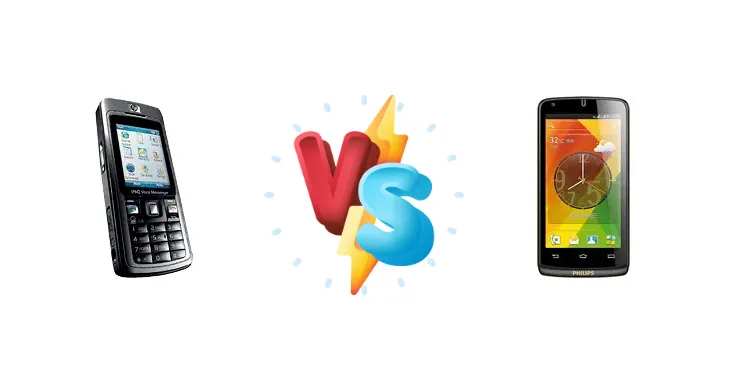
Comparing the HP iPAQ 514 and the Philips W7376 is akin to examining a pivotal shift in mobile computing. The iPAQ 514, representing the mature PDA era, relied on the efficient but limited TI OMAP 850 platform. The Philips W7376, arriving later, showcases the burgeoning smartphone landscape with its dual-core 1.2 GHz processor, signaling a move towards more complex and powerful mobile experiences.
🏆 Quick Verdict
For users prioritizing responsiveness and multitasking, the Philips W7376 is the clear winner. Its dual-core 1.2 GHz processor delivers significantly more processing power than the iPAQ 514’s 200 MHz ARM9, making it better suited for demanding applications and a smoother user experience. However, the iPAQ 514 remains a viable option for basic PDA functions.
| Network |
|---|
| 2G bands | GSM 850 / 900 / 1800 / 1900 | GSM 850 / 900 / 1800 / 1900 - SIM 1 & SIM 2 |
| 3G bands | - | HSDPA 850 / 2100 |
| EDGE | Class 10 | - |
| GPRS | Class 10 | - |
| Speed | - | HSPA 7.2/5.76 Mbps |
| Technology | GSM | GSM / HSPA |
| Launch |
|---|
| Announced | 2007, February | 2013, October. Released 2013, October |
| Status | Discontinued | Discontinued |
| Body |
|---|
| Dimensions | 107 x 48.6 x 16.3 mm (4.21 x 1.91 x 0.64 in) | 129 x 66.7 x 9.9 mm (5.08 x 2.63 x 0.39 in) |
| SIM | Mini-SIM | Dual SIM (Mini-SIM, dual stand-by) |
| Weight | 102 g (3.60 oz) | 172 g (6.07 oz) |
| Display |
|---|
| Resolution | 176 x 220 pixels (~141 ppi density) | 540 x 960 pixels, 16:9 ratio (~256 ppi density) |
| Size | 2.0 inches, 12.6 cm2 (~24.2% screen-to-body ratio) | 4.3 inches, 51.0 cm2 (~59.2% screen-to-body ratio) |
| Type | TFT, 65K colors | TFT |
| Platform |
|---|
| CPU | 200 MHz ARM926EJ-S | Dual-core 1.2 GHz |
| Chipset | TI OMAP 850 | - |
| OS | Microsoft Windows Mobile 6.0 Standard | Android 4.0.4 (Ice Cream Sandwich) |
| Memory |
|---|
| Card slot | microSD (dedicated slot) | microSDHC (dedicated slot) |
| Internal | 64MB RAM, 128MB ROM | 4GB |
| Main Camera |
|---|
| Features | - | LED flash |
| Single | 1.3 MP | 5 MP, AF |
| Video | Yes | Yes |
| Selfie camera |
|---|
| Single | - | Yes |
| | No | - |
| Sound |
|---|
| 3.5mm jack | No | Yes |
| 35mm jack | No | Yes |
| Alert types | Vibration; Downloadable polyphonic, MP3, AAC ringtones | - |
| Loudspeaker | Yes | Yes |
| Comms |
|---|
| Bluetooth | 1.2 | 3.0, A2DP |
| NFC | - | No |
| Positioning | No | GPS |
| Radio | No | No |
| USB | miniUSB | microUSB 2.0 |
| WLAN | Wi-Fi 802.11b/g | Wi-Fi 802.11 b/g |
| Features |
|---|
| Browser | WAP 2.0/xHTML, HTML (PocketIE) | - |
| Sensors | - | Accelerometer |
| | Pocket Office
MP3/AAC/AAC+/WMA/OGG/AMR player
WMV/MP4 player
Predictive text input
Voice memo | - |
| Battery |
|---|
| Stand-by | Up to 188 h | - |
| Talk time | Up to 6 h 30 min | Up to 10 h |
| Type | Removable Li-Ion 1100 mAh battery | Li-Ion 2400 mAh, removable |
| Misc |
|---|
| Colors | Black | Black/Silver |
| Price | About 90 EUR | - |
HP iPAQ 514
- Excellent power efficiency due to the ARM9 processor.
- Compact and lightweight design, typical of PDAs.
- Reliable for basic PDA functions like note-taking and contact management.
- Limited processing power for demanding applications.
- Poor multitasking capabilities.
- Outdated technology compared to the Philips W7376.
Philips W7376
- Significantly faster processing speed with the dual-core 1.2 GHz processor.
- Improved multitasking capabilities.
- More modern smartphone-like experience.
- Potentially shorter battery life due to the more powerful processor.
- Likely larger and heavier than the iPAQ 514.
- May suffer from thermal throttling under sustained load.
Display Comparison
Information regarding the displays of both devices is unavailable. However, given the iPAQ 514’s era, it likely featured a resistive touchscreen with a relatively low resolution. The Philips W7376, being a later model, may have incorporated a capacitive touchscreen and a higher resolution display, offering improved clarity and responsiveness. The iPAQ 514’s display was optimized for stylus input, while the W7376 likely aimed for more direct finger interaction.
Camera Comparison
Details regarding camera specifications are unavailable for both devices. However, PDAs of the iPAQ 514’s generation rarely included high-quality cameras; any camera present would have been low-resolution and primarily for basic image capture. The Philips W7376, being a later model, likely featured a more capable camera, though still limited by the technology of the time. Image processing capabilities would have been significantly more advanced on the W7376.
Performance
The core difference lies in the processors. The HP iPAQ 514’s 200 MHz ARM926EJ-S chipset, while efficient, is fundamentally limited in its processing capabilities. It excels at single-threaded tasks but struggles with multitasking. Conversely, the Philips W7376’s dual-core 1.2 GHz processor represents a substantial leap forward. The dual-core architecture allows for parallel processing, significantly improving performance in multi-threaded applications and enabling smoother multitasking. The higher clock speed further amplifies this advantage. The iPAQ 514’s OMAP 850 likely used slower memory interfaces compared to the W7376, further widening the performance gap.
Battery Life
Battery life is difficult to compare without specific mAh ratings. The iPAQ 514’s ARM9 processor is inherently more power-efficient than the W7376’s dual-core 1.2 GHz processor. However, the W7376’s larger processing capacity might necessitate a larger battery to compensate. Charging times would have been significantly longer for both devices compared to modern smartphones, and the W7376’s more complex power management system might have introduced additional charging overhead.
Buying Guide
Buy the HP iPAQ 514 if you need a reliable, compact device for basic note-taking, contact management, and simple scheduling – a true digital assistant focused on core PDA tasks. Buy the Philips W7376 if you prefer a device capable of running more complex applications, handling multitasking with ease, and offering a more modern smartphone-like experience, even if it comes at the cost of potentially reduced battery life due to the more powerful processor.
Frequently Asked Questions
❓ Will the HP iPAQ 514 struggle with modern applications, even emulated ones?
Yes, the iPAQ 514’s 200 MHz ARM9 processor is severely underpowered for even basic modern applications. While emulation might be possible for very simple software, performance will be extremely slow and frustrating. It’s best suited for applications designed for its original platform.
❓ Is the dual-core processor in the Philips W7376 enough to handle any current mobile games?
No, the Philips W7376’s 1.2 GHz dual-core processor, while a significant improvement over the iPAQ 514, is still far too weak to run modern mobile games. Even older, less demanding games will likely experience significant performance issues. It was designed for applications available during its release period.
❓ What kind of storage options were available for these devices?
The iPAQ 514 likely utilized CompactFlash (CF) cards for storage expansion, a common standard at the time. The Philips W7376 may have used microSD cards, offering a smaller and more convenient storage solution. Internal storage capacity would have been limited on both devices.