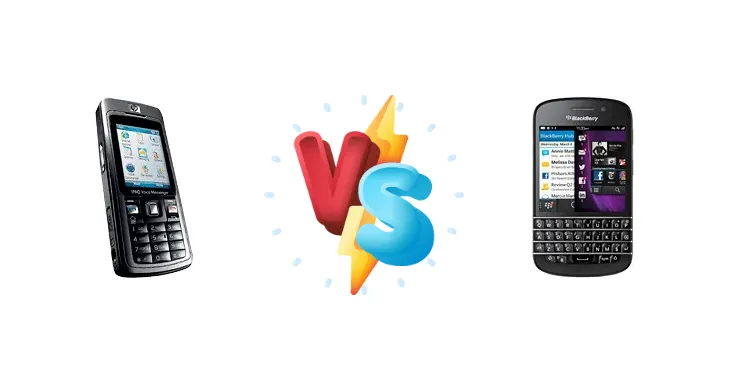
The HP iPAQ 514 and BlackBerry Q10 represent vastly different eras of mobile computing. The iPAQ, a relic of the Pocket PC age, prioritized personal information management and basic connectivity. The Q10, arriving much later, aimed to bridge the gap between a traditional smartphone and a physical keyboard experience. This comparison isn't about a direct contest of specs, but understanding how far mobile technology has advanced and who each device still serves today.
🏆 Quick Verdict
For the average user in 2024, the BlackBerry Q10 is the clear winner. Its Snapdragon S4 chipset offers significantly more processing power, a functional camera, and a vastly superior user experience. While the iPAQ 514 holds historical value, its limited capabilities make it impractical for modern use.
| Network |
|---|
| 2G bands | GSM 850 / 900 / 1800 / 1900 | GSM 850 / 900 / 1800 / 1900 - all versions |
| 3G bands | - | HSDPA 850 / 1900 / 2100 - SQN100-1 |
| 4G bands | - | 2, 4, 5, 17 - SQN100-1, SQN100-5 |
| EDGE | Class 10 | - |
| GPRS | Class 10 | - |
| Speed | - | EV-DO Rev.A 3.1 Mbps, HSPA, LTE (market dependent) |
| Technology | GSM | GSM / CDMA / HSPA / LTE |
| | - | 25 - SQN100-4 |
| Launch |
|---|
| Announced | 2007, February | 2013, January. Released 2013, April |
| Status | Discontinued | Discontinued |
| Body |
|---|
| Build | - | Glass front, plastic back, plastic frame |
| Dimensions | 107 x 48.6 x 16.3 mm (4.21 x 1.91 x 0.64 in) | 119.6 x 66.8 x 10.4 mm (4.71 x 2.63 x 0.41 in) |
| Keyboard | - | QWERTY |
| SIM | Mini-SIM | Micro-SIM |
| Weight | 102 g (3.60 oz) | 139 g (4.90 oz) |
| Display |
|---|
| Resolution | 176 x 220 pixels (~141 ppi density) | 720 x 720 pixels, 1:1 ratio (~328 ppi density) |
| Size | 2.0 inches, 12.6 cm2 (~24.2% screen-to-body ratio) | 3.1 inches, 31.0 cm2 (~38.8% screen-to-body ratio) |
| Type | TFT, 65K colors | Super AMOLED |
| Platform |
|---|
| CPU | 200 MHz ARM926EJ-S | Dual-core 1.5 GHz Krait (LTE version)/ Cortex-A9 (Non-LTE) |
| Chipset | TI OMAP 850 | Snapdragon S4 (LTE version)/ TI OMAP 4470 (Non-LTE) |
| GPU | - | Adreno 225 (LTE version)/ PowerVR SGX544 (Non-LTE) |
| OS | Microsoft Windows Mobile 6.0 Standard | BlackBerry OS 10, upgradable to 10.3.1 |
| Memory |
|---|
| Card slot | microSD (dedicated slot) | microSDXC (dedicated slot) |
| Internal | 64MB RAM, 128MB ROM | 16GB 2GB RAM |
| Main Camera |
|---|
| Features | - | LED flash, HDR, panorama |
| Single | 1.3 MP | 8 MP, f/2.2, 31mm (standard), AF |
| Video | Yes | 1080p@30fps |
| Selfie camera |
|---|
| Single | - | 2 MP |
| Video | - | 720p |
| | No | - |
| Sound |
|---|
| 3.5mm jack | No | Yes |
| 35mm jack | No | Yes |
| Alert types | Vibration; Downloadable polyphonic, MP3, AAC ringtones | - |
| Loudspeaker | Yes | Yes |
| Comms |
|---|
| Bluetooth | 1.2 | 4.0, A2DP |
| NFC | - | Yes |
| Positioning | No | GPS |
| Radio | No | FM radio (after SW upgrade) |
| USB | miniUSB | microUSB 2.0 |
| WLAN | Wi-Fi 802.11b/g | Wi-Fi 802.11 a/b/g/n, dual band, hotspot |
| Features |
|---|
| Browser | WAP 2.0/xHTML, HTML (PocketIE) | - |
| Sensors | - | Accelerometer, gyro, proximity, compass |
| | Pocket Office
MP3/AAC/AAC+/WMA/OGG/AMR player
WMV/MP4 player
Predictive text input
Voice memo | HDMI port |
| Battery |
|---|
| Stand-by | Up to 188 h | Up to 360 h (3G) |
| Talk time | Up to 6 h 30 min | Up to 10 h (2G) / Up to 13 h 30 min (3G) |
| Type | Removable Li-Ion 1100 mAh battery | Li-Ion 2100 mAh, removable |
| Misc |
|---|
| Colors | Black | Black, White |
| Price | About 90 EUR | About 110 EUR |
| SAR | - | 1.16 W/kg (head) 0.75 W/kg (body) |
| SAR EU | - | 1.41 W/kg (head) 0.78 W/kg (body) |
| Tests |
|---|
| Audio quality | - |
Noise -89.6dB / Crosstalk -82.7dB |
| Battery life | - |
Endurance rating 56h
|
| Camera | - |
Photo / Video |
| Display | - |
Contrast ratio: Infinite (nominal) / 2.856:1 (sunlight) |
| Loudspeaker | - |
Voice 69dB / Noise 66dB / Ring 75dB
|
HP iPAQ 514
- Historical significance and collectibility
- Compact size and lightweight design
- Simple and focused operating system (Windows Mobile)
- Extremely limited processing power
- Outdated display technology
- Poor camera capabilities (if present)
- Limited app compatibility
BlackBerry Q10
- Physical QWERTY keyboard for efficient typing
- More powerful Snapdragon S4 processor
- Functional camera for photos and videos
- Longer battery life
- More secure BlackBerry OS
- BlackBerry OS app ecosystem is limited
- Device is discontinued and support is limited
- May require sourcing a replacement battery
Display Comparison
The BlackBerry Q10 boasts a display with an infinite (nominal) contrast ratio and 2.856:1 in sunlight, suggesting a reasonably viewable screen even outdoors. The iPAQ 514’s display specifications are not provided, but typical of Pocket PCs of the era, it would have been a smaller, lower-resolution LCD with significantly lower brightness and contrast. The Q10’s larger screen size and superior contrast make it far more usable for reading and media consumption. The Q10's display technology, while not cutting-edge even at its release, is a generation ahead of what the iPAQ could offer.
Camera Comparison
The BlackBerry Q10 includes both photo and video capabilities, a feature largely absent or extremely limited in devices like the iPAQ 514. While the Q10’s camera isn’t a standout performer by today’s standards, it provides a functional way to capture images and videos. The iPAQ 514, if equipped with a camera (many models weren't), would have offered extremely low resolution and poor image quality. The Q10’s camera represents a significant leap in mobile photography.
Performance
The performance disparity is substantial. The HP iPAQ 514’s 200 MHz ARM926EJ-S CPU is dwarfed by the BlackBerry Q10’s Snapdragon S4 (either dual-core 1.5 GHz Krait for LTE versions or Cortex-A9 for non-LTE). The Snapdragon S4, built on a more advanced process node, delivers significantly faster processing speeds and improved graphics performance. This translates to a responsive user interface on the Q10, while the iPAQ 514 would struggle with even basic multitasking. The Q10’s architecture allows for a more fluid experience with modern apps (though compatibility remains a challenge).
Battery Life
The BlackBerry Q10’s endurance rating of 56 hours is impressive, indicating a well-optimized power management system. The iPAQ 514’s battery life, while decent for its time, would be significantly shorter due to its less efficient processor and smaller battery capacity. The Q10’s longer battery life allows for extended use without frequent charging, a crucial advantage for users who rely on their devices throughout the day. The Q10’s battery performance is a direct result of the more efficient Snapdragon chipset.
Buying Guide
Buy the HP iPAQ 514 if you are a collector of vintage technology, a retro-computing enthusiast, or require a device for specific legacy applications that only run on Windows Mobile. Buy the BlackBerry Q10 if you prioritize a physical keyboard for efficient typing, a more modern operating system, and basic smartphone functionality like web browsing and photography, and appreciate a unique, secure platform.
Frequently Asked Questions
❓ Can the BlackBerry Q10 still be used with modern mobile networks?
The LTE version of the BlackBerry Q10 supports 4G LTE, but compatibility with newer 5G networks is not available. Depending on your carrier, 3G support may also be phasing out, potentially limiting its usability. However, it can still connect to Wi-Fi networks for data access.
❓ Is it possible to install Android on the BlackBerry Q10?
While there have been attempts to port Android to the BlackBerry Q10, the process is complex and often results in an unstable and incomplete experience. The hardware differences and lack of official support make a fully functional Android port challenging.
❓ What kind of storage does the HP iPAQ 514 use, and is it expandable?
The HP iPAQ 514 typically used CompactFlash (CF) cards for storage, which were expandable. However, CF cards are becoming increasingly rare and expensive. Finding compatible storage can be a challenge.
❓ What are the security advantages of the BlackBerry Q10's operating system?
BlackBerry OS was renowned for its security features, including hardware-based encryption and a secure boot process. This made the Q10 a popular choice for security-conscious users and organizations. While not impervious, it offered a higher level of security than many contemporary smartphones.