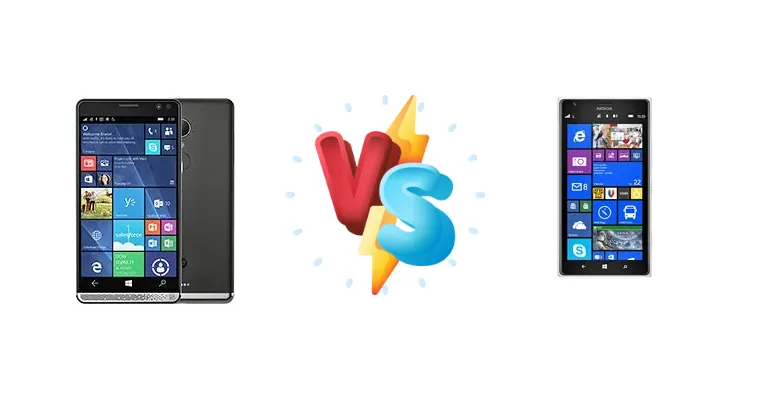
The HP Elite x3 and Nokia Lumia 1520 represent peak Windows Phone hardware, released in 2016 and 2013 respectively. While both aimed for the high-end, they took different approaches. The Lumia 1520 prioritized battery life and a large display, while the Elite x3 focused on a more compact form factor and a newer Snapdragon chipset. This comparison revisits these devices to determine which offered the better experience, and how they hold up today.
🏆 Quick Verdict
For the average user seeking a functional, albeit dated, Windows Phone experience, the Nokia Lumia 1520 is the better choice. Its exceptional 107-hour endurance rating significantly outweighs the Elite x3’s marginal performance gains from the Snapdragon 820, especially considering both devices are limited by the Windows Phone ecosystem.
| Network |
|---|
| 2G bands | GSM 850 / 900 / 1800 / 1900 - SIM 1 & SIM 2 (dual-SIM model only) | GSM 850 / 900 / 1800 / 1900 - all versions |
| 3G bands | HSDPA 850 / 900 / 1700(AWS) / 1900 / 2100 | HSDPA 850 / 900 / 1900 / 2100 - RM-937, RM-939, RM-940 |
| 4G bands | 1, 2, 3, 4, 5, 7, 8, 12, 17, 19, 20, 26, 28, 29, 38, 39, 40, 41 - EMEA | 1, 3, 7, 8, 20 - RM-937 |
| Speed | HSPA 21.1/5.76 Mbps, LTE Cat6 300/50 Mbps | HSPA 42.2/5.76 Mbps, LTE Cat4 150/50 Mbps |
| Technology | GSM / HSPA / LTE | GSM / HSPA / LTE |
| | 1, 2, 3, 4, 5, 7, 12, 17, 20, 29, 30 - Americas | 2, 4, 5, 7, 17 - RM-938, RM-940 |
| Launch |
|---|
| Announced | 2016, February. Released 2016, August | 2013, October. Released 2013, November |
| Status | Discontinued | Discontinued |
| Body |
|---|
| Dimensions | 161.8 x 83.5 x 7.8 mm (6.37 x 3.29 x 0.31 in) | 162.8 x 85.4 x 8.7 mm, 120.3 cc (6.41 x 3.36 x 0.34 in) |
| SIM | · Nano-SIM· Nano-SIM + Nano-SIM | Nano-SIM |
| Weight | 195 g (6.88 oz) | 209 g (7.37 oz) |
| | IP67 dust/water resistant (up to 1m for 30 mins)
MIL-STD-810G compliant*
*does not guarantee ruggedness or use in extreme conditions | - |
| Display |
|---|
| Protection | Corning Gorilla Glass 4 | Corning Gorilla Glass 2 |
| Resolution | 1440 x 2560 pixels, 16:9 ratio (~494 ppi density) | 1080 x 1920 pixels, 16:9 ratio (~367 ppi density) |
| Size | 5.96 inches, 97.5 cm2 (~72.2% screen-to-body ratio) | 6.0 inches, 99.2 cm2 (~71.4% screen-to-body ratio) |
| Type | AMOLED, 350 nits (typ) | IPS LCD |
| | - | ClearBlack display |
| Platform |
|---|
| CPU | Quad-core (2x2.15 GHz Kryo & 2x1.6 GHz Kryo) | Quad-core 2.2 GHz Krait 400 |
| Chipset | Qualcomm MSM8996 Snapdragon 820 (14 nm) | Qualcomm MSM8974 Snapdragon 800 (28 nm) |
| GPU | Adreno 530 | Adreno 330 |
| OS | Microsoft Windows 10 | Microsoft Windows Phone 8, upgradable to Windows 10 |
| Memory |
|---|
| Card slot | microSDXC (uses shared SIM slot) - dual SIM model only | microSDXC (dedicated slot) |
| Internal | 64GB 4GB RAM | 16GB 2GB RAM, 32GB 2GB RAM |
| | eMMC 5.1 | eMMC 4.5 |
| Main Camera |
|---|
| Features | LED flash, HDR, panorama | Zeiss optics, dual-LED flash, panorama |
| Single | 16 MP, f/2.2, 1.31µm, PDAF | 20 MP, f/2.4, 26mm (wide), 1/2.5", 1.12µm, AF, OIS |
| Video | 4K@30fps, 1080p@30fps | 4K@30fps (after WP8 Denim update), 1080p@30fps, stereo sound rec. |
| Selfie camera |
|---|
| Single | 8 MP, f/2.2, 1/4.0", 1.12µm | 1.2 MP, f/2.4 |
| Video | 1080p@30fps | 720p@30fps |
| Sound |
|---|
| 3.5mm jack | Yes | Yes |
| 35mm jack | Yes | Yes |
| Loudspeaker | Yes, with stereo speakers | Yes |
| | Tuned by Bang & Olufsen
| - |
| Comms |
|---|
| Bluetooth | 4.0, A2DP, LE | 4.0, A2DP, EDR, LE/ aptX after WP8 Denim update |
| NFC | Yes | Yes |
| Positioning | GPS, GLONASS, BDS | GPS, GLONASS |
| Radio | No | FM radio |
| USB | USB Type-C 3.0, magnetic connector | microUSB 2.0 |
| WLAN | Wi-Fi 802.11 a/b/g/n/ac, dual-band, hotspot | Wi-Fi 802.11 a/b/g/n/ac, dual-band, hotspot |
| Features |
|---|
| Sensors | Iris scanner, fingerprint (rear-mounted), accelerometer, gyro, proximity, compass, barometer | Accelerometer, gyro, proximity, compass, sensor core |
| | Microsoft Continuum support | - |
| Battery |
|---|
| Charging | 10W wired
Wireless (Qi) | Wireless (Qi) |
| Music play | - | Up to 124 h |
| Stand-by | - | Up to 768 h (2G) / Up to 768 h (3G) |
| Talk time | - | Up to 27 h 40 min (2G) / Up to 25 h (3G) |
| Type | Li-Po 4150 mAh, non-removable | Li-Ion 3400 mAh, non-removable (BV-4BW) |
| Misc |
|---|
| Colors | Gold, Graphite/Chrome | Yellow, white, black, red, green (AT&T) |
| Price | About 700 EUR | About 350 EUR |
| SAR EU | - | 0.64 W/kg (head) 0.20 W/kg (body) |
| Tests |
|---|
| Audio quality | - |
Noise -89.3dB / Crosstalk -89.4dB |
| Battery life | - |
Endurance rating 107h
|
| Camera | - |
Photo / Video |
| Display | - |
Contrast ratio: 1207:1 (nominal) / 1.813:1 (sunlight) |
| Loudspeaker | - |
Voice 73dB / Noise 66dB / Ring 74dB
|
HP Elite x3
- More modern Snapdragon 820 processor
- Compact and pocketable design
- Qi wireless charging support
- Significantly shorter battery life
- Limited real-world performance gain over the Lumia 1520
- Smaller display
Nokia Lumia 1520
- Exceptional 107-hour battery life
- Large 6-inch display for media consumption
- Proven reliability and image quality
- Older Snapdragon 800 processor
- Larger and less pocketable design
- Less efficient chipset
Display Comparison
Both devices feature similar contrast ratios of 1207:1 (nominal) and 1.813:1 (sunlight), suggesting comparable outdoor visibility. However, the Lumia 1520’s 6-inch display dwarfs the Elite x3’s 5.96-inch screen, offering a more immersive experience for video playback. While neither device boasts modern features like high refresh rates or LTPO technology, the larger canvas of the Lumia 1520 is a clear advantage for content consumption.
Camera Comparison
Both devices offer photo and video capabilities, but detailed camera specs are limited in the provided data. The Lumia 1520, known for its excellent image processing in its time, likely benefits from Nokia’s software optimizations. Without specific sensor size or aperture information, it’s difficult to definitively declare a winner. However, the Lumia 1520’s reputation for consistent image quality gives it a slight edge. The Elite x3’s newer processor *could* enable faster image processing, but this is dependent on software implementation.
Performance
The HP Elite x3’s Qualcomm MSM8996 Snapdragon 820, built on a 14nm process, represents a significant architectural leap over the Nokia Lumia 1520’s Snapdragon 800 (28nm). The 820’s Kryo cores (2x2.15 GHz & 2x1.6 GHz) offer improved per-core performance and efficiency compared to the 800’s 2.2 GHz Krait 400 cores. This translates to faster app loading times and smoother multitasking on the Elite x3. However, the real-world performance difference within the constraints of Windows Phone 8.1/10 is likely to be minimal for most users. The 28nm process of the Snapdragon 800 is less efficient, potentially leading to more heat generation under sustained load.
Battery Life
The Nokia Lumia 1520’s standout feature is its incredible 107-hour endurance rating. This is a testament to its large battery capacity and the efficiency of the Snapdragon 800 in handling the Windows Phone OS. The HP Elite x3, with its 10W wired and Qi wireless charging, offers convenience, but cannot compete with the sheer longevity of the Lumia 1520. While the Snapdragon 820 is more power-efficient than the 800, the difference isn’t enough to overcome the Lumia 1520’s substantial battery advantage.
Buying Guide
Buy the HP Elite x3 if you need a more modern processor for potential experimentation with alternative OS ports (though success is not guaranteed) and prefer a smaller, more pocketable device. Buy the Nokia Lumia 1520 if you prioritize all-day, and even multi-day, battery life, a large screen for media consumption, and a proven track record of reliability within the Windows Phone environment.
Frequently Asked Questions
❓ Is the Snapdragon 820 in the HP Elite x3 powerful enough to run modern Android ROMs smoothly?
While the Snapdragon 820 is a capable chip, successfully porting and running a modern Android ROM on the Elite x3 is highly dependent on developer support and optimization. Expect significant bugs and performance limitations even if a functional ROM is available. The device was not designed for Android, and driver compatibility is a major hurdle.
❓ How does the wireless charging on both devices compare in terms of speed?
Both the HP Elite x3 and Nokia Lumia 1520 support Qi wireless charging, but at the time of their release, wireless charging standards were less advanced. Expect relatively slow charging speeds compared to modern devices – likely around 5-7W for both. The Elite x3’s 10W wired charging is faster, but the Lumia 1520’s battery life minimizes the need for frequent charging.
❓ Given the age of both devices, are replacement batteries readily available?
Finding replacement batteries for either device is becoming increasingly difficult. While some third-party options may exist, their quality and reliability are questionable. The Lumia 1520’s original battery was known for its longevity, but after a decade, replacement is likely necessary for optimal performance.