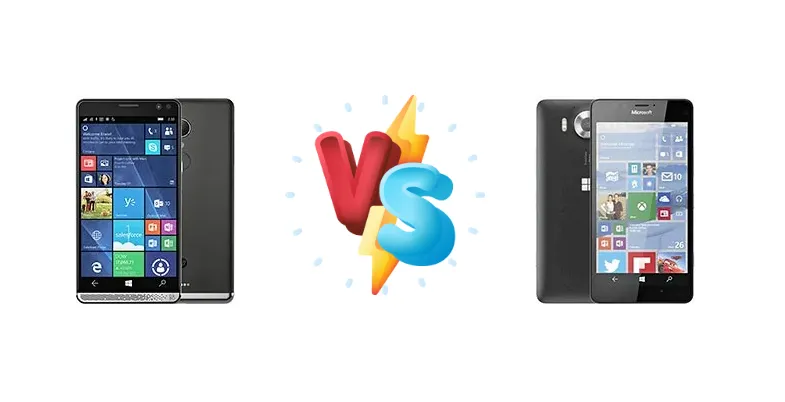
Released in 2016, the HP Elite x3 and Microsoft Lumia 950 Dual SIM represent the pinnacle of Windows 10 Mobile hardware. While both aimed for the high-end, they took different approaches. The Elite x3 focused on business productivity and a unique Continuum experience, while the Lumia 950 prioritized camera capabilities and a more traditional smartphone form factor. This comparison dissects their core differences, particularly their Snapdragon processors and charging technologies.
🏆 Quick Verdict
For the average user seeking a functional device from this era, the HP Elite x3 emerges as the slightly better choice. Its Snapdragon 820 offers a noticeable performance advantage over the 808 in the Lumia 950, and the inclusion of Qi wireless charging adds convenience. However, the Lumia 950’s faster wired charging is a compelling counterpoint.
| Network |
|---|
| 2G bands | GSM 850 / 900 / 1800 / 1900 - SIM 1 & SIM 2 (dual-SIM model only) | GSM 850 / 900 / 1800 / 1900 - SIM 1 & SIM 2 |
| 3G bands | HSDPA 850 / 900 / 1700(AWS) / 1900 / 2100 | HSDPA 850 / 900 / 1700(AWS) / 1900 / 2100 |
| 4G bands | 1, 2, 3, 4, 5, 7, 8, 12, 17, 19, 20, 26, 28, 29, 38, 39, 40, 41 - EMEA | 1, 2, 3, 4, 5, 7, 8, 12, 17, 20, 28, 38, 40 |
| Speed | HSPA 21.1/5.76 Mbps, LTE Cat6 300/50 Mbps | HSPA 42.2/5.76 Mbps, LTE Cat4 150/50 Mbps |
| Technology | GSM / HSPA / LTE | GSM / HSPA / LTE |
| | 1, 2, 3, 4, 5, 7, 12, 17, 20, 29, 30 - Americas | - |
| Launch |
|---|
| Announced | 2016, February. Released 2016, August | 2015, October. Released 2015, December |
| Status | Discontinued | Discontinued |
| Body |
|---|
| Dimensions | 161.8 x 83.5 x 7.8 mm (6.37 x 3.29 x 0.31 in) | 145 x 73.2 x 8.2 mm (5.71 x 2.88 x 0.32 in) |
| SIM | · Nano-SIM· Nano-SIM + Nano-SIM | Nano-SIM + Nano-SIM |
| Weight | 195 g (6.88 oz) | 150 g (5.29 oz) |
| | IP67 dust/water resistant (up to 1m for 30 mins)
MIL-STD-810G compliant*
*does not guarantee ruggedness or use in extreme conditions | - |
| Display |
|---|
| Protection | Corning Gorilla Glass 4 | Corning Gorilla Glass 3 |
| Resolution | 1440 x 2560 pixels, 16:9 ratio (~494 ppi density) | 1440 x 2560 pixels, 16:9 ratio (~565 ppi density) |
| Size | 5.96 inches, 97.5 cm2 (~72.2% screen-to-body ratio) | 5.2 inches, 74.5 cm2 (~70.2% screen-to-body ratio) |
| Type | AMOLED, 350 nits (typ) | AMOLED |
| | - | ClearBlack display |
| Platform |
|---|
| CPU | Quad-core (2x2.15 GHz Kryo & 2x1.6 GHz Kryo) | Hexa-core (4x1.4 GHz Cortex-A53 & 2x1.8 GHz Cortex-A57) |
| Chipset | Qualcomm MSM8996 Snapdragon 820 (14 nm) | Qualcomm MSM8992 Snapdragon 808 (20 nm) |
| GPU | Adreno 530 | Adreno 418 |
| OS | Microsoft Windows 10 | Microsoft Windows 10 |
| Memory |
|---|
| Card slot | microSDXC (uses shared SIM slot) - dual SIM model only | microSDXC (dedicated slot) |
| Internal | 64GB 4GB RAM | 32GB 3GB RAM |
| | eMMC 5.1 | eMMC 5.0 |
| Main Camera |
|---|
| Features | LED flash, HDR, panorama | Zeiss optics, triple-LED RGB flash, panorama, HDR |
| Single | 16 MP, f/2.2, 1.31µm, PDAF | 20 MP, f/1.9, 26mm (wide), 1/2.4", 1.12µm, AF, OIS |
| Video | 4K@30fps, 1080p@30fps | 4K@30fps, stereo sound rec., 1080p@30/60fps (after SW update) |
| Selfie camera |
|---|
| Single | 8 MP, f/2.2, 1/4.0", 1.12µm | 5 MP, f/2.4 |
| Video | 1080p@30fps | 1080p@30fps |
| Sound |
|---|
| 3.5mm jack | Yes | Yes |
| 35mm jack | Yes | Yes |
| Loudspeaker | Yes, with stereo speakers | Yes |
| | Tuned by Bang & Olufsen
| - |
| Comms |
|---|
| Bluetooth | 4.0, A2DP, LE | 4.1, A2DP |
| NFC | Yes | Yes |
| Positioning | GPS, GLONASS, BDS | GPS, GLONASS, BDS |
| Radio | No | FM radio |
| USB | USB Type-C 3.0, magnetic connector | USB Type-C 3.1 |
| WLAN | Wi-Fi 802.11 a/b/g/n/ac, dual-band, hotspot | Wi-Fi 802.11 a/b/g/n/ac, dual-band, hotspot |
| Features |
|---|
| Sensors | Iris scanner, fingerprint (rear-mounted), accelerometer, gyro, proximity, compass, barometer | Iris scanner, accelerometer, gyro, proximity, compass, barometer, sensor core |
| | Microsoft Continuum support | Microsoft Continuum support |
| Battery |
|---|
| Charging | 10W wired
Wireless (Qi) | 18W wired
Wireless (Qi) |
| Music play | - | Up to 67 h |
| Stand-by | - | Up to 288 h (2G) / Up to 288 h (3G) |
| Talk time | - | Up to 23 h (2G) / Up to 18 h (3G) |
| Type | Li-Po 4150 mAh, non-removable | Li-Ion 3000 mAh, removable |
| Misc |
|---|
| Colors | Gold, Graphite/Chrome | Black, White |
| Price | About 700 EUR | About 280 EUR |
HP Elite x3
- Faster Snapdragon 820 processor for smoother performance.
- More efficient 14nm manufacturing process.
- Qi Wireless Charging for added convenience.
- Slower 10W wired charging.
- Likely less impressive camera system compared to the Lumia 950.
Microsoft Lumia 950 Dual SIM
- Faster 18W wired charging for quicker top-ups.
- Potentially superior camera performance.
- Dual SIM functionality for travelers.
- Less powerful Snapdragon 808 processor.
- Less efficient 20nm manufacturing process.
Display Comparison
Display specifications are not provided, but given the release timeframe, both likely featured 5.5-6 inch AMOLED displays with 1080p resolution. The Elite x3, being a business-focused device, may have prioritized color accuracy for document viewing, while the Lumia 950 likely tuned its display for vibrant image reproduction. Bezels were typical for 2016, and neither device would compete with modern edge-to-edge designs.
Camera Comparison
Camera details are limited, but the Lumia 950 was marketed heavily for its camera prowess. While sensor sizes aren't specified, the Lumia 950 likely featured a larger sensor and more advanced image processing algorithms than the Elite x3. The Lumia 950’s emphasis on camera features suggests a stronger focus on low-light performance and image detail. The Elite x3’s camera was likely adequate for business use, such as document scanning, but wouldn’t compete with the Lumia 950 in photographic quality.
Performance
The core difference lies in the chipsets. The HP Elite x3’s Qualcomm MSM8996 Snapdragon 820, built on a 14nm process, boasts a quad-core CPU with a Kryo architecture (2x2.15 GHz & 2x1.6 GHz). This architecture provides a performance uplift over the older Snapdragon 808. The Lumia 950’s MSM8992 Snapdragon 808, fabricated on a larger 20nm node, uses a hexa-core configuration (4x1.4 GHz Cortex-A53 & 2x1.8 GHz Cortex-A57). While the 808’s six cores might seem advantageous, the 820’s Kryo cores are more efficient and deliver superior single-core performance, crucial for responsive UI and application loading. The 14nm process also contributes to better thermal management, potentially reducing throttling during sustained workloads. Users prioritizing multitasking and demanding applications will see a tangible benefit from the Elite x3’s processor.
Battery Life
Battery capacities are not provided. However, the charging speeds reveal a key difference. The Lumia 950 supports 18W wired charging, significantly faster than the Elite x3’s 10W. Both support Qi wireless charging, offering convenience, but the wired charging speed gives the Lumia 950 an advantage for quick top-ups. The Snapdragon 808’s less efficient 20nm process might necessitate a larger battery to achieve comparable battery life to the Elite x3, despite the slower charging speed.
Buying Guide
Buy the HP Elite x3 if you need a robust device for business tasks, value the Continuum desktop experience, and prioritize overall performance. Its Snapdragon 820 will handle multitasking and demanding applications more smoothly. Buy the Microsoft Lumia 950 Dual SIM if you prioritize camera quality, require faster wired charging, and prefer a more conventional smartphone experience. The Lumia 950’s camera system, while aging, still holds up reasonably well for casual photography.
Frequently Asked Questions
❓ Does the Snapdragon 808 in the Lumia 950 struggle with modern app performance, even for basic tasks?
While the Snapdragon 808 was a flagship processor in its time, its age and less efficient architecture mean it will struggle with demanding modern applications. Basic tasks like calling, texting, and web browsing should be fine, but expect slowdowns and lag when running newer apps or multitasking heavily.
❓ Is the Continuum feature on the HP Elite x3 still functional and useful in 2024?
The Continuum feature, allowing the Elite x3 to connect to a monitor and function like a desktop PC, is technically still functional, but its usefulness is severely limited by the end of support for Windows 10 Mobile. App compatibility is a major issue, and the overall experience will be far from seamless.
❓ Given the age of both devices, are replacement batteries readily available?
Finding replacement batteries for both the HP Elite x3 and Microsoft Lumia 950 is becoming increasingly difficult. Third-party options may be available, but their quality and reliability can vary significantly. Battery health is a major consideration when purchasing either device.