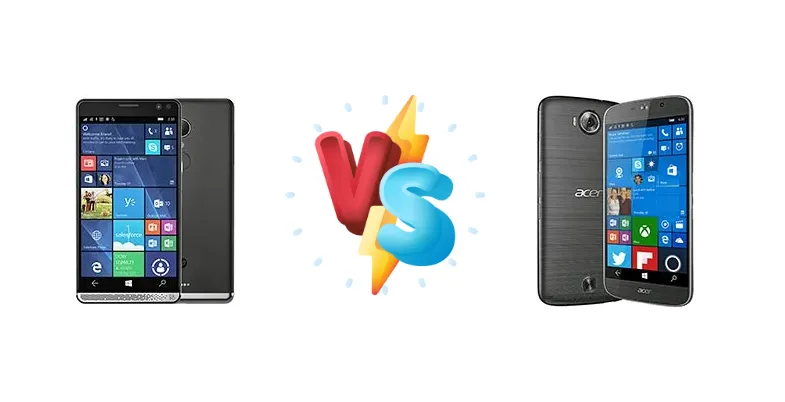
Released in 2016, the HP Elite x3 and Acer Liquid Jade Primo represent a fascinating, now-historical, period of Windows 10 Mobile ambition. Both aimed to deliver a premium smartphone experience with desktop-like functionality via Continuum, but they differed significantly in their core hardware. This comparison revisits these devices, focusing on the architectural differences between their Qualcomm Snapdragon chipsets and their implications for the user.
🏆 Quick Verdict
For the user seeking the best possible performance and future-proofing (even within the constraints of a discontinued OS), the HP Elite x3 emerges as the superior choice. Its Snapdragon 820, built on a smaller 14nm process, offers a noticeable performance advantage over the Acer Liquid Jade Primo’s Snapdragon 808, despite both boasting similar battery endurance ratings.
| Network |
|---|
| 2G bands | GSM 850 / 900 / 1800 / 1900 - SIM 1 & SIM 2 (dual-SIM model only) | GSM 850 / 900 / 1800 / 1900 - SIM 1 & SIM 2 |
| 3G bands | HSDPA 850 / 900 / 1700(AWS) / 1900 / 2100 | HSDPA 850 / 900 / 1900 / 2100 - Europe/ Taiwan |
| 4G bands | 1, 2, 3, 4, 5, 7, 8, 12, 17, 19, 20, 26, 28, 29, 38, 39, 40, 41 - EMEA | LTE 800 / 1800 / 2100 / 2600 - Europe |
| Speed | HSPA 21.1/5.76 Mbps, LTE Cat6 300/50 Mbps | HSPA 42.2/5.76 Mbps, LTE (2CA) Cat6 300/50 Mbps |
| Technology | GSM / HSPA / LTE | GSM / HSPA / LTE |
| | 1, 2, 3, 4, 5, 7, 12, 17, 20, 29, 30 - Americas | LTE 700 / 1700 / 1900 / 2600 - USA |
| Launch |
|---|
| Announced | 2016, February. Released 2016, August | 2015, September. Released 2016, April |
| Status | Discontinued | Discontinued |
| Body |
|---|
| Dimensions | 161.8 x 83.5 x 7.8 mm (6.37 x 3.29 x 0.31 in) | 156.5 x 75.9 x 8.4 mm (6.16 x 2.99 x 0.33 in) |
| SIM | · Nano-SIM· Nano-SIM + Nano-SIM | Nano-SIM + Nano-SIM |
| Weight | 195 g (6.88 oz) | 150 g (5.29 oz) |
| | IP67 dust/water resistant (up to 1m for 30 mins)
MIL-STD-810G compliant*
*does not guarantee ruggedness or use in extreme conditions | - |
| Display |
|---|
| Protection | Corning Gorilla Glass 4 | Corning Gorilla Glass (unspecified version) |
| Resolution | 1440 x 2560 pixels, 16:9 ratio (~494 ppi density) | 1080 x 1920 pixels, 16:9 ratio (~401 ppi density) |
| Size | 5.96 inches, 97.5 cm2 (~72.2% screen-to-body ratio) | 5.5 inches, 83.4 cm2 (~70.2% screen-to-body ratio) |
| Type | AMOLED, 350 nits (typ) | AMOLED |
| Platform |
|---|
| CPU | Quad-core (2x2.15 GHz Kryo & 2x1.6 GHz Kryo) | Hexa-core (4x1.4 GHz Cortex-A53 & 2x1.8 GHz Cortex-A57) |
| Chipset | Qualcomm MSM8996 Snapdragon 820 (14 nm) | Qualcomm MSM8992 Snapdragon 808 (20 nm) |
| GPU | Adreno 530 | Adreno 418 |
| OS | Microsoft Windows 10 | Microsoft Windows 10 |
| Memory |
|---|
| Card slot | microSDXC (uses shared SIM slot) - dual SIM model only | microSDXC (uses shared SIM slot) |
| Internal | 64GB 4GB RAM | 32GB 3GB RAM |
| | eMMC 5.1 | eMMC 5.0 |
| Main Camera |
|---|
| Features | LED flash, HDR, panorama | Dual-LED flash, HDR, panorama |
| Single | 16 MP, f/2.2, 1.31µm, PDAF | 21 MP, f/2.2, AF |
| Video | 4K@30fps, 1080p@30fps | 4K@30fps, 1080p@30fps |
| Selfie camera |
|---|
| Single | 8 MP, f/2.2, 1/4.0", 1.12µm | 8 MP, f/2.2 |
| Video | 1080p@30fps | 1080p@30fps |
| Sound |
|---|
| 3.5mm jack | Yes | Yes |
| 35mm jack | Yes | Yes |
| Loudspeaker | Yes, with stereo speakers | Yes |
| | Tuned by Bang & Olufsen
| - |
| Comms |
|---|
| Bluetooth | 4.0, A2DP, LE | 4.0, A2DP, LE, EDR |
| NFC | Yes | No |
| Positioning | GPS, GLONASS, BDS | GPS |
| Radio | No | FM radio |
| USB | USB Type-C 3.0, magnetic connector | USB Type-C 3.1 |
| WLAN | Wi-Fi 802.11 a/b/g/n/ac, dual-band, hotspot | Wi-Fi 802.11 a/b/g/n/ac, dual-band, Wi-Fi Direct, hotspot |
| Features |
|---|
| Sensors | Iris scanner, fingerprint (rear-mounted), accelerometer, gyro, proximity, compass, barometer | Accelerometer, gyro, proximity, compass |
| | Microsoft Continuum support | Microsoft Continuum support |
| Battery |
|---|
| Charging | 10W wired
Wireless (Qi) | - |
| Stand-by | - | Up to 330 h (3G) |
| Talk time | - | Up to 20 h (3G) |
| Type | Li-Po 4150 mAh, non-removable | Li-Po 2870 mAh, non-removable |
| Misc |
|---|
| Colors | Gold, Graphite/Chrome | Black |
| Price | About 700 EUR | About 220 EUR |
| Tests |
|---|
| Battery life | - |
Endurance rating 56h
|
| Camera | - |
Photo / Video |
HP Elite x3
- Superior Snapdragon 820 performance
- More efficient 14nm process
- Qi wireless charging support
- Potentially higher price on the used market
- Reliance on discontinued Windows 10 Mobile OS
Acer Liquid Jade Primo
- Potentially lower price point
- Good battery endurance (56h)
- Compact form factor (likely)
- Less powerful Snapdragon 808 chipset
- Less efficient 20nm process
- Limited charging options (likely)
Display Comparison
Context data lacks display specifics for both devices. However, given their release timeframe and target market, both likely featured 5-5.5 inch Full HD displays. The Elite x3, positioned as a business device, may have prioritized color accuracy and viewing angles, while the Liquid Jade Primo likely focused on vibrant colors. Without detailed specs, a definitive comparison is impossible, but the Elite x3’s higher price point suggests a potentially superior panel.
Camera Comparison
Both devices feature 'Photo / Video' capabilities, but specific details are absent. Given the market positioning, the Elite x3 likely had a more refined camera experience, potentially with better low-light performance and image stabilization. The Liquid Jade Primo may have focused on quick capture and social media sharing. Without sensor size, aperture, or image processing details, a precise comparison is impossible. The lack of detail suggests neither device was a camera-centric flagship.
Performance
The core difference lies in the chipsets. The HP Elite x3’s Snapdragon 820, fabricated on a 14nm process, boasts a quad-core Kryo CPU (2x2.15 GHz & 2x1.6 GHz). This architecture prioritizes performance and efficiency. Conversely, the Acer Liquid Jade Primo utilizes the Snapdragon 808 (20nm) with a hexa-core CPU (4x1.4 GHz Cortex-A53 & 2x1.8 GHz Cortex-A57). The 820’s newer architecture and smaller process node translate to superior single-core and multi-core performance, and better thermal management under sustained load. The 808’s Cortex-A57 cores, while capable, are less efficient than the Kryo cores in the 820. This means the Elite x3 will handle demanding applications and Continuum sessions more smoothly.
Battery Life
Both devices are reported to have an endurance rating of 56 hours. This suggests similar battery life despite the Snapdragon 820’s higher performance. The 820’s 14nm process likely contributes to improved power efficiency, offsetting the performance gains. The Elite x3 offers 10W wired charging and Qi wireless charging, providing greater convenience. The Liquid Jade Primo’s charging capabilities are unknown, but likely limited to wired charging.
Buying Guide
Buy the HP Elite x3 if you prioritize performance for legacy Windows 10 Mobile applications and Continuum functionality, and are willing to accept a potentially higher price point on the used market. Buy the Acer Liquid Jade Primo if you are looking for a more affordable entry point into the Windows 10 Mobile ecosystem, and are less concerned with demanding tasks or future software updates. Both are niche devices for collectors or those committed to the platform.
Frequently Asked Questions
❓ Will the HP Elite x3’s Snapdragon 820 handle modern emulation well?
While the Snapdragon 820 is a capable chip, attempting to emulate modern Android or iOS operating systems on the Elite x3 will likely result in limited performance. The architecture is optimized for Windows 10 Mobile, and emulation is resource-intensive. Expect significant slowdowns and compatibility issues.
❓ Is the Acer Liquid Jade Primo a good option for someone interested in exploring Windows 10 Mobile?
The Liquid Jade Primo provides a relatively affordable entry point into the Windows 10 Mobile ecosystem. However, it's crucial to understand that Microsoft has discontinued support for the OS. Functionality will be limited, and security updates are no longer available. It's best suited for collectors or enthusiasts willing to accept these limitations.
❓ Does the Snapdragon 808 in the Liquid Jade Primo suffer from significant thermal throttling?
The Snapdragon 808 was known to be prone to thermal throttling under sustained load. While the Liquid Jade Primo’s design may mitigate this to some extent, expect performance to decrease during prolonged gaming or demanding tasks. The Elite x3’s 820, with its more efficient process, is less susceptible to this issue.