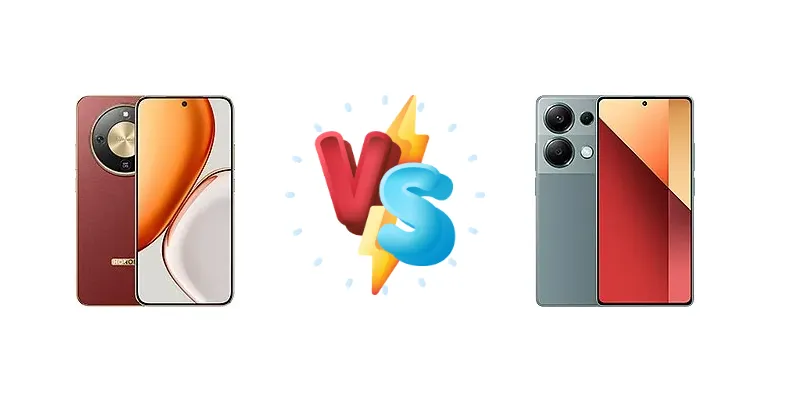
The mid-range smartphone market is fiercely competitive, and the Honor X9d and Xiaomi Redmi Note 13 Pro 4G represent compelling options for budget-conscious buyers. The X9d arrives with a newer generation Snapdragon chipset, while the Redmi Note 13 Pro 4G focuses on display brightness and fast charging. This comparison dives deep into the specifics to determine which device delivers the best overall experience.
🏆 Quick Verdict
For the average user prioritizing long-term performance and future-proofing, the Honor X9d is the better choice. Its Snapdragon 6 Gen 4, built on a 4nm process, offers a significant architectural advantage over the Redmi Note 13 Pro 4G’s Helio G99 Ultra, translating to smoother multitasking and potentially better gaming performance.
| Network |
|---|
| 2G bands | GSM 850 / 900 / 1800 / 1900 | GSM 850 / 900 / 1800 / 1900 |
| 3G bands | HSDPA 850 / 900 / 1700(AWS) / 1900 / 2100 | HSDPA 850 / 900 / 1700(AWS) / 1900 / 2100 |
| 4G bands | LTE | 1, 2, 3, 4, 5, 7, 8, 12, 13, 17, 18, 19, 20, 26, 28, 38, 40, 41, 66 |
| 5G bands | SA/NSA | - |
| Speed | HSPA, LTE, 5G | HSPA, LTE |
| Technology | GSM / HSPA / LTE / 5G | GSM / HSPA / LTE |
| Launch |
|---|
| Announced | 2025, September 24 | 2024, January 15 |
| Status | Available. Released 2025, October 09 | Available. Released 2024, January 15 |
| Body |
|---|
| Build | - | Glass front (Gorilla Glass 5), plastic frame, plastic back |
| Dimensions | 161.9 x 76.1 x 7.8 mm (6.37 x 3.00 x 0.31 in) | 161.1 x 75 x 8 mm (6.34 x 2.95 x 0.31 in) |
| SIM | Nano-SIM + Nano-SIM | Nano-SIM + Nano-SIM |
| Weight | 193 g (6.81 oz) | 188 g (6.63 oz) |
| Display |
|---|
| Protection | Aluminosilicate glass | Corning Gorilla Glass 5 |
| Resolution | 1200 x 2640 pixels (~427 ppi density) | 1080 x 2400 pixels, 20:9 ratio (~395 ppi density) |
| Size | 6.79 inches, 112.1 cm2 (~90.9% screen-to-body ratio) | 6.67 inches, 107.4 cm2 (~88.9% screen-to-body ratio) |
| Type | AMOLED, 1B colors, 120Hz, 3840Hz PWM, HDR, 800 nits (typ), 1800 nits (HBM), 6000 nits (peak) | AMOLED, 1B colors, 120Hz, 500 nits (typ), 1000 nits (HBM), 1300 nits (peak) |
| Platform |
|---|
| CPU | Octa-core (1x2.3 GHz Cortex-A720s & 3x2.2 GHz Cortex-A720s & 4x1.8 GHz Cortex-A520s) | Octa-core (2x2.2 GHz Cortex-A76 & 6x2.0 GHz Cortex-A55) |
| Chipset | Qualcomm Snapdragon 6 Gen 4 (4 nm) | Mediatek Helio G99 Ultra |
| GPU | Adreno 810 | Mali-G57 MC2 |
| OS | Android 15, Magic OS 9 | Android 13, up to 3 major Android upgrades, HyperOS |
| Memory |
|---|
| Card slot | No | microSDXC (uses shared SIM slot) |
| Internal | 256GB 8GB RAM, 256GB 12GB RAM, 512GB 12GB RAM | 128GB 8GB RAM, 256GB 8GB RAM, 256GB 12GB RAM, 512GB 8GB RAM, 512GB 12GB RAM |
| Main Camera |
|---|
| Dual | 108 MP, f/1.8, (wide), PDAF, OIS
5 MP, f/2.2, (ultrawide) | - |
| Features | LED flash, panorama, HDR | LED flash, HDR, panorama |
| Triple | - | 200 MP, f/1.7, 23mm (wide), 1/1.4", 0.56µm, multi-directional PDAF, OIS
8 MP, f/2.2, 15mm, 120˚ (ultrawide), 1/4.4", 1.0µm
2 MP (macro) |
| Video | 4K@30fps, 1080p@30fps, gyro-EIS | 1080p@30/60fps |
| Selfie camera |
|---|
| Single | 16 MP, f/2.5, (wide) | 16 MP, f/2.4, (wide), 1/3.0", 1.0µm |
| Video | 1080p@30fps | 1080p@30/60fps |
| Sound |
|---|
| 35mm jack | No | Yes |
| Loudspeaker | Yes, with stereo speakers | Yes, with dual speakers |
| Comms |
|---|
| Bluetooth | 5.2, A2DP, LE, aptX HD, aptX Adaptive | 5.2, A2DP, LE |
| Infrared port | - | Yes |
| NFC | Yes | Yes (market/region dependent) |
| Positioning | GPS, GALILEO, GLONASS, BDS | GPS, GLONASS, GALILEO, BDS |
| Radio | No | FM radio |
| USB | USB Type-C 2.0, OTG | USB Type-C 2.0, OTG |
| WLAN | Wi-Fi 802.11 a/b/g/n/ac/6, dual-band, Wi-Fi Direct | Wi-Fi 802.11 a/b/g/n/ac, dual-band |
| Features |
|---|
| Sensors | Fingerprint (under display, optical), accelerometer, compass, gyro, proximity | Fingerprint (under display, optical), accelerometer, gyro, compass |
| Battery |
|---|
| Charging | 66W wired
7.5W reverse wired | 67W wired, 50% in 16 min, 100% in 46 min |
| Type | Si/C Li-Ion 8300 mAh | 5000 mAh |
| Misc |
|---|
| Colors | Reddish Brown, Midnight Black, Sunrise Gold, Forest Green | Midnight Black, Lavender Purple, Forest Green |
| Models | MTN-NX1 | 23117RA68G, 2312FPCA6G |
| Price | About 300 EUR | € 92.00 / $ 269.99 / £ 299.99 |
| SAR | - | 1.09 W/kg (head) 1.09 W/kg (body) |
| SAR EU | - | 0.99 W/kg (head) 0.99 W/kg (body) |
Honor X9d
- More modern and efficient Snapdragon 6 Gen 4 chipset
- 4nm process for better thermal management
- 7.5W reverse wired charging
- Display specifications are unknown
- Camera details are limited
Xiaomi Redmi Note 13 Pro 4G
- Very bright 1047 nit display
- Fast 67W wired charging (0-100% in 46 minutes)
- Excellent battery life (11:36h active use)
- Older Helio G99 Ultra chipset
- Less efficient 12nm process
Display Comparison
The Xiaomi Redmi Note 13 Pro 4G boasts a significantly brighter display, reaching a measured 1047 nits. This is a clear advantage for users frequently exposed to direct sunlight. While the Honor X9d’s display specifications are not provided, the Redmi’s brightness level suggests a strong focus on outdoor visibility. The Redmi Note 13 Pro 4G’s panel likely utilizes AMOLED technology, common in this price bracket, offering vibrant colors and deep blacks. However, without knowing the X9d’s panel type and peak brightness, a definitive judgment on color accuracy and overall visual quality is difficult.
Camera Comparison
Both phones are expected to feature multi-camera systems, but detailed camera specifications are limited. The Redmi Note 13 Pro 4G’s camera is listed as 'Photo / Video', indicating a focus on both stills and video recording. Without knowing sensor sizes, apertures, or the presence of Optical Image Stabilization (OIS), it’s difficult to assess image quality. However, the Redmi Note 13 Pro 4G likely features a higher megapixel main sensor, a common marketing tactic in this segment. The Honor X9d’s camera capabilities remain largely unknown, making a direct comparison challenging. We can assume both phones will offer standard features like portrait mode and night mode.
Performance
The Honor X9d’s Qualcomm Snapdragon 6 Gen 4 (4nm) represents a substantial leap forward in efficiency and performance compared to the Redmi Note 13 Pro 4G’s MediaTek Helio G99 Ultra. The Snapdragon 6 Gen 4 utilizes newer Cortex-A720s cores, offering improved IPC (Instructions Per Clock) over the older Cortex-A76 cores found in the Helio G99 Ultra. The 4nm fabrication process of the Snapdragon further enhances efficiency, reducing heat and enabling sustained performance. While the Helio G99 Ultra is a capable chip, the Snapdragon 6 Gen 4’s architecture and process node give the X9d a clear edge in demanding tasks and long gaming sessions. The X9d’s CPU configuration (1x2.3 GHz Cortex-A720s & 3x2.2 GHz Cortex-A720s & 4x1.8 GHz Cortex-A520s) is also more balanced than the Redmi’s (2x2.2 GHz Cortex-A76 & 6x2.0 GHz Cortex-A55).
Battery Life
The Xiaomi Redmi Note 13 Pro 4G demonstrates impressive charging speeds, achieving 50% charge in 16 minutes and 100% in 46 minutes with its 67W wired charging. The Honor X9d’s 66W wired charging is comparable, though potentially slightly slower. The Redmi Note 13 Pro 4G also boasts a strong active use battery score of 11:36h, indicating excellent battery life. While the Honor X9d’s battery capacity is not specified, the Snapdragon 6 Gen 4’s 4nm efficiency should contribute to competitive battery performance. The X9d also offers 7.5W reverse wired charging, a useful feature for topping up accessories.
Buying Guide
Buy the Honor X9d if you need a phone that will remain responsive for years to come, and value a more modern chipset architecture for sustained performance. Buy the Xiaomi Redmi Note 13 Pro 4G if you prioritize a very bright display for outdoor visibility and faster charging speeds, and are less concerned with raw processing power or long-term software support.
Frequently Asked Questions
❓ Will the Snapdragon 6 Gen 4 in the Honor X9d handle demanding games like PUBG Mobile smoothly?
The Snapdragon 6 Gen 4’s newer architecture and improved GPU performance should provide a noticeably smoother gaming experience compared to the Helio G99 Ultra. While it won’t match flagship-level performance, it should be capable of running PUBG Mobile at medium to high settings with stable frame rates.
❓ How does the 67W charging on the Redmi Note 13 Pro 4G compare to other phones in this price range?
67W charging is relatively fast for the mid-range segment. While some phones offer even faster charging (80W or 120W), 67W is still significantly quicker than the 33W or 25W charging found on many competitors, allowing for a full charge in under an hour.
❓ Is the Helio G99 Ultra known to overheat during prolonged use?
The Helio G99 Ultra can experience some thermal throttling during extended gaming sessions or demanding tasks. The 12nm process node is less efficient than the 4nm process used in the Snapdragon 6 Gen 4, leading to higher heat generation. The Honor X9d is likely to maintain cooler temperatures and more consistent performance under load.
❓ Does the Redmi Note 13 Pro 4G support video recording at 4K resolution?
While not explicitly stated in the provided data, the Redmi Note 13 Pro 4G likely supports 4K video recording at 30fps, a common feature in smartphones with capable camera systems. However, the quality of the 4K video will depend on the sensor and image processing capabilities.