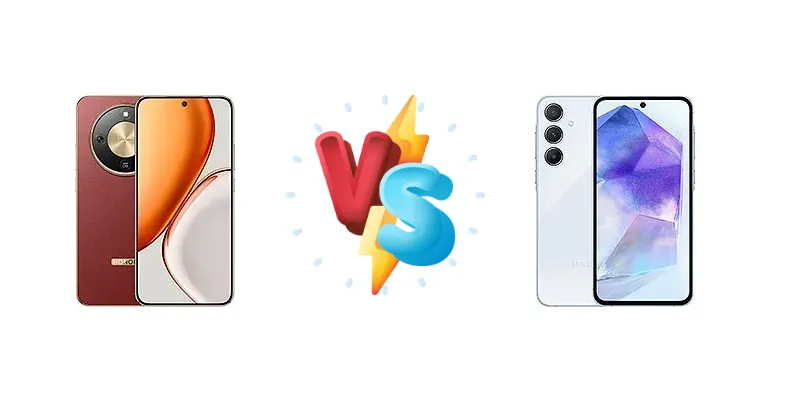
The mid-range smartphone market is fiercely competitive, and the Honor X9d and Samsung Galaxy A55 are two strong contenders vying for your attention. The X9d focuses on delivering a strong processor and fast charging at an aggressive price point, while the Galaxy A55 prioritizes a bright display and Samsung’s established software ecosystem. This comparison will dissect their key differences to help you choose the right device.
🏆 Quick Verdict
For the average user prioritizing a vibrant display and reliable software experience, the Samsung Galaxy A55 is the better choice. However, the Honor X9d offers compelling value with its Snapdragon 6 Gen 4 chipset and significantly faster 66W charging, making it ideal for users who prioritize performance-per-dollar.
| Network |
|---|
| 2G bands | GSM 850 / 900 / 1800 / 1900 | GSM 850 / 900 / 1800 / 1900 |
| 3G bands | HSDPA 850 / 900 / 1700(AWS) / 1900 / 2100 | HSDPA 850 / 900 / 1700(AWS) / 1900 / 2100 |
| 4G bands | LTE | 1, 2, 3, 4, 5, 7, 8, 12, 17, 20, 25, 26, 28, 32, 38, 40, 41, 66 |
| 5G bands | SA/NSA | 1, 3, 5, 7, 8, 20, 28, 38, 40, 41, 66, 77, 78 SA/NSA/Sub6 |
| Speed | HSPA, LTE, 5G | HSPA, LTE, 5G |
| Technology | GSM / HSPA / LTE / 5G | GSM / HSPA / LTE / 5G |
| Launch |
|---|
| Announced | 2025, September 24 | 2024, March 11 |
| Status | Available. Released 2025, October 09 | Available. Released 2024, March 15 |
| Body |
|---|
| Build | - | Glass front (Gorilla Glass Victus+), glass back (Gorilla Glass), aluminum frame |
| Dimensions | 161.9 x 76.1 x 7.8 mm (6.37 x 3.00 x 0.31 in) | 161.1 x 77.4 x 8.2 mm (6.34 x 3.05 x 0.32 in) |
| SIM | Nano-SIM + Nano-SIM | · Nano-SIM· Nano-SIM + eSIM· Nano-SIM + Nano-SIM· Nano-SIM + Nano-SIM + eSIM (max 2 at a time) |
| Weight | 193 g (6.81 oz) | 213 g (7.51 oz) |
| Display |
|---|
| Protection | Aluminosilicate glass | Corning Gorilla Glass Victus+ |
| Resolution | 1200 x 2640 pixels (~427 ppi density) | 1080 x 2340 pixels, 19.5:9 ratio (~390 ppi density) |
| Size | 6.79 inches, 112.1 cm2 (~90.9% screen-to-body ratio) | 6.6 inches, 106.9 cm2 (~85.8% screen-to-body ratio) |
| Type | AMOLED, 1B colors, 120Hz, 3840Hz PWM, HDR, 800 nits (typ), 1800 nits (HBM), 6000 nits (peak) | Super AMOLED, 120Hz, HDR10+, 1000 nits (HBM) |
| Platform |
|---|
| CPU | Octa-core (1x2.3 GHz Cortex-A720s & 3x2.2 GHz Cortex-A720s & 4x1.8 GHz Cortex-A520s) | Octa-core (4x2.75 GHz Cortex-A78 & 4x2.0 GHz Cortex-A55) |
| Chipset | Qualcomm Snapdragon 6 Gen 4 (4 nm) | Exynos 1480 (4 nm) |
| GPU | Adreno 810 | Xclipse 530 |
| OS | Android 15, Magic OS 9 | Android 14, up to 4 major Android upgrades, One UI 6.1 |
| Memory |
|---|
| Card slot | No | microSDXC (uses shared SIM slot) |
| Internal | 256GB 8GB RAM, 256GB 12GB RAM, 512GB 12GB RAM | 128GB 6GB RAM, 128GB 8GB RAM, 256GB 6GB RAM, 256GB 8GB RAM, 256GB 12GB RAM |
| Main Camera |
|---|
| Dual | 108 MP, f/1.8, (wide), PDAF, OIS
5 MP, f/2.2, (ultrawide) | - |
| Features | LED flash, panorama, HDR | LED flash, panorama, HDR |
| Triple | - | 50 MP, f/1.8, (wide), 1/1.56", 1.0µm, PDAF, OIS
12 MP, f/2.2, 123˚ (ultrawide), 1/3.06", 1.12µm
5 MP (macro) |
| Video | 4K@30fps, 1080p@30fps, gyro-EIS | 4K@30fps, 1080p@30/60fps, gyro-EIS |
| Selfie camera |
|---|
| Single | 16 MP, f/2.5, (wide) | 32 MP, f/2.2, 26mm (wide), 1/2.74", 0.8µm |
| Video | 1080p@30fps | 4K@30fps, 1080p@30/60fps |
| Sound |
|---|
| 35mm jack | No | No |
| Loudspeaker | Yes, with stereo speakers | Yes, with stereo speakers |
| Comms |
|---|
| Bluetooth | 5.2, A2DP, LE, aptX HD, aptX Adaptive | 5.3, A2DP, LE |
| NFC | Yes | Yes (market/region dependent) |
| Positioning | GPS, GALILEO, GLONASS, BDS | GPS, GALILEO, GLONASS, BDS, QZSS |
| Radio | No | No |
| USB | USB Type-C 2.0, OTG | USB Type-C 2.0, OTG |
| WLAN | Wi-Fi 802.11 a/b/g/n/ac/6, dual-band, Wi-Fi Direct | Wi-Fi 802.11 a/b/g/n/ac/6, dual-band, Wi-Fi Direct |
| Features |
|---|
| Sensors | Fingerprint (under display, optical), accelerometer, compass, gyro, proximity | Fingerprint (under display, optical), accelerometer, gyro, compass |
| Battery |
|---|
| Charging | 66W wired
7.5W reverse wired | 25W wired |
| Type | Si/C Li-Ion 8300 mAh | Li-Ion 5000 mAh |
| Misc |
|---|
| Colors | Reddish Brown, Midnight Black, Sunrise Gold, Forest Green | Iceblue, Lilac, Navy, Lemon |
| Models | MTN-NX1 | SM-A556V, SM-A556B, SM-A556B/DS, SM-A556E, SM-A556E/DS, SM-A5560 |
| Price | About 300 EUR | $ 324.99 / £ 251.50 / € 319.99 / ₹ 23,998 |
| SAR EU | - | 0.68 W/kg (head) 1.04 W/kg (body) |
Honor X9d
- Faster 66W charging
- Potentially better thermal management with Snapdragon 6 Gen 4
- More modern CPU architecture (Cortex-A720s)
- Unknown display quality
- Battery life likely shorter than A55
Samsung Galaxy A55
- Brighter, more vibrant display (1010 nits)
- Longer battery life (13:27h active use)
- Established Samsung software ecosystem
- Slower 25W charging
- Older CPU core architecture (Cortex-A78)
Display Comparison
The Samsung Galaxy A55 boasts a significantly brighter display, reaching a measured 1010 nits, compared to an unstated peak brightness for the Honor X9d. This translates to superior visibility outdoors under direct sunlight. While the X9d’s panel technology isn’t specified, the A55’s likely utilizes Super AMOLED, known for its vibrant colors and deep blacks. The A55’s brightness advantage is crucial for media consumption and gaming in bright environments, while the X9d’s display quality remains unknown without further testing. Bezels are assumed to be comparable given the market segment, but color accuracy is where the A55 is expected to excel.
Camera Comparison
Without detailed camera specs, a direct comparison is difficult. However, the market positioning suggests the Galaxy A55 will likely have a more refined image processing pipeline, focusing on natural colors and dynamic range. The Honor X9d will likely prioritize computational photography to enhance image quality. The absence of information regarding sensor sizes and OIS on the X9d makes it difficult to assess its low-light performance. The A55’s camera system is expected to benefit from Samsung’s established camera expertise, offering a more consistent and reliable experience. We can assume both phones will include a standard wide, ultrawide, and macro setup, but the quality of the macro lens is likely to be minimal on both.
Performance
The core difference lies in the chipsets: the Honor X9d utilizes the Qualcomm Snapdragon 6 Gen 4 (4nm), while the Samsung Galaxy A55 features the Exynos 1480 (4nm). The Exynos 1480 employs older Cortex-A78 cores (2.75 GHz) compared to the X9d’s newer Cortex-A720s (2.3 GHz & 2.2 GHz). While the A78 cores have a higher clock speed, the A720s architecture is more efficient. The Snapdragon 6 Gen 4’s 4nm process node should provide better thermal efficiency, potentially leading to sustained performance during extended gaming sessions. The A55’s CPU configuration suggests a focus on burst performance, while the X9d aims for consistent, efficient power. RAM speed is not specified for either device, but LPDDR5X is likely on the A55, potentially giving it a slight edge in memory bandwidth.
Battery Life
The Samsung Galaxy A55 demonstrates a clear advantage in battery life, achieving 13 hours and 27 minutes of active use. The Honor X9d’s battery capacity is not specified, but its 66W wired charging significantly outpaces the A55’s 25W charging. This means the X9d can replenish its battery much faster, minimizing downtime. While the A55 offers longer runtimes on a single charge, the X9d’s faster charging mitigates this difference for users who prefer frequent, short charging cycles. A full charge on the X9d is expected to take under an hour, while the A55 will likely require over an hour and a half.
Buying Guide
Buy the Honor X9d if you need a phone that can handle demanding apps and games without breaking the bank, and if fast charging is a top priority. You’ll benefit from the Snapdragon 6 Gen 4’s efficiency and the convenience of 66W wired charging. Buy the Samsung Galaxy A55 if you prefer a brighter, more color-accurate display, a polished software experience with guaranteed updates, and a longer-lasting battery for all-day use. The A55 is geared towards users who value a refined and reliable experience over raw processing power.
Frequently Asked Questions
❓ Does the Exynos 1480 in the Galaxy A55 tend to overheat during prolonged gaming sessions?
While the Exynos 1480 is a capable chip, it's known to exhibit some thermal throttling under sustained load. Samsung's software optimizations help mitigate this, but users engaging in extended gaming may experience some performance dips. The Honor X9d’s Snapdragon 6 Gen 4, with its 4nm process, is expected to manage heat more efficiently.
❓ Is the 66W charging on the Honor X9d compatible with Power Delivery (PD) chargers?
The Honor X9d utilizes its own 66W charging protocol, which is not universally compatible with Power Delivery (PD) chargers. While some PD chargers may work at a reduced wattage, it's best to use the charger included in the box or a charger specifically designed for Honor's 66W SuperCharge technology to achieve optimal charging speeds.
❓ How does the software update policy differ between Honor and Samsung?
Samsung typically offers longer software support for its A-series devices, including multiple years of Android OS updates and security patches. Honor’s update policy is less consistent and generally provides fewer updates over the lifespan of the device. This is a significant advantage for the Galaxy A55, ensuring long-term security and feature enhancements.
❓ Will the Honor X9d be able to run demanding games like Genshin Impact or PUBG Mobile smoothly?
The Snapdragon 6 Gen 4 is capable of running popular games like Genshin Impact and PUBG Mobile, but you may need to adjust graphics settings to achieve a consistently smooth frame rate. Expect to play at medium settings for optimal performance. The Exynos 1480 in the A55 will likely offer slightly better sustained performance in these titles.