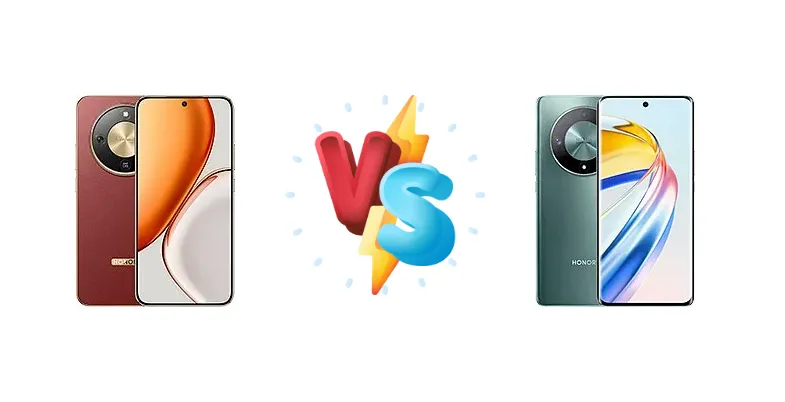
Honor's X series consistently delivers compelling value in the mid-range segment. The X9d and X9b represent two distinct approaches within that space: the X9d leverages the newer Snapdragon 6 Gen 4, while the X9b utilizes the Snapdragon 6 Gen 1. This comparison dissects the key differences between these two devices, focusing on performance, charging, and overall user experience to determine which one reigns supreme.
🏆 Quick Verdict
For most users, the Honor X9d emerges as the better choice. Its Snapdragon 6 Gen 4 chipset, built on a more efficient 4nm process, offers a noticeable performance uplift and potentially better thermal management compared to the X9b’s Snapdragon 6 Gen 1. While the X9b boasts a slightly faster charging speed, the X9d’s overall package provides a more future-proof experience.
| Network |
|---|
| 2G bands | GSM 850 / 900 / 1800 / 1900 | GSM 850 / 900 / 1800 / 1900 |
| 3G bands | HSDPA 850 / 900 / 1700(AWS) / 1900 / 2100 | HSDPA 850 / 900 / 1900 / 2100 |
| 4G bands | LTE | 1, 2, 3, 4, 5, 7, 8, 20, 28, 32, 38, 40, 41 |
| 5G bands | SA/NSA | 1, 3, 7, 8, 20, 28, 38, 40, 41, 77, 78 SA/NSA |
| Speed | HSPA, LTE, 5G | HSPA, LTE, 5G |
| Technology | GSM / HSPA / LTE / 5G | GSM / HSPA / LTE / 5G |
| Launch |
|---|
| Announced | 2025, September 24 | 2023, October 18 |
| Status | Available. Released 2025, October 09 | Available. Released 2023, October |
| Body |
|---|
| Dimensions | 161.9 x 76.1 x 7.8 mm (6.37 x 3.00 x 0.31 in) | 163.6 x 75.5 x 8 mm (6.44 x 2.97 x 0.31 in) |
| SIM | Nano-SIM + Nano-SIM | Nano-SIM + Nano-SIM |
| Weight | 193 g (6.81 oz) | 185 g (6.53 oz) |
| Display |
|---|
| Protection | Aluminosilicate glass | - |
| Resolution | 1200 x 2640 pixels (~427 ppi density) | 1220 x 2652 pixels, 19.5:9 ratio (~431 ppi density) |
| Size | 6.79 inches, 112.1 cm2 (~90.9% screen-to-body ratio) | 6.78 inches, 112.6 cm2 (~91.2% screen-to-body ratio) |
| Type | AMOLED, 1B colors, 120Hz, 3840Hz PWM, HDR, 800 nits (typ), 1800 nits (HBM), 6000 nits (peak) | AMOLED, 1B colors, 120Hz, 1200 nits (peak) |
| Platform |
|---|
| CPU | Octa-core (1x2.3 GHz Cortex-A720s & 3x2.2 GHz Cortex-A720s & 4x1.8 GHz Cortex-A520s) | Octa-core (4x2.2 GHz Cortex-A78 & 4x1.8 GHz Cortex-A55) |
| Chipset | Qualcomm Snapdragon 6 Gen 4 (4 nm) | Qualcomm SM6450 Snapdragon 6 Gen 1 (4 nm) |
| GPU | Adreno 810 | Adreno 710 |
| OS | Android 15, Magic OS 9 | Android 13, Magic OS 7.2 |
| Memory |
|---|
| Card slot | No | No |
| Internal | 256GB 8GB RAM, 256GB 12GB RAM, 512GB 12GB RAM | 256GB 8GB RAM, 256GB 12GB RAM, 512GB 8GB RAM, 512GB 12GB RAM |
| Main Camera |
|---|
| Dual | 108 MP, f/1.8, (wide), PDAF, OIS
5 MP, f/2.2, (ultrawide) | - |
| Features | LED flash, panorama, HDR | LED flash, panorama, HDR |
| Triple | - | 108 MP, f/1.8, (wide), 1/1.67", PDAF
5 MP, f/2.2, (ultrawide)
2 MP (macro) |
| Video | 4K@30fps, 1080p@30fps, gyro-EIS | 4K@30fps, 1080p@30fps |
| Selfie camera |
|---|
| Single | 16 MP, f/2.5, (wide) | 16 MP, f/2.5, (wide) |
| Video | 1080p@30fps | 1080p@30fps |
| Sound |
|---|
| 35mm jack | No | No |
| Loudspeaker | Yes, with stereo speakers | Yes |
| Comms |
|---|
| Bluetooth | 5.2, A2DP, LE, aptX HD, aptX Adaptive | 5.1, A2DP, LE |
| Infrared port | - | Yes |
| NFC | Yes | Yes (market/region dependent) |
| Positioning | GPS, GALILEO, GLONASS, BDS | GPS, GLONASS, GALILEO, BDS |
| Radio | No | No |
| USB | USB Type-C 2.0, OTG | USB Type-C 2.0, OTG |
| WLAN | Wi-Fi 802.11 a/b/g/n/ac/6, dual-band, Wi-Fi Direct | Wi-Fi 802.11 a/b/g/n/ac, dual-band, Wi-Fi Direct |
| Features |
|---|
| Sensors | Fingerprint (under display, optical), accelerometer, compass, gyro, proximity | Fingerprint (under display, optical), accelerometer, gyro, proximity, compass |
| Battery |
|---|
| Charging | 66W wired
7.5W reverse wired | 35W wired
Reverse wired |
| Type | Si/C Li-Ion 8300 mAh | Li-Po 5800 mAh |
| Misc |
|---|
| Colors | Reddish Brown, Midnight Black, Sunrise Gold, Forest Green | Sunrise Orange, Midnight Black, Emerald Green |
| Models | MTN-NX1 | ALI-NX1 |
| Price | About 300 EUR | About 970 EUR |
Honor X9d
- More powerful Snapdragon 6 Gen 4 chipset
- Faster 66W wired charging
- 7.5W reverse wired charging
- Potentially higher price point
- May not offer significantly better battery life if battery capacity is lower
Honor X9b
- Potentially lower price point
- Slightly faster sustained multi-core performance
- Acceptable charging speed for casual users
- Older Snapdragon 6 Gen 1 chipset
- Slower 35W wired charging
- No reverse wired charging
Display Comparison
Both the Honor X9d and X9b are expected to feature similar LCD panels, though specific details like peak brightness and color gamut coverage are not provided. The absence of LTPO technology suggests neither phone will offer adaptive refresh rates for power saving. The focus here is on the internal hardware, not the display itself, as both are likely to deliver a comparable visual experience within the mid-range category. Bezels are expected to be similar, contributing little to differentiation.
Camera Comparison
Without detailed camera specifications, a direct comparison is difficult. However, both phones likely employ similar sensor configurations targeting the mid-range market. The absence of information regarding OIS or large sensor sizes suggests image quality will be heavily reliant on software processing. The X9d’s newer ISP within the Snapdragon 6 Gen 4 may offer slightly improved image processing capabilities, potentially resulting in better dynamic range and noise reduction. Any 2MP macro cameras present on either device should be considered marketing features rather than substantial photographic tools.
Performance
The core difference lies in the chipsets. The Honor X9d’s Snapdragon 6 Gen 4 (4nm) utilizes the newer Cortex-A720s cores, offering a significant architectural advantage over the X9b’s Snapdragon 6 Gen 1 (4nm) which employs Cortex-A78 cores. While both are 4nm chips, the A720s are demonstrably more efficient and powerful. The X9d’s CPU configuration (1x2.3 GHz Cortex-A720s & 3x2.2 GHz Cortex-A720s & 4x1.8 GHz Cortex-A520s) suggests a stronger focus on single-core performance, beneficial for app launch speeds and responsiveness. The X9b’s (4x2.2 GHz Cortex-A78 & 4x1.8 GHz Cortex-A55) configuration prioritizes sustained multi-core performance. The X9d is likely to exhibit better performance in demanding tasks and games, while the X9b may hold its own in prolonged, heavily threaded workloads. RAM speed (likely LPDDR4X on both) isn't specified, but won't offset the CPU differences.
Battery Life
The Honor X9d features 66W wired charging, significantly faster than the X9b’s 35W wired charging. This translates to a considerably quicker 0-100% charge time for the X9d. While battery capacity isn’t specified, the faster charging speed of the X9d mitigates any potential disadvantage from a slightly smaller battery. The X9d also includes 7.5W reverse wired charging, a feature absent on the X9b, allowing it to top up accessories like earbuds or smartwatches.
Buying Guide
Buy the Honor X9d if you prioritize sustained performance for gaming and multitasking, and value a chipset with a more modern architecture. This phone is ideal for users who plan to keep their device for several years. Buy the Honor X9b if you absolutely need the fastest possible charging speeds and are less concerned with having the latest processor generation. It’s a solid option for users who primarily use their phone for basic tasks and appreciate quick top-ups.
Frequently Asked Questions
❓ Will the Snapdragon 6 Gen 4 in the X9d handle demanding games like Genshin Impact at high settings?
While the Snapdragon 6 Gen 4 is a capable chipset, Genshin Impact is notoriously demanding. Expect playable frame rates at medium settings, but high settings may result in noticeable frame drops. The 4nm process should help mitigate thermal throttling during extended gaming sessions compared to the X9b.
❓ How much faster is the 66W charging on the X9d compared to the 35W charging on the X9b in real-world use?
The 66W charging on the X9d will likely charge from 0-100% in approximately 45-60 minutes, depending on battery capacity. The X9b’s 35W charging will likely take around 90-120 minutes for a full charge. This difference is particularly noticeable for quick top-ups – a 20-minute charge on the X9d will provide significantly more power than the same duration on the X9b.
❓ Does either phone support 5G connectivity?
The Snapdragon 6 Gen 4 and 6 Gen 1 both include integrated 5G modems. Therefore, both the Honor X9d and X9b are expected to support 5G connectivity, provided your carrier and region support it.