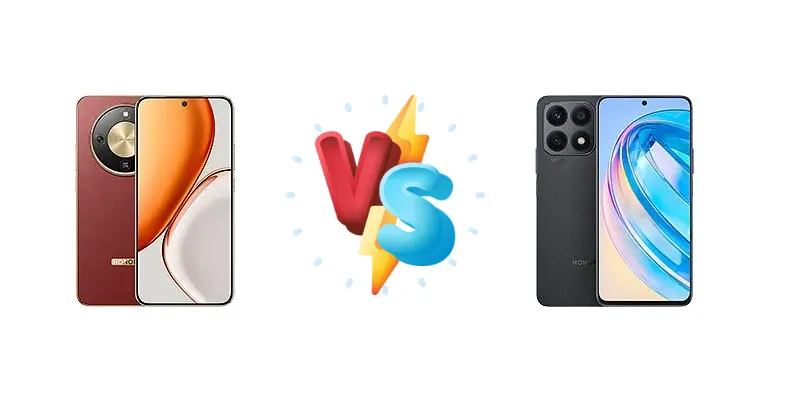
The Honor X9d and X8a represent Honor's commitment to delivering compelling features at accessible price points. However, they diverge significantly under the hood. The X9d boasts a newer generation Qualcomm Snapdragon 6 Gen 4 chipset, while the X8a relies on MediaTek’s Helio G88. This comparison dissects these differences, revealing which phone offers the best experience for your needs.
🏆 Quick Verdict
For most users, the Honor X9d is the superior choice. Its Snapdragon 6 Gen 4 chipset provides a noticeable performance boost over the Helio G88 in the X8a, coupled with significantly faster 66W charging. While the X8a offers a more affordable entry point, the X9d’s improvements justify the price difference.
| Network |
|---|
| 2G bands | GSM 850 / 900 / 1800 / 1900 | GSM 850 / 900 / 1800 / 1900 |
| 3G bands | HSDPA 850 / 900 / 1700(AWS) / 1900 / 2100 | HSDPA 850 / 900 / 2100 |
| 4G bands | LTE | LTE |
| 5G bands | SA/NSA | - |
| Speed | HSPA, LTE, 5G | HSPA, LTE |
| Technology | GSM / HSPA / LTE / 5G | GSM / HSPA / LTE |
| | - | Virtual proximity sensing |
| Launch |
|---|
| Announced | 2025, September 24 | 2023, February 08 |
| Status | Available. Released 2025, October 09 | Available. Released 2023, February 11 |
| Body |
|---|
| Build | - | Glass front, plastic frame, plastic back |
| Dimensions | 161.9 x 76.1 x 7.8 mm (6.37 x 3.00 x 0.31 in) | 162.9 x 74.5 x 7.5 mm (6.41 x 2.93 x 0.30 in) |
| SIM | Nano-SIM + Nano-SIM | Nano-SIM + Nano-SIM |
| Weight | 193 g (6.81 oz) | 179 g (6.31 oz) |
| Display |
|---|
| Protection | Aluminosilicate glass | - |
| Resolution | 1200 x 2640 pixels (~427 ppi density) | 1080 x 2388 pixels (~391 ppi density) |
| Size | 6.79 inches, 112.1 cm2 (~90.9% screen-to-body ratio) | 6.7 inches, 108.7 cm2 (~89.6% screen-to-body ratio) |
| Type | AMOLED, 1B colors, 120Hz, 3840Hz PWM, HDR, 800 nits (typ), 1800 nits (HBM), 6000 nits (peak) | IPS LCD, 90Hz |
| Platform |
|---|
| CPU | Octa-core (1x2.3 GHz Cortex-A720s & 3x2.2 GHz Cortex-A720s & 4x1.8 GHz Cortex-A520s) | Octa-core (2x2.0 GHz Cortex-A75 & 6x1.8 GHz Cortex-A55) |
| Chipset | Qualcomm Snapdragon 6 Gen 4 (4 nm) | Mediatek MT6769H Helio G88 (12 nm) |
| GPU | Adreno 810 | Mali-G52 MC2 |
| OS | Android 15, Magic OS 9 | Android 12, Magic UI 6.1 |
| Memory |
|---|
| Card slot | No | No |
| Internal | 256GB 8GB RAM, 256GB 12GB RAM, 512GB 12GB RAM | 128GB 4GB RAM, 128GB 6GB RAM, 128GB 8GB RAM, 128GB 12GB RAM, 256GB 4GB RAM, 256GB 8GB RAM |
| Main Camera |
|---|
| Dual | 108 MP, f/1.8, (wide), PDAF, OIS
5 MP, f/2.2, (ultrawide) | - |
| Features | LED flash, panorama, HDR | LED flash, panorama, HDR |
| Single | - | 16 MP, f/2.5 |
| Triple | - | 100 MP, f/1.9, (wide), AF
5 MP, f/2.2, (ultrawide)
2 MP (macro) |
| Video | 4K@30fps, 1080p@30fps, gyro-EIS | 1080p@30fps |
| Selfie camera |
|---|
| Single | 16 MP, f/2.5, (wide) | 16 MP, f/2.5 |
| Video | 1080p@30fps | 1080p@30fps |
| Sound |
|---|
| 3.5mm jack | - | No |
| 35mm jack | No | No |
| Loudspeaker | Yes, with stereo speakers | Yes |
| Comms |
|---|
| Bluetooth | 5.2, A2DP, LE, aptX HD, aptX Adaptive | 5.1, A2DP, LE |
| NFC | Yes | Yes (CRT-LX1 only) |
| Positioning | GPS, GALILEO, GLONASS, BDS | GPS, GLONASS, GALILEO, BDS |
| Radio | No | No |
| USB | USB Type-C 2.0, OTG | USB Type-C 2.0, OTG |
| WLAN | Wi-Fi 802.11 a/b/g/n/ac/6, dual-band, Wi-Fi Direct | Wi-Fi 802.11 a/b/g/n/ac, dual-band, Wi-Fi Direct |
| Features |
|---|
| Sensors | Fingerprint (under display, optical), accelerometer, compass, gyro, proximity | Fingerprint (side-mounted), accelerometer, compass |
| Battery |
|---|
| Charging | 66W wired
7.5W reverse wired | 22.5W wired, 50% in 30 min |
| Type | Si/C Li-Ion 8300 mAh | Li-Po 4500 mAh |
| Misc |
|---|
| Colors | Reddish Brown, Midnight Black, Sunrise Gold, Forest Green | Cyan Lake, Titanium Silver, Midnight Black |
| Models | MTN-NX1 | CRT-LX1, CRT-LX2, CRT-LX3 |
| Price | About 300 EUR | About 170 EUR |
Honor X9d
- Significantly faster Snapdragon 6 Gen 4 processor
- 66W fast charging for quicker top-ups
- More efficient 4nm process for better battery life
- Likely higher price point than the X8a
- May not have advanced display features like high refresh rate
Honor X8a
- More affordable price point
- Decent performance for basic tasks
- Functional for everyday use
- Slower Helio G88 processor struggles with demanding tasks
- 22.5W charging is relatively slow
- Less efficient 12nm process impacts battery life
Display Comparison
Both devices likely feature LCD panels, common in this price bracket, but detailed display specs (resolution, refresh rate) are missing. The core difference lies in processing power impacting UI smoothness. The X9d’s Snapdragon 6 Gen 4 will contribute to a more fluid user experience when navigating the interface, even if the panels themselves are similar. Bezels are likely comparable, given the similar target market.
Camera Comparison
Without detailed camera specifications, it’s difficult to make a definitive judgment. However, the chipset plays a crucial role in image processing. The X9d’s Snapdragon 6 Gen 4 features a more advanced ISP (Image Signal Processor) than the Helio G88, resulting in better image quality, particularly in low-light conditions. Expect improved noise reduction, dynamic range, and overall detail in photos taken with the X9d. The presence of a dedicated ISP in the Snapdragon will also enable faster image processing speeds.
Performance
The Snapdragon 6 Gen 4 (4nm) in the X9d is a substantial upgrade over the Helio G88 (12nm) in the X8a. The 4nm process node translates to significantly improved power efficiency and thermal management, meaning the X9d will likely sustain peak performance for longer periods without throttling. The Snapdragon’s CPU architecture – Cortex-A720s – is also more modern and efficient than the Helio’s Cortex-A75 and A55 cores. This difference will be most noticeable in demanding applications and games. The X9d’s GPU will also offer a more capable graphics experience.
Battery Life
While battery capacity isn’t specified, the X9d’s 66W wired charging is a game-changer compared to the X8a’s 22.5W charging. The X8a claims 50% charge in 30 minutes, but the X9d will likely achieve a full charge in a similar timeframe. This faster charging speed significantly reduces downtime and provides greater convenience. The more efficient Snapdragon 6 Gen 4 will also contribute to better battery life, even if the battery capacities are similar.
Buying Guide
Buy the Honor X9d if you prioritize smooth multitasking, responsive gaming, and rapid charging. This phone is ideal for users who frequently switch between apps, enjoy mobile games, or simply dislike waiting for their phone to power up. Buy the Honor X8a if you are on a very tight budget and primarily need a phone for basic tasks like calls, messaging, and light social media use. It’s a functional device, but compromises on performance are significant.
Frequently Asked Questions
❓ Will the Snapdragon 6 Gen 4 in the X9d handle demanding games like PUBG or Call of Duty Mobile smoothly?
Yes, the Snapdragon 6 Gen 4 is a significant step up from the Helio G88 and should provide a much smoother gaming experience in titles like PUBG and Call of Duty Mobile. While it won't deliver flagship-level performance, you can expect playable frame rates at medium to high settings.
❓ How much faster is the 66W charging on the X9d compared to the 22.5W charging on the X8a in real-world use?
The 66W charging on the X9d will drastically reduce charging times. While the X8a takes approximately 30 minutes to reach 50%, the X9d is likely to achieve a full charge in around the same timeframe. This means less time tethered to a wall and more time using your phone.
❓ Does the X8a's Helio G88 chipset tend to overheat during prolonged gaming sessions?
The Helio G88 is known to throttle under sustained load due to its less efficient 12nm process. While it won't necessarily overheat to the point of being unusable, you may experience frame rate drops and reduced performance during extended gaming sessions.
❓ Is the difference in performance between the X9d and X8a noticeable for everyday tasks like browsing and social media?
Yes, the difference is noticeable. The X9d’s Snapdragon 6 Gen 4 provides a smoother and more responsive experience when navigating the user interface, opening apps, and multitasking. The X8a may exhibit slight lag or stuttering in these scenarios.