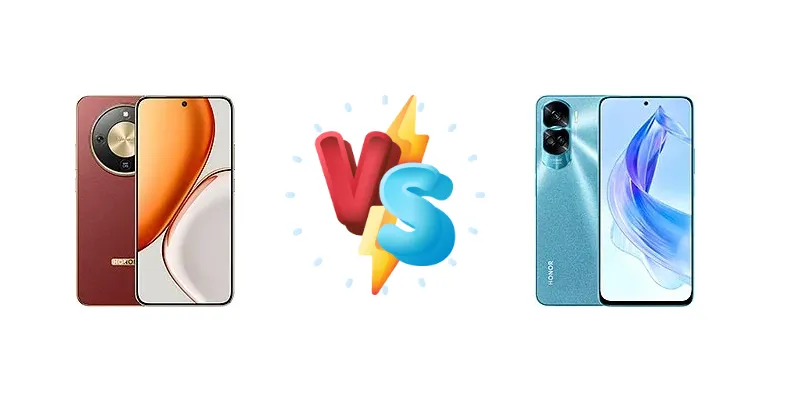
Honor's mid-range offerings, the X9d and 90 Lite, present a compelling choice for budget-conscious consumers. The X9d leverages Qualcomm's newer Snapdragon 6 Gen 4, while the 90 Lite opts for MediaTek's Dimensity 6020. This comparison dissects the key differences, focusing on performance, charging, and overall user experience to determine which device delivers the best value.
🏆 Quick Verdict
For most users, the Honor X9d emerges as the stronger contender. Its Snapdragon 6 Gen 4, built on a more efficient 4nm process, promises better sustained performance and thermal management compared to the 7nm Dimensity 6020. While the 90 Lite offers respectable charging speeds, the X9d's 66W charging is significantly faster.
| Network |
|---|
| 2G bands | GSM 850 / 900 / 1800 / 1900 | GSM 850 / 900 / 1800 / 1900 |
| 3G bands | HSDPA 850 / 900 / 1700(AWS) / 1900 / 2100 | HSDPA 850 / 900 / 1900 / 2100 |
| 4G bands | LTE | LTE |
| 5G bands | SA/NSA | SA/NSA |
| Speed | HSPA, LTE, 5G | HSPA, LTE, 5G |
| Technology | GSM / HSPA / LTE / 5G | GSM / HSPA / LTE / 5G |
| Launch |
|---|
| Announced | 2025, September 24 | 2023, June 20 |
| Status | Available. Released 2025, October 09 | Available. Released 2023, June 20 |
| Body |
|---|
| Dimensions | 161.9 x 76.1 x 7.8 mm (6.37 x 3.00 x 0.31 in) | 162.9 x 74.5 x 7.5 mm (6.41 x 2.93 x 0.30 in) |
| SIM | Nano-SIM + Nano-SIM | Nano-SIM + Nano-SIM |
| Weight | 193 g (6.81 oz) | 179 g (6.31 oz) |
| Display |
|---|
| Protection | Aluminosilicate glass | - |
| Resolution | 1200 x 2640 pixels (~427 ppi density) | 1080 x 2388 pixels (~391 ppi density) |
| Size | 6.79 inches, 112.1 cm2 (~90.9% screen-to-body ratio) | 6.7 inches, 108.7 cm2 (~89.6% screen-to-body ratio) |
| Type | AMOLED, 1B colors, 120Hz, 3840Hz PWM, HDR, 800 nits (typ), 1800 nits (HBM), 6000 nits (peak) | IPS LCD, 90Hz |
| Platform |
|---|
| CPU | Octa-core (1x2.3 GHz Cortex-A720s & 3x2.2 GHz Cortex-A720s & 4x1.8 GHz Cortex-A520s) | Octa-core (2x2.2 GHz Cortex-A76 & 6x2.0 GHz Cortex-A55) |
| Chipset | Qualcomm Snapdragon 6 Gen 4 (4 nm) | Mediatek Dimensity 6020 (7 nm) |
| GPU | Adreno 810 | Mali-G57 MC2 |
| OS | Android 15, Magic OS 9 | Android 13, Magic OS 7.1 |
| Memory |
|---|
| Card slot | No | No |
| Internal | 256GB 8GB RAM, 256GB 12GB RAM, 512GB 12GB RAM | 256GB 4GB RAM, 256GB 8GB RAM |
| Main Camera |
|---|
| Dual | 108 MP, f/1.8, (wide), PDAF, OIS
5 MP, f/2.2, (ultrawide) | - |
| Features | LED flash, panorama, HDR | LED flash, HDR, panorama |
| Triple | - | 100 MP, f/1.9, (wide), PDAF
5 MP, f/2.2, (ultrawide)
2 MP (macro) |
| Video | 4K@30fps, 1080p@30fps, gyro-EIS | 1080p@30fps |
| Selfie camera |
|---|
| Single | 16 MP, f/2.5, (wide) | 16 MP, f/2.5, (wide) |
| Video | 1080p@30fps | 1080p@30fps |
| Sound |
|---|
| 35mm jack | No | No |
| Loudspeaker | Yes, with stereo speakers | Yes |
| Comms |
|---|
| Bluetooth | 5.2, A2DP, LE, aptX HD, aptX Adaptive | 5.1, A2DP, LE (5.3, France) |
| NFC | Yes | Yes (market/region dependent) |
| Positioning | GPS, GALILEO, GLONASS, BDS | GPS, GLONASS, GALILEO, BDS |
| Radio | No | Unspecified |
| USB | USB Type-C 2.0, OTG | USB Type-C 2.0, OTG |
| WLAN | Wi-Fi 802.11 a/b/g/n/ac/6, dual-band, Wi-Fi Direct | Wi-Fi 802.11 a/b/g/n/ac, dual-band, Wi-Fi Direct |
| Features |
|---|
| Sensors | Fingerprint (under display, optical), accelerometer, compass, gyro, proximity | Fingerprint (side-mounted), accelerometer, compass |
| Battery |
|---|
| Charging | 66W wired
7.5W reverse wired | 35W wired, 55% in 30 min (Europe)
22.5W wired (Global) |
| Type | Si/C Li-Ion 8300 mAh | Li-Po 4500 mAh |
| Misc |
|---|
| Colors | Reddish Brown, Midnight Black, Sunrise Gold, Forest Green | Titanium Silver, Cyan Lake, Midnight Black |
| Models | MTN-NX1 | CRT-NX1 |
| Price | About 300 EUR | £ 143.99 |
Honor X9d
- Faster 66W charging for quicker top-ups.
- More efficient Snapdragon 6 Gen 4 (4nm) chipset.
- Potentially better sustained performance due to thermal efficiency.
- Specific battery capacity is unknown.
- Display specifications are not detailed.
Honor 90 Lite
- Established MediaTek Dimensity 6020 architecture.
- Potentially lower price point.
- Decent charging speeds (35W/22.5W).
- Less efficient 7nm process node.
- Slower charging compared to the X9d.
- Potentially more thermal throttling under sustained load.
Display Comparison
Neither device's display specifications are provided, so a direct comparison is limited. However, given the price points, both likely utilize LCD panels. The absence of LTPO technology suggests neither will offer adaptive refresh rates for power saving. Bezels are likely comparable, and color accuracy will depend on software calibration. The user experience will likely be similar in terms of visual fidelity.
Camera Comparison
Without detailed camera specs, a definitive comparison is difficult. However, the focus should be on the main sensor resolution and aperture. Assuming both phones feature similar sensor sizes, the image processing capabilities of the respective chipsets will be a key differentiator. Qualcomm's Snapdragon typically excels in image signal processing (ISP), potentially resulting in better dynamic range and low-light performance on the X9d. The presence or absence of Optical Image Stabilization (OIS) would be a significant advantage for either device, but this information is unavailable.
Performance
The core difference lies in the chipsets. The Honor X9d’s Snapdragon 6 Gen 4 (4nm) boasts newer Cortex-A720s cores, offering a potential architectural advantage over the Honor 90 Lite’s Dimensity 6020 (7nm) with its older Cortex-A76 cores. The 4nm fabrication process of the Snapdragon is crucial; it translates to improved power efficiency and reduced heat generation, potentially leading to less throttling during extended gaming sessions. While the Dimensity 6020’s A76 cores are individually faster clocked, the Snapdragon’s newer architecture and process node likely provide better overall sustained performance. The X9d's CPU configuration (1x2.3GHz + 3x2.2GHz + 4x1.8GHz) suggests a focus on balancing performance and efficiency, while the 90 Lite's (2x2.2GHz + 6x2.0GHz) leans towards a more traditional big.LITTLE setup.
Battery Life
The Honor X9d’s 66W wired charging is a clear advantage over the Honor 90 Lite’s 35W (Europe) or 22.5W (Global) charging. The X9d can rapidly replenish its battery, minimizing downtime. While the 90 Lite claims 55% charge in 30 minutes (Europe), the X9d will likely achieve a significantly higher percentage in the same timeframe. The actual battery capacity of each device is unknown, but the faster charging of the X9d mitigates the impact of a potentially smaller battery.
Buying Guide
Buy the Honor X9d if you prioritize sustained performance for gaming or multitasking, and value faster charging speeds. This phone is ideal for users who frequently push their devices. Buy the Honor 90 Lite if you prefer a slightly more established chipset architecture (Cortex-A76 cores) and are less concerned with peak performance or extremely rapid charging. It's a solid choice for everyday tasks and media consumption.
Frequently Asked Questions
❓ Will the Dimensity 6020 in the Honor 90 Lite struggle with graphically demanding games like Genshin Impact?
The Dimensity 6020 is capable of running Genshin Impact, but you'll likely need to lower the graphics settings to medium or low to maintain a stable frame rate. The Snapdragon 6 Gen 4 in the X9d, due to its newer architecture and improved efficiency, will offer a smoother experience at similar settings, and potentially allow for higher settings without significant frame drops.
❓ How much faster is the 66W charging on the Honor X9d compared to the 35W charging on the European Honor 90 Lite?
The 66W charging on the X9d will significantly reduce charging times. While the 90 Lite (Europe) takes approximately 30 minutes to reach 55%, the X9d is expected to reach a much higher percentage in the same timeframe, potentially exceeding 80-90%. This translates to less time tethered to a charger.
❓ Does the Snapdragon 6 Gen 4 in the Honor X9d overheat during prolonged gaming sessions?
The Snapdragon 6 Gen 4's 4nm process is designed to mitigate overheating. While some heat generation is inevitable during intensive gaming, the X9d is expected to manage thermals more effectively than the 90 Lite's Dimensity 6020, resulting in less performance throttling and a more consistent gaming experience.