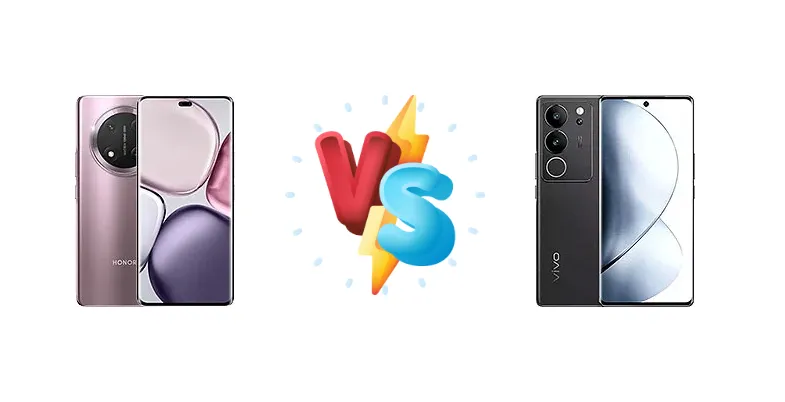
The mid-range smartphone market is fiercely competitive, and the Honor X9c and vivo V29 Pro represent compelling options for users seeking a balance of features and affordability. The X9c focuses on delivering solid performance with a focus on value, while the V29 Pro aims higher with a more powerful chipset and faster charging, but at a potentially higher price point. This comparison will dissect their key differences to help you choose the right device.
🏆 Quick Verdict
For the average user prioritizing all-around performance and faster charging, the vivo V29 Pro emerges as the stronger contender. Its Dimensity 8200 chipset provides a significant performance uplift over the Snapdragon 6 Gen 1 in the Honor X9c, justifying the potential price difference. However, the X9c remains a viable option for budget-conscious buyers.
| Network |
|---|
| 2G bands | GSM 850 / 900 / 1800 / 1900 | GSM 850 / 900 / 1800 / 1900 |
| 3G bands | HSDPA 850 / 900 / 1900 / 2100 | HSDPA 850 / 900 / 1700(AWS) / 1900 / 2100 |
| 4G bands | LTE | 1, 3, 4, 5, 8, 19, 28, 34, 38, 39, 40, 41 |
| 5G bands | SA/NSA | 1, 3, 5, 8, 28, 40, 77, 78 SA/NSA |
| Speed | HSPA, LTE, 5G | HSPA, LTE, 5G |
| Technology | GSM / HSPA / LTE / 5G | GSM / HSPA / LTE / 5G |
| Launch |
|---|
| Announced | 2024, November 05 | 2023, October 04 |
| Status | Available. Released 2024, November 15 | Available. Released 2023, October 10 |
| Body |
|---|
| Build | - | Glass front, glass back, plastic frame |
| Dimensions | 162.8 x 75.5 x 8 mm (6.41 x 2.97 x 0.31 in) | 164.2 x 74.4 x 7.5 mm (6.46 x 2.93 x 0.30 in) |
| SIM | Nano-SIM + Nano-SIM | Nano-SIM + Nano-SIM |
| Weight | 189 g (6.67 oz) | 188 g (6.63 oz) |
| Display |
|---|
| Resolution | 1224 x 2700 pixels (~437 ppi density) | 1260 x 2800 pixels, 20:9 ratio (~453 ppi density) |
| Size | 6.78 inches, 111.5 cm2 (~90.7% screen-to-body ratio) | 6.78 inches, 111.0 cm2 (~90.8% screen-to-body ratio) |
| Type | AMOLED, 1B colors, 120Hz, 3840Hz PWM, 4000 nits (peak) | AMOLED, 120Hz |
| Platform |
|---|
| CPU | Octa-core (4x2.2 GHz Cortex-A78 & 4x1.8 GHz Cortex-A55) | Octa-core (1x3.1 GHz Cortex-A78 & 3x3.0 GHz Cortex-A78 & 4x2.0 GHz Cortex-A55) |
| Chipset | Qualcomm SM6450 Snapdragon 6 Gen 1 (4 nm) | Mediatek Dimensity 8200 (4 nm) |
| GPU | Adreno 710 | Mali-G610 MC6 |
| OS | Android 14, Magic OS 8 | Android 13, up to 3 major Android upgrades, Funtouch 13 |
| Memory |
|---|
| Card slot | No | No |
| Internal | 256GB 8GB RAM, 256GB 12GB RAM, 512GB 12GB RAM | 256GB 8GB RAM, 256GB 12GB RAM |
| Main Camera |
|---|
| Dual | - | 50 MP, f/1.9, (wide), 1/1.56", 1.0µm, PDAF, OIS
12 MP, f/2.0, (telephoto), 1/2.93", 1.22µm, PDAF, 2x optical zoom
8 MP, f/2.2, (ultrawide), 1/4.0", 1.12µm |
| Features | LED flash, panorama, HDR | Ring-LED flash, panorama, HDR |
| Triple | 108 MP, f/1.8, (wide), 1/1.67", PDAF, OIS
5 MP, f/2.2, (ultrawide) | - |
| Video | 4K@30fps, 1080p@30/60fps | 4K@30fps, 1080p@30fps |
| Selfie camera |
|---|
| Single | 16 MP, f/2.5, (wide) | 50 MP, f/2.0, 22mm (wide), 1/2.76", 0.64µm, AF |
| Video | 1080p@30fps | 1080p@30fps |
| Sound |
|---|
| 35mm jack | No | No |
| Loudspeaker | Yes, with stereo speakers | Yes |
| Comms |
|---|
| Bluetooth | 5.1, A2DP, LE | 5.3, A2DP, LE |
| NFC | Yes (market/region dependent) | No |
| Positioning | GPS, GLONASS, GALILEO, BDS | GPS (L1), GLONASS (G1), BDS (B1I), GALILEO (E1), QZSS (L1), NavIC |
| Radio | No | No |
| USB | USB Type-C 2.0, OTG | USB Type-C 2.0, OTG |
| WLAN | Wi-Fi 802.11 a/b/g/n/ac, dual-band, Wi-Fi Direct | Wi-Fi 802.11 a/b/g/n/ac, dual-band |
| Features |
|---|
| Sensors | Fingerprint (under display, optical), accelerometer, gyro, proximity, compass | Fingerprint (under display, optical), accelerometer, gyro, proximity, compass |
| Battery |
|---|
| Charging | 66W wired
Reverse wired | 80W wired, 50% in 18 min |
| Type | Si/C Li-Ion 6600 mAh | 4600 mAh |
| Misc |
|---|
| Colors | Titanium Purple, Titanium Black, Jade Cyan | Himalayan Blue, Space Black, Pink |
| Models | - | V2251 |
| Price | $ 459.99 / ₹ 21,999 | About 460 EUR |
| SAR | - | 1.17 W/kg (head) 0.77 W/kg (body) |
Honor X9c
- Excellent value for money
- 66W fast charging with reverse wired charging
- Efficient 4nm Snapdragon 6 Gen 1 chipset
- Less powerful chipset compared to the V29 Pro
- Likely a less advanced camera system
vivo V29 Pro
- Powerful Dimensity 8200 chipset for smooth performance
- 80W super-fast charging
- Brighter display for better outdoor visibility
- Potentially higher price point
- May have more aggressive background app management to maximize battery life
Display Comparison
The vivo V29 Pro boasts a significantly brighter display, reaching a measured peak of 1029 nits. This is crucial for outdoor visibility, a clear advantage over the Honor X9c, which lacks published brightness data. While both utilize 4nm chipsets, the V29 Pro’s brighter screen will impact battery consumption. We expect both to use AMOLED panels, common in this price bracket, but the V29 Pro’s higher peak brightness is a tangible benefit for users who frequently use their phones in direct sunlight.
Camera Comparison
The context data lacks detailed camera specifications for both devices. However, given vivo’s history, the V29 Pro likely prioritizes camera capabilities with advanced image processing and potentially larger sensors. The Honor X9c, positioned as a value-focused device, may offer a more basic camera setup. Without specific sensor details, it’s difficult to make a definitive judgment, but we anticipate the V29 Pro to deliver superior image quality, particularly in low-light conditions. The presence or absence of Optical Image Stabilization (OIS) on the V29 Pro would be a key differentiator.
Performance
The core difference lies in the chipsets: the Honor X9c features the Qualcomm Snapdragon 6 Gen 1, while the vivo V29 Pro is powered by the MediaTek Dimensity 8200. The Dimensity 8200’s CPU configuration – a 1x3.1 GHz Cortex-A78, 3x3.0 GHz Cortex-A78, and 4x2.0 GHz Cortex-A55 – significantly outperforms the Snapdragon 6 Gen 1’s 4x2.2 GHz Cortex-A78 & 4x1.8 GHz Cortex-A55. This translates to faster app loading times, smoother multitasking, and a more enjoyable gaming experience on the V29 Pro. Both are built on a 4nm process, offering good efficiency, but the Dimensity 8200’s superior architecture provides a clear performance edge.
Battery Life
The vivo V29 Pro demonstrates a clear advantage in battery performance, achieving an active use score of 12:07 hours and an endurance rating of 113 hours. While the Honor X9c’s battery capacity is unknown, the V29 Pro’s endurance suggests a well-optimized system. Furthermore, the V29 Pro’s 80W wired charging, capable of reaching 50% charge in just 18 minutes, significantly outpaces the Honor X9c’s 66W charging. This faster charging speed is a major convenience factor for users who need to quickly top up their battery.
Buying Guide
Buy the Honor X9c if you need a reliable daily driver with decent performance for everyday tasks and light gaming, and prioritize maximizing value for your money. You'll appreciate the 66W charging and a generally smooth experience without breaking the bank. Buy the vivo V29 Pro if you prefer a more responsive and capable device for demanding applications, gaming, and content creation. The Dimensity 8200 chipset and 80W charging will deliver a noticeably smoother and faster experience, especially for power users.
Frequently Asked Questions
❓ Does the Dimensity 8200 in the vivo V29 Pro get noticeably hot during extended gaming sessions?
While the Dimensity 8200 is a powerful chip, its 4nm fabrication process and vivo’s thermal management solutions should prevent excessive overheating. However, sustained gaming at maximum settings will inevitably generate heat. Expect some throttling after prolonged use, but it should be manageable and not severely impact gameplay.
❓ Is the 66W charging on the Honor X9c sufficient for most users, or is the 80W on the V29 Pro a significant upgrade?
66W charging is still quite fast and will adequately charge the phone overnight. However, the 80W charging on the V29 Pro offers a noticeable time saving, especially for quick top-ups. Reaching 50% in 18 minutes is a significant convenience for users who are always on the go.
❓ How does the Snapdragon 6 Gen 1 handle graphically demanding games like PUBG Mobile or Genshin Impact?
The Snapdragon 6 Gen 1 can run PUBG Mobile at medium settings without significant issues. Genshin Impact may require lower settings to maintain a stable frame rate. It's suitable for casual gaming, but the Dimensity 8200 in the V29 Pro will provide a much smoother and more consistent experience for demanding titles.