
Honor X9c vs Google Pixel 7a: Which Mid-Range Phone Reigns Supreme?
| Phones Images | |||||
|---|---|---|---|---|---|
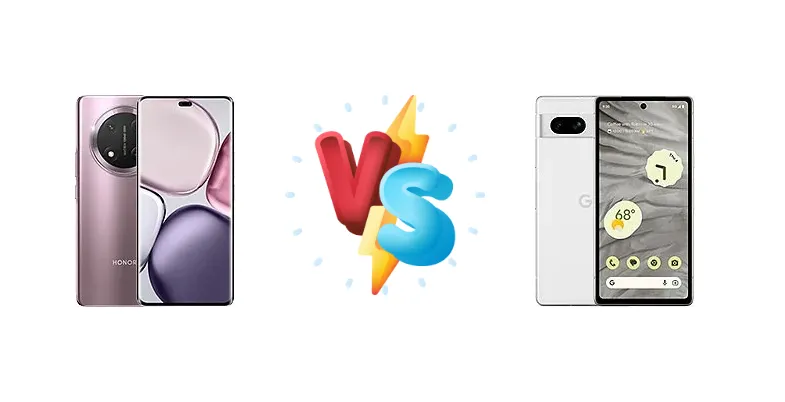
|
🏆 Quick Verdict
For the average user prioritizing camera quality and software experience, the Google Pixel 7a is the clear winner. However, the Honor X9c provides exceptional value with its 66W charging and capable performance, making it ideal for users who prioritize battery convenience and affordability.
| PHONES | ||
|---|---|---|
| Phone Names | Honor X9c | Google Pixel 7a |
| Network | ||
|---|---|---|
| 2G bands | GSM 850 / 900 / 1800 / 1900 | GSM 850 / 900 / 1800 / 1900 |
| 3G bands | HSDPA 850 / 900 / 1900 / 2100 | HSDPA 800 / 850 / 900 / 1700(AWS) / 1900 / 2100 |
| 4G bands | LTE | 1, 2, 3, 4, 5, 7, 8, 12, 13, 14, 17, 20, 25, 26, 28, 29, 30, 38, 40, 41, 48, 66, 71 - GWKK3, G0DZQ |
| 5G bands | SA/NSA | 1, 2, 3, 5, 7, 8, 12, 14, 20, 25, 28, 30, 38, 41, 48, 66, 71, 77, 78 SA/NSA/Sub6 - GWKK3 |
| Speed | HSPA, LTE, 5G | HSPA, LTE, 5G |
| Technology | GSM / HSPA / LTE / 5G | GSM / HSPA / LTE / 5G |
| - | 1, 2, 3, 5, 7, 8, 12, 20, 25, 28, 38, 40, 41, 66, 75, 76, 77, 78, 79 SA/NSA/Sub6 - GHL1X, G82U8 | |
| Launch | ||
|---|---|---|
| Announced | 2024, November 05 | 2023, May 10 |
| Status | Available. Released 2024, November 15 | Available. Released 2023, May 10 |
| Body | ||
|---|---|---|
| Build | - | Glass front (Gorilla Glass 3), aluminum frame, plastic back |
| Dimensions | 162.8 x 75.5 x 8 mm (6.41 x 2.97 x 0.31 in) | 152 x 72.9 x 9 mm (5.98 x 2.87 x 0.35 in) |
| SIM | Nano-SIM + Nano-SIM | Nano-SIM + eSIM |
| Weight | 189 g (6.67 oz) | 193.5 g (6.84 oz) |
| - | IP67 dust/water resistant (up to 1m for 30 min) | |
| Display | ||
|---|---|---|
| Protection | - | Corning Gorilla Glass 3 |
| Resolution | 1224 x 2700 pixels (~437 ppi density) | 1080 x 2400 pixels, 20:9 ratio (~429 ppi density) |
| Size | 6.78 inches, 111.5 cm2 (~90.7% screen-to-body ratio) | 6.1 inches, 90.7 cm2 (~81.8% screen-to-body ratio) |
| Type | AMOLED, 1B colors, 120Hz, 3840Hz PWM, 4000 nits (peak) | OLED, HDR, 90Hz |
| - | Always-on display | |
| Platform | ||
|---|---|---|
| CPU | Octa-core (4x2.2 GHz Cortex-A78 & 4x1.8 GHz Cortex-A55) | Octa-core (2x2.85 GHz Cortex-X1 & 2x2.35 GHz Cortex-A78 & 4x1.80 GHz Cortex-A55) |
| Chipset | Qualcomm SM6450 Snapdragon 6 Gen 1 (4 nm) | Google Tensor G2 (5 nm) |
| GPU | Adreno 710 | Mali-G710 MP7 |
| OS | Android 14, Magic OS 8 | Android 13, upgradable to Android 15, up to 5 major Android upgrades |
| Memory | ||
|---|---|---|
| Card slot | No | No |
| Internal | 256GB 8GB RAM, 256GB 12GB RAM, 512GB 12GB RAM | 128GB 8GB RAM |
| - | UFS 3.1 | |
| Main Camera | ||
|---|---|---|
| Dual | - | 64 MP, f/1.9, 26mm (wide), 1/1.73", 0.8µm, dual pixel PDAF, OIS 13 MP, f/2.2, 120˚ (ultrawide), 1.12µm |
| Features | LED flash, panorama, HDR | Dual-LED flash, Pixel Shift, Auto-HDR, panorama |
| Triple | 108 MP, f/1.8, (wide), 1/1.67", PDAF, OIS 5 MP, f/2.2, (ultrawide) | - |
| Video | 4K@30fps, 1080p@30/60fps | 4K@30/60fps, 1080p@30/60/120/240fps, OIS |
| Selfie camera | ||
|---|---|---|
| Features | - | HDR, panorama |
| Single | 16 MP, f/2.5, (wide) | 13 MP, f/2.2, 20mm (ultrawide), 1.12µm |
| Video | 1080p@30fps | 4K@30fps, 1080p@30fps |
| Sound | ||
|---|---|---|
| 3.5mm jack | - | No |
| 35mm jack | No | No |
| Loudspeaker | Yes, with stereo speakers | Yes, with stereo speakers |
| Comms | ||
|---|---|---|
| Bluetooth | 5.1, A2DP, LE | 5.3, A2DP, LE |
| NFC | Yes (market/region dependent) | Yes |
| Positioning | GPS, GLONASS, GALILEO, BDS | GPS, GLONASS, GALILEO, BDS, QZSS, NavIC |
| Radio | No | No |
| USB | USB Type-C 2.0, OTG | USB Type-C 3.2 |
| WLAN | Wi-Fi 802.11 a/b/g/n/ac, dual-band, Wi-Fi Direct | Wi-Fi 802.11 a/b/g/n/ac/6e, tri-band |
| Features | ||
|---|---|---|
| Sensors | Fingerprint (under display, optical), accelerometer, gyro, proximity, compass | Fingerprint (under display, optical), accelerometer, gyro, proximity, compass, barometer |
| Battery | ||
|---|---|---|
| Charging | 66W wired Reverse wired | 18W wired, PD3.0 7.5W wireless |
| Type | Si/C Li-Ion 6600 mAh | Li-Po 4385 mAh |
| Misc | ||
|---|---|---|
| Colors | Titanium Purple, Titanium Black, Jade Cyan | Charcoal, Snow, Sea, Coral |
| Models | - | GWKK3, GHL1X, G0DZQ, G82U8 |
| Price | $ 459.99 / ₹ 21,999 | € 179.90 / $ 150.00 / £ 170.00 / ₹ 25,980 |
Honor X9c
- Blazing-fast 66W charging
- Aggressive price point
- Reverse wired charging capability
- Less powerful chipset compared to Tensor G2
- Likely inferior camera performance
Google Pixel 7a
- Superior camera quality and image processing
- Powerful Tensor G2 chipset
- Clean and updated Android experience
- Slow 18W charging
- Higher price tag
Display Comparison
The Pixel 7a boasts a significantly brighter display, reaching a measured 1070 nits, compared to the Honor X9c’s unspecified peak brightness. This translates to better visibility outdoors under direct sunlight. While the X9c’s panel technology isn’t detailed, the Pixel 7a’s OLED panel delivers vibrant colors and deep blacks. The Pixel 7a’s smaller size (6.1 inches vs. X9c’s 6.8 inches) may appeal to users preferring a more compact device, though the X9c offers a larger viewing area for media consumption. Color accuracy is likely superior on the Pixel 7a, given Google’s display calibration standards.
Camera Comparison
The Pixel 7a’s camera system is a major strength, leveraging Google’s renowned computational photography. While specific sensor details are missing for both, the Pixel 7a’s image processing excels in dynamic range, detail preservation, and low-light performance. The X9c likely relies more on hardware specifications, and without knowing the sensor size, it’s difficult to assess its capabilities. The Pixel 7a’s video recording capabilities are also expected to be superior, benefiting from the Tensor G2’s image signal processor. Ignoring the likely low-resolution macro sensors on both devices, the Pixel 7a’s overall camera experience is expected to be significantly more refined.
Performance
The core difference lies in the chipsets. The Google Pixel 7a’s Tensor G2 (5nm) is architecturally more advanced than the Honor X9c’s Snapdragon 6 Gen 1 (4nm). The Tensor G2 features a prime Cortex-X1 core clocked at 2.85 GHz, alongside A78 cores, providing a substantial performance advantage in demanding tasks and AI processing. While the Snapdragon 6 Gen 1 offers a respectable octa-core configuration, its Cortex-A78 cores are clocked lower at 2.2 GHz. The 5nm process of the Tensor G2 also contributes to better thermal efficiency, potentially reducing throttling during sustained workloads. The Pixel 7a is the clear winner for gaming and resource-intensive applications.
Battery Life
The Pixel 7a has an endurance rating of 76 hours, indicating solid battery life. The Honor X9c’s battery capacity is not specified, but its real-world performance will be heavily influenced by its power efficiency. However, the X9c’s 66W wired charging is a massive advantage, allowing for a full charge in under an hour. The Pixel 7a’s 18W charging is comparatively slow. The X9c also offers reverse wired charging, a feature absent on the Pixel 7a, adding to its convenience for charging accessories.
Buying Guide
Buy the Honor X9c if you need a phone that can rapidly recharge – its 66W charging is a game-changer for power users. It’s also the better choice for those on a tighter budget who still want a reliable and functional smartphone. Buy the Google Pixel 7a if you prioritize camera performance, a clean and consistently updated Android experience, and benefit from Google’s AI-powered features. It’s the superior choice for photography enthusiasts and those deeply integrated into the Google ecosystem.