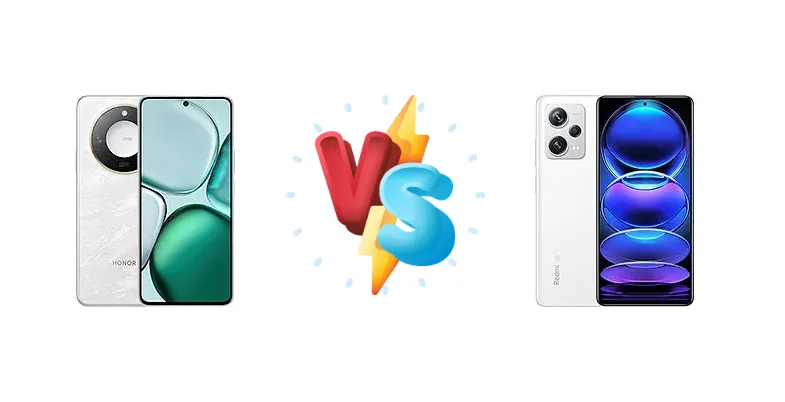
The mid-range smartphone market is fiercely competitive, and the Honor X9c Smart and Xiaomi Redmi Note 12 Pro+ represent compelling options for users seeking a balance of performance and features. While both devices utilize MediaTek Dimensity chipsets, they diverge significantly in charging speed and overall user experience. This comparison dissects these differences to determine which phone best suits your needs.
🏆 Quick Verdict
For the average user prioritizing rapid charging and a potentially smoother experience, the Xiaomi Redmi Note 12 Pro+ is the clear winner. Its 120W charging and slightly more powerful Dimensity 1080 chipset offer tangible benefits. However, the Honor X9c Smart presents a strong value proposition for those less concerned with charging speed.
| Network |
|---|
| 2G bands | GSM 850 / 900 / 1800 / 1900 | GSM 850 / 900 / 1800 / 1900 - SIM 1 & SIM 2 |
| 3G bands | HSDPA 850 / 900 / 1900 / 2100 | HSDPA 800 / 850 / 900 / 1900 / 2100 |
| 4G bands | LTE | 1, 3, 5, 8, 19, 34, 38, 39, 40, 41 - International, China |
| 5G bands | SA/NSA | 1, 3, 5, 8, 28, 38, 40, 41, 77, 78 SA/NSA - International |
| Speed | HSPA, LTE, 5G | HSPA, LTE-A (CA), 5G |
| Technology | GSM / HSPA / LTE / 5G | GSM / CDMA / HSPA / EVDO / LTE / 5G |
| | - | 1, 3, 5, 8, 28, 38, 41, 77, 78 SA/NSA - China |
| Launch |
|---|
| Announced | 2024, December 02 | 2022, October 27 |
| Status | Available. Released 2024, December 08 | Available. Released 2022, November 01 |
| Body |
|---|
| Build | - | Glass front (Gorilla Glass 5), glass back |
| Dimensions | 166 x 75.8 x 7.9 mm (6.54 x 2.98 x 0.31 in) | 162.9 x 76 x 8.9 mm (6.41 x 2.99 x 0.35 in) |
| SIM | Nano-SIM + Nano-SIM | Dual SIM (Nano-SIM, dual stand-by) |
| Weight | 193 g (6.81 oz) | 208.4 g (7.34 oz) |
| | - | IP53, dust and splash resistant |
| Display |
|---|
| Protection | - | Corning Gorilla Glass 5 |
| Resolution | 1080 x 2412 pixels, 20:9 ratio (~389 ppi density) | 1080 x 2400 pixels, 20:9 ratio (~395 ppi density) |
| Size | 6.8 inches, 111.3 cm2 (~88.4% screen-to-body ratio) | 6.67 inches, 107.4 cm2 (~86.8% screen-to-body ratio) |
| Type | TFT LCD, 120Hz, 850 (HBM) | OLED, 1B colors, 120Hz, Dolby Vision, HDR10+, 500 nits (typ), 900 nits (HBM) |
| Platform |
|---|
| CPU | Octa-core (2x2.5 GHz Cortex-A78 & 6x2.0 GHz Cortex-A55) | Octa-core (2x2.6 GHz Cortex-A78 & 6x2.0 GHz Cortex-A55) |
| Chipset | Mediatek Dimensity 7025 Ultra (6 nm) | Mediatek MT6877V Dimensity 1080 (6 nm) |
| GPU | IMG BXM-8-256 | Mali-G68 MC4 |
| OS | Android 14, Magic OS 8 | Android 12, MIUI 13 |
| Memory |
|---|
| Card slot | No | No |
| Internal | 256GB 8GB RAM, 256GB 12GB RAM | 256GB 8GB RAM, 256GB 12GB RAM |
| | - | UFS 2.2 |
| Main Camera |
|---|
| Dual | 108 MP, f/1.8, (wide), 1/1.67", PDAF
5 MP, f/2.2, (ultrawide) | - |
| Features | LED flash, panorama, HDR | Dual-LED dual-tone flash, HDR, panorama |
| Triple | - | 200 MP, f/1.7, 24mm (wide), 1/1.4", 0.56µm, PDAF, OIS
8 MP, f/2.2, 120˚ (ultrawide), 1/4", 1.12µm
2 MP, f/2.4, (macro) |
| Video | 1080p@30fps | 4K@30fps, 1080p@30/60/120fps, 720p@960fps |
| Selfie camera |
|---|
| Features | - | HDR |
| Single | 16 MP, f/2.5, (wide) | 16 MP, f/2.5, (wide), 1/3.06", 1.0µm |
| Video | 1080p@30fps | 1080p@30/60fps |
| Sound |
|---|
| 3.5mm jack | - | Yes |
| 35mm jack | No | - |
| Loudspeaker | Yes | Yes, with stereo speakers |
| | - | 24-bit/192kHz audio |
| Comms |
|---|
| Bluetooth | 5.3, A2DP, LE, aptX HD | 5.2, A2DP, LE |
| Infrared port | - | Yes |
| NFC | Yes (market/region dependent) | Yes (market/region dependent) |
| Positioning | GPS, GLONASS, GALILEO, BDS | GPS (L1), GLONASS (G1), BDS (B1I+B1c), GALILEO (E1), QZSS (L1) |
| Radio | No | No |
| USB | USB Type-C 2.0, OTG | USB Type-C 2.0, OTG |
| WLAN | Wi-Fi 802.11 a/b/g/n/ac, dual-band, Wi-Fi Direct | Wi-Fi 802.11 a/b/g/n/ac/6, dual-band, Wi-Fi Direct |
| Features |
|---|
| Sensors | Fingerprint (side-mounted, optical), accelerometer, gyro, proximity (ultrasound), compass | Fingerprint (side-mounted), accelerometer, proximity, gyro, compass |
| Battery |
|---|
| Charging | 35W wired
5W reverse wired | 120W wired, PD3.0, 100% in 19 min (advertised) |
| Type | Li-Po 5800 mAh | Li-Po 5000 mAh, non-removable |
| Misc |
|---|
| Colors | Ocean Cyan, Moonlight White | Arctic White, Iceberg Blue, Obsidian Black, Trend edition |
| Models | - | 22101316UCP, 22101316UG |
| Price | - | $ 348.00 / £ 439.00 / € 399.00 / ₹ 29,949 |
| Tests |
|---|
| Battery life | - |
Endurance rating 88h
|
| Camera | - |
Photo / Video |
| Display | - |
Contrast ratio: Infinite (nominal) |
| Loudspeaker | - |
-26.7 LUFS (Good)
|
| Performance | - |
AnTuTu: 498710 (v9)
GeekBench: 2208 (v5.1), 2372 (v6)
GFXBench: 22fps (ES 3.1 onscreen) |
Honor X9c Smart
- More affordable price point
- Decent performance for everyday tasks
- 5W reverse wired charging
- Slower 35W charging
- Likely utilizes an LCD display
- Less powerful chipset compared to the Redmi Note 12 Pro+
Xiaomi Redmi Note 12 Pro+
- Ultra-fast 120W charging
- More powerful Dimensity 1080 chipset
- Potentially superior display quality (AMOLED)
- Higher price tag
- May experience more thermal throttling under sustained load
- Detailed camera specs are limited
Display Comparison
The Redmi Note 12 Pro+ boasts an 'Infinite' (nominal) contrast ratio, suggesting a high-quality AMOLED panel, though specific peak brightness and color accuracy data are missing. The X9c Smart's display specifications are not provided, making a direct comparison difficult. However, given its positioning, it likely utilizes an LCD panel, which generally offers lower contrast and less vibrant colors than AMOLED. The absence of LTPO technology on either device suggests standard refresh rate management, potentially impacting battery life during dynamic content viewing.
Camera Comparison
The Redmi Note 12 Pro+’s camera system is the more compelling of the two, though detailed sensor information is lacking. The presence of OIS (Optical Image Stabilization) is a significant advantage, enabling sharper photos and smoother videos, especially in low-light conditions. The X9c Smart’s camera specifications are not detailed enough to assess its capabilities, but its likely reliance on software processing to compensate for a potentially less capable sensor. The absence of information regarding lens apertures further complicates a direct comparison; wider apertures (lower f-number) generally perform better in low light.
Performance
Both phones employ 6nm MediaTek Dimensity chipsets, but the Redmi Note 12 Pro+ features the Dimensity 1080 clocked at 2.6 GHz, a slight increase over the X9c Smart’s Dimensity 7025 Ultra at 2.5 GHz. While both CPUs share the same core configuration (2x Cortex-A78 & 6x Cortex-A55), the higher clock speed of the 1080 translates to marginally faster processing in CPU-bound tasks. The impact on real-world performance will be noticeable in demanding applications and multitasking, favoring the Redmi Note 12 Pro+. RAM specifications are not provided, but LPDDR5x support would be a significant advantage for either device, improving data transfer speeds and overall responsiveness.
Battery Life
The Redmi Note 12 Pro+’s 120W wired charging is its standout feature, advertised to reach 100% in just 19 minutes. This is a substantial advantage over the X9c Smart’s 35W charging. While the Redmi Note 12 Pro+ has an endurance rating of 88h, the actual battery capacity is unknown. The X9c Smart’s 5W reverse wired charging is a useful addition for topping up accessories, but the slower charging speed will require significantly more time to fully charge the device. The faster charging of the Redmi Note 12 Pro+ mitigates the impact of a potentially smaller battery capacity.
Buying Guide
Buy the Honor X9c Smart if you need a reliable daily driver with a decent processor and don't prioritize extremely fast charging. It's ideal for users who value affordability and aren't heavy gamers or content creators. Buy the Xiaomi Redmi Note 12 Pro+ if you prefer blazing-fast 120W charging, a potentially smoother user experience thanks to the Dimensity 1080, and are willing to pay a premium for these features. This phone caters to power users and those constantly on the go.
Frequently Asked Questions
❓ Does the Dimensity 7025 Ultra in the Honor X9c Smart struggle with graphically intensive games like Genshin Impact?
While the Dimensity 7025 Ultra is a capable chipset, demanding games like Genshin Impact may require reduced graphics settings for a smooth experience. The Redmi Note 12 Pro+'s Dimensity 1080 offers a slight performance advantage and may handle these games at higher settings, but both phones will likely experience some level of thermal throttling during extended gaming sessions.
❓ How much faster is the 120W charging on the Redmi Note 12 Pro+ compared to the 35W charging on the Honor X9c Smart in real-world usage?
The 120W charging on the Redmi Note 12 Pro+ is dramatically faster. While the X9c Smart will take well over an hour to fully charge, the Redmi Note 12 Pro+ can reach 100% in approximately 19 minutes (as advertised). This difference is particularly beneficial for users who frequently need to quickly top up their battery.
❓ Is the camera on the Redmi Note 12 Pro+ significantly better for low-light photography?
The Redmi Note 12 Pro+ likely offers superior low-light photography due to the inclusion of OIS (Optical Image Stabilization). OIS reduces blur caused by hand shake, allowing for longer exposure times in dark environments, resulting in brighter and more detailed images. Without OIS, the X9c Smart will rely more heavily on software processing, which can introduce noise and artifacts.