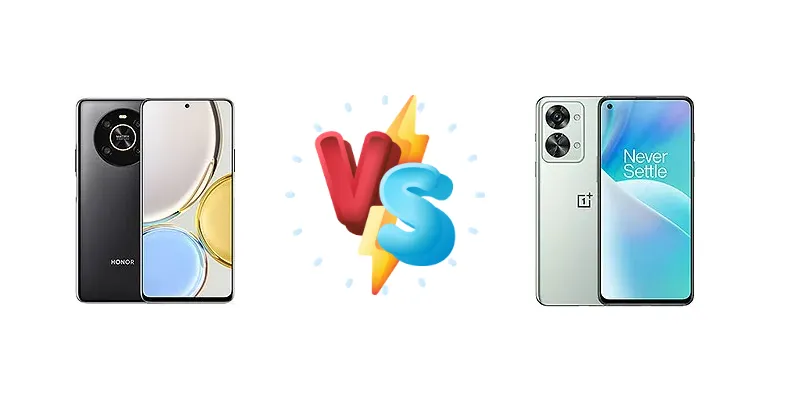
The mid-range smartphone market is fiercely competitive, and the Honor X9 and OnePlus Nord 2T represent compelling options for budget-conscious buyers. The X9 focuses on efficient performance with a Snapdragon 680, while the Nord 2T aims for a more powerful experience with the MediaTek Dimensity 1300. This comparison dissects their key differences to determine which device best suits your needs.
🏆 Quick Verdict
For the average user prioritizing a balance of efficiency and smooth daily performance, the OnePlus Nord 2T emerges as the stronger contender. Its Dimensity 1300 chipset delivers significantly more processing power, and the 80W SuperVOOC charging provides a faster top-up than the Honor X9’s 66W charging, despite both phones boasting a 100-hour endurance rating.
| Network |
|---|
| 2G bands | GSM 850 / 900 / 1800 / 1900 | GSM 850 / 900 / 1800 / 1900 |
| 3G bands | HSDPA 850 / 900 / 1900 / 2100 | HSDPA 800 / 850 / 900 / 1700(AWS) / 1800 / 1900 / 2100 |
| 4G bands | LTE | 1, 2, 3, 4, 5, 7, 8, 12, 17, 18, 19, 20, 26, 28, 32, 34, 38, 39, 40, 41, 66 |
| 5G bands | - | 1, 3, 7, 8, 20, 28, 38, 41, 78 SA/NSA |
| Speed | HSPA, LTE | HSPA 42.2/5.76 Mbps, LTE Cat18 1200/150 Mbps, 5G |
| Technology | GSM / HSPA / LTE | GSM / HSPA / LTE / 5G |
| Launch |
|---|
| Announced | 2022, March 31 | 2022, May 19 |
| Status | Available. Released 2022, April 14 | Available. Released 2022, May 21 |
| Body |
|---|
| Build | - | Glass front (Gorilla Glass 5), plastic frame |
| Dimensions | 166.1 x 75.8 x 8.1 mm (6.54 x 2.98 x 0.32 in) | 159.1 x 73.2 x 8.2 mm (6.26 x 2.88 x 0.32 in) |
| SIM | · Nano-SIM· Nano-SIM + Nano-SIM | Nano-SIM + Nano-SIM |
| Weight | 189 g (6.67 oz) | 190 g (6.70 oz) |
| Display |
|---|
| Protection | - | Corning Gorilla Glass 5 |
| Resolution | 1080 x 2388 pixels (~385 ppi density) | 1080 x 2400 pixels, 20:9 ratio (~409 ppi density) |
| Size | 6.81 inches, 112.3 cm2 (~89.2% screen-to-body ratio) | 6.43 inches, 99.8 cm2 (~85.7% screen-to-body ratio) |
| Type | IPS LCD, 90Hz | AMOLED, 90Hz, HDR10+ |
| Platform |
|---|
| CPU | Octa-core (4x2.4 GHz Kryo 265 Gold & 4x1.9 GHz Kryo 265 Silver) | Octa-core (1x3.0 GHz Cortex-A78 & 3x2.6 GHz Cortex-A78 & 4x2.0 GHz Cortex-A55) |
| Chipset | Qualcomm SM6225 Snapdragon 680 4G (6 nm) | Mediatek Dimensity 1300 (6 nm) |
| GPU | Adreno 610 | Mali-G77 MC9 |
| OS | Android 11, Magic UI 4.2 | Android 12, upgradable to Android 14, OxygenOS 14 |
| Memory |
|---|
| Card slot | No | No |
| Internal | 128GB 6GB RAM, 128GB 8GB RAM | 128GB 8GB RAM, 256GB 12GB RAM |
| | - | UFS 3.1 |
| Main Camera |
|---|
| Features | LED flash, panorama, HDR | Dual-LED flash, HDR, panorama |
| Quad | 64 MP, f/1.8, 26mm (wide), PDAF
8 MP, f/2.2, (ultrawide)
2 MP (macro)
Auxiliary lens | - |
| Single | - | 32 MP, f/2.4, (wide), 1/2.8", 0.8µm |
| Triple | - | 50 MP, f/1.9, 24mm (wide), 1/1.56", 1.0µm, PDAF, OIS
8 MP, f/2.2, 120˚ (ultrawide)
Auxiliary lens |
| Video | 1080p@30fps | 4K@30fps, 1080p@30/60/120/480fps, gyro-EIS |
| Selfie camera |
|---|
| Features | - | Auto HDR |
| Single | 16 MP, f/2.5 | 32 MP, f/2.4, (wide), 1/2.8", 0.8µm |
| Video | 1080p@30fps | 1080p@30fps, gyro-EIS |
| Sound |
|---|
| 3.5mm jack | No | No |
| 35mm jack | No | No |
| Loudspeaker | Yes | Yes, with stereo speakers |
| Comms |
|---|
| Bluetooth | 5.1, A2DP, LE | 5.2, A2DP, LE, aptX HD |
| NFC | Yes | Yes |
| Positioning | GPS, GLONASS, GALILEO, BDS | GPS, GLONASS, GALILEO, BDS, NavIC |
| Radio | No | No |
| USB | USB Type-C 2.0, OTG | USB Type-C 2.0, OTG |
| WLAN | Wi-Fi 802.11 a/b/g/n/ac, dual-band, Wi-Fi Direct | Wi-Fi 802.11 a/b/g/n/ac/6, dual-band, Wi-Fi Direct |
| Features |
|---|
| Sensors | Fingerprint (side-mounted), accelerometer, compass | Fingerprint (under display, optical), accelerometer, gyro, proximity, compass |
| | Virtual proximity sensing | - |
| Battery |
|---|
| Charging | 66W wired, 81% in 30 min | 80W wired, PD |
| Type | Li-Po 4800 mAh | Li-Po 4500 mAh |
| Misc |
|---|
| Colors | Titanium Silver, Ocean Blue, Midnight Black | Gray Shadow, Jade Fog |
| Models | - | CPH2399, CPH2401 |
| Price | About 230 EUR | € 144.39 / $ 169.99 / ₹ 31,490 |
| Tests |
|---|
| Battery life | - |
Endurance rating 100h
|
| Camera | - |
Photo / Video |
| Display | - |
Contrast ratio: Infinite (nominal) |
| Loudspeaker | - |
-25.6 LUFS (Very good)
|
| Performance | - |
AnTuTu: 490545 (v8) | 604467 (v9)
GeekBench: 2790 (v5.1)
GFXBench: 40fps (ES 3.1 onscreen) |
Honor X9
- Excellent power efficiency with Snapdragon 680
- Competitive 66W fast charging
- Potentially lower price point
- Significantly less powerful CPU than Nord 2T
- Likely limited to 60Hz display refresh rate
- Limited performance for demanding games
OnePlus Nord 2T
- Powerful MediaTek Dimensity 1300 chipset
- 80W SuperVOOC charging with PD
- Likely higher display brightness and refresh rate
- Potentially higher price
- Dimensity 1300 may generate more heat under sustained load
- Battery life may be slightly less efficient than X9
Display Comparison
The OnePlus Nord 2T boasts a measured peak brightness of 636 nits, suggesting a more visible display in direct sunlight compared to the Honor X9, for which brightness data is unavailable. While both displays are likely to utilize AMOLED technology (based on brand trends), the Nord 2T’s 'Infinite' contrast ratio indicates a superior black level and overall image quality. The absence of refresh rate information for the X9 suggests it may be limited to 60Hz, while the Nord 2T is likely to offer a smoother 90Hz or 120Hz experience, enhancing scrolling and animations.
Camera Comparison
Both devices offer photo and video capabilities, but detailed sensor information is lacking for both. However, the chipset difference suggests the Nord 2T will benefit from a more capable image signal processor (ISP) within the Dimensity 1300, leading to better image processing, noise reduction, and dynamic range. Without specific sensor size or aperture data, it’s difficult to definitively declare a winner, but the Nord 2T’s processing power gives it an edge. The presence of a 2MP macro camera on either device is unlikely to significantly impact overall image quality and should be considered a secondary feature.
Performance
The core difference lies in the chipsets. The OnePlus Nord 2T’s MediaTek Dimensity 1300, built on a 6nm process, features a more powerful CPU configuration – a 1x3.0 GHz Cortex-A78 core alongside 3x2.6 GHz Cortex-A78 cores and 4x2.0 GHz Cortex-A55 cores – compared to the Honor X9’s Qualcomm Snapdragon 680 (4x2.4 GHz Kryo 265 Gold & 4x1.9 GHz Kryo 265 Silver). This translates to a substantial performance advantage for the Nord 2T in CPU-intensive tasks and gaming. While both are 6nm chips, the Dimensity 1300’s architecture is more modern and efficient, offering better sustained performance. The X9’s Snapdragon 680 prioritizes power efficiency over raw speed.
Battery Life
Both the Honor X9 and OnePlus Nord 2T achieve an endurance rating of 100 hours, indicating comparable battery life under similar usage conditions. However, the charging speeds differ significantly. The Nord 2T’s 80W SuperVOOC charging with PD support allows for a much faster recharge – a full charge is achievable in under 30 minutes. The Honor X9’s 66W charging, while still fast, takes longer to reach 100%, reaching 81% in 30 minutes. This faster charging capability on the Nord 2T is a significant convenience factor for users who frequently need to top up their battery.
Buying Guide
Buy the Honor X9 if you prioritize long-term battery efficiency and a consistently smooth experience for basic tasks like browsing, social media, and calls. It’s ideal for users who don’t heavily game or require demanding app performance. Buy the OnePlus Nord 2T if you value faster processing speeds for gaming, multitasking, and content creation, and appreciate the convenience of significantly faster charging. This phone is geared towards users who push their smartphones harder.
Frequently Asked Questions
❓ Does the MediaTek Dimensity 1300 in the OnePlus Nord 2T tend to overheat during prolonged gaming sessions?
While the Dimensity 1300 is a powerful chip, it can generate more heat than the Snapdragon 680 under sustained load. However, OnePlus typically implements effective thermal management solutions, including vapor chamber cooling, to mitigate overheating. Expect some throttling during extended gaming, but it shouldn't lead to significant performance drops in most scenarios.
❓ Is the 66W charging on the Honor X9 sufficient for a full day's use, even with moderate to heavy usage?
The 66W charging on the Honor X9 is reasonably fast, and combined with the Snapdragon 680's power efficiency, it should be sufficient to provide a full day's use for most users. However, if you consistently engage in demanding tasks like gaming or video streaming, you might find yourself needing to top up the battery during the day. It reaches 81% in 30 minutes.
❓ How does the Snapdragon 680 handle multitasking compared to the Dimensity 1300?
The Dimensity 1300’s more powerful CPU and GPU architecture provide a significantly smoother multitasking experience. While the Snapdragon 680 can handle basic multitasking, the Nord 2T will exhibit less lag and stutter when switching between multiple apps or running resource-intensive applications simultaneously.