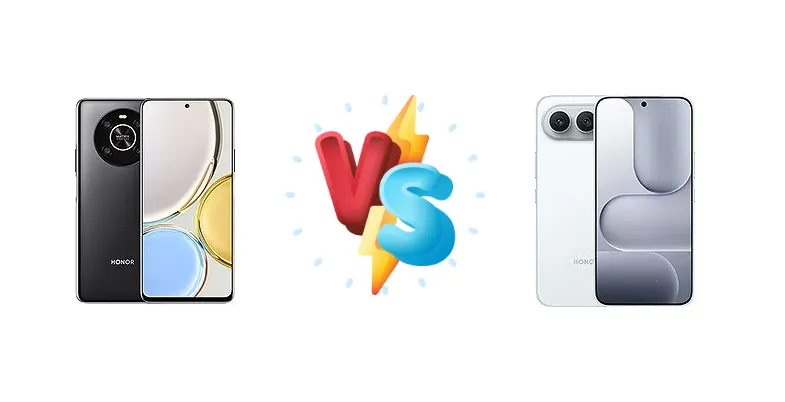
The Honor 500 and X9 represent distinct approaches within Honor’s smartphone lineup. The X9 aims for accessible pricing and solid everyday performance, while the 500 steps up with a more powerful processor and faster charging, targeting users who demand more from their device. This comparison dissects the key differences to help you determine which Honor phone best suits your needs.
🏆 Quick Verdict
For the average user prioritizing performance and future-proofing, the Honor 500 is the clear winner. Its Snapdragon 8s Gen 4 chipset offers a substantial leap in processing power and gaming capabilities. However, the Honor X9 remains a compelling option for budget-conscious buyers who value efficiency and a lower price point.
| Network |
|---|
| 2G bands | GSM 850 / 900 / 1800 / 1900 | GSM 850 / 900 / 1800 / 1900 |
| 3G bands | HSDPA 850 / 900 / 1900 / 2100 | HSDPA 800 / 850 / 900 / 1700(AWS) / 1900 / 2100 |
| 4G bands | LTE | LTE |
| 5G bands | - | SA/NSA |
| Speed | HSPA, LTE | HSPA, LTE, 5G |
| Technology | GSM / HSPA / LTE | GSM / HSPA / LTE / 5G |
| Launch |
|---|
| Announced | 2022, March 31 | 2025, November 24 |
| Status | Available. Released 2022, April 14 | Available. Released 2025, November 27 |
| Body |
|---|
| Build | - | Glass front, aluminum frame |
| Dimensions | 166.1 x 75.8 x 8.1 mm (6.54 x 2.98 x 0.32 in) | 155.8 x 74.2 x 7.8 mm (6.13 x 2.92 x 0.31 in) |
| SIM | · Nano-SIM· Nano-SIM + Nano-SIM | Nano-SIM + Nano-SIM |
| Weight | 189 g (6.67 oz) | 198 g (6.98 oz) |
| Display |
|---|
| Protection | - | Aluminosilicate glass |
| Resolution | 1080 x 2388 pixels (~385 ppi density) | 1264 x 2736 pixels, 19.5:9 ratio (~460 ppi density) |
| Size | 6.81 inches, 112.3 cm2 (~89.2% screen-to-body ratio) | 6.55 inches, 105.4 cm2 (~91.2% screen-to-body ratio) |
| Type | IPS LCD, 90Hz | AMOLED, 1B colors, 120Hz, 3840Hz PWM, HDR Vivid, 6000 nits (peak) |
| Platform |
|---|
| CPU | Octa-core (4x2.4 GHz Kryo 265 Gold & 4x1.9 GHz Kryo 265 Silver) | Octa-core (1x3.21 GHz Cortex-X4 & 3x3.0 GHz Cortex-A720 & 2x2.8 GHz Cortex-A720 & 2x2.0 GHz Cortex-A720) |
| Chipset | Qualcomm SM6225 Snapdragon 680 4G (6 nm) | Qualcomm SM8735 Snapdragon 8s Gen 4 (4 nm) |
| GPU | Adreno 610 | Adreno 825 |
| OS | Android 11, Magic UI 4.2 | Android 16, MagicOS 10 |
| Memory |
|---|
| Card slot | No | No |
| Internal | 128GB 6GB RAM, 128GB 8GB RAM | 256GB 12GB RAM, 512GB 12GB RAM, 512GB 16GB RAM |
| Main Camera |
|---|
| Dual | - | 200 MP, f/1.9, (wide), 1/1.4", 0.56µm, PDAF, OIS
12 MP, f/2.2, 117˚ (ultrawide), AF |
| Features | LED flash, panorama, HDR | LED flash, HDR, panorama |
| Quad | 64 MP, f/1.8, 26mm (wide), PDAF
8 MP, f/2.2, (ultrawide)
2 MP (macro)
Auxiliary lens | - |
| Video | 1080p@30fps | 4K, 1080p, gyro-EIS, OIS |
| Selfie camera |
|---|
| Features | - | HDR |
| Single | 16 MP, f/2.5 | 50 MP, f/2.0, (wide) |
| Video | 1080p@30fps | 4K, 1080p, gyro-EIS |
| Sound |
|---|
| 3.5mm jack | No | - |
| 35mm jack | No | No |
| Loudspeaker | Yes | Yes, with stereo speakers |
| Comms |
|---|
| Bluetooth | 5.1, A2DP, LE | 6.0, A2DP, LE, aptX HD, aptX Adaptive, aptX Lossless, LHDC 5, Auracast, ASHA |
| Infrared port | - | Yes |
| NFC | Yes | Yes |
| Positioning | GPS, GLONASS, GALILEO, BDS | GPS (L1+L5), GLONASS (L1), BDS (B1I+B1c+B2a+B2b), GALILEO (E1+E5a+E5b), QZSS (L1+L5), NavIC (L5) |
| Radio | No | No |
| USB | USB Type-C 2.0, OTG | USB Type-C 2.0, OTG |
| WLAN | Wi-Fi 802.11 a/b/g/n/ac, dual-band, Wi-Fi Direct | Wi-Fi 802.11 a/b/g/n/ac/6/7, dual-band, Wi-Fi Direct |
| Features |
|---|
| Sensors | Fingerprint (side-mounted), accelerometer, compass | Fingerprint (under display, optical), accelerometer, gyro, proximity, compass (ultrasound) |
| | Virtual proximity sensing | - |
| Battery |
|---|
| Charging | 66W wired, 81% in 30 min | 80W wired
5W reverse wired |
| Type | Li-Po 4800 mAh | Si/C Li-Ion 8000 mAh |
| Misc |
|---|
| Colors | Titanium Silver, Ocean Blue, Midnight Black | Black, Silver, Blue, Pink |
| Models | - | MEY-AN00 |
| Price | About 230 EUR | About 330 EUR |
Honor X9
- More affordable price point
- Efficient Snapdragon 680 chipset for everyday tasks
- Respectable 66W wired charging
- Significantly lower performance compared to the 500
- Likely lacks advanced camera features
Honor 500
- Powerful Snapdragon 8s Gen 4 for gaming and demanding apps
- Faster 80W wired charging with 5W reverse charging
- Likely superior camera system
- Higher price tag
- Potentially shorter battery life due to increased power consumption
Display Comparison
Display specifications are not provided for either device. However, given the X9’s positioning, it likely features a standard LCD panel, while the 500, being a more premium offering, may incorporate an AMOLED display for richer colors and deeper blacks. The absence of details like refresh rate and resolution makes a direct comparison difficult, but the 500’s higher price suggests a superior visual experience. Bezels are also likely to be slimmer on the 500, contributing to a more modern aesthetic.
Camera Comparison
Camera details are absent, but we can infer some differences. The Honor 500, positioned higher in the market, likely boasts a more sophisticated camera system with a larger main sensor and optical image stabilization (OIS). The Snapdragon 8s Gen 4’s ISP (Image Signal Processor) also offers advanced image processing capabilities. The X9 will likely feature a more basic camera setup, adequate for casual photography but lacking the dynamic range and low-light performance of the 500. The absence of information prevents a detailed analysis of lens apertures and secondary sensors.
Performance
The core difference lies in the chipsets. The Honor 500’s Snapdragon 8s Gen 4 (4nm) is a significant upgrade over the X9’s Snapdragon 680 (6nm). The 8s Gen 4 features a Cortex-X4 prime core clocked at 3.21 GHz, alongside three Cortex-A720 cores at 3.0 GHz and two more at 2.8 GHz, offering substantially higher peak performance. The X9’s octa-core CPU, while efficient, is geared towards everyday tasks, with its Kryo 265 Gold cores peaking at 2.4 GHz. The 4nm process node of the 8s Gen 4 also translates to improved thermal efficiency, reducing throttling during sustained workloads. Gamers and power users will overwhelmingly benefit from the 500’s superior processing capabilities.
Battery Life
Battery capacities are not specified. However, the Honor 500’s 80W wired charging is a clear advantage over the X9’s 66W charging. The 500 can reach 81% charge in 30 minutes, suggesting a full charge in under 45 minutes. The 500 also supports 5W reverse wired charging, a feature absent on the X9. While the X9’s charging speed is respectable, the 500’s faster charging minimizes downtime, a crucial benefit for power users. The actual battery life will depend on the mAh capacity of each device, but the 500’s more efficient chipset could offset a potentially smaller battery.
Buying Guide
Buy the Honor X9 if you need a reliable daily driver for basic tasks, social media, and light gaming, and prioritize long battery life and affordability. Buy the Honor 500 if you prefer a smoother experience with demanding apps, enjoy mobile gaming, and appreciate faster charging speeds, even if it means a higher upfront cost.
Frequently Asked Questions
❓ Will the Snapdragon 680 in the Honor X9 struggle with graphically intensive games like Genshin Impact?
Yes, the Snapdragon 680 is a mid-range chipset and will likely struggle to deliver a smooth experience in demanding games like Genshin Impact, even at lower settings. Expect noticeable frame drops and potential overheating. The Honor 500’s Snapdragon 8s Gen 4 is far better equipped to handle such titles.
❓ Does the Honor 500’s faster charging generate excessive heat during the charging process?
While 80W charging is fast, the Snapdragon 8s Gen 4’s 4nm process and Honor’s thermal management systems should mitigate excessive heat buildup. However, some warmth during charging is normal. The 500 is designed to optimize charging speed while maintaining safe operating temperatures.
❓ Is the lack of detailed camera specifications a concern for the Honor 500 and X9?
Yes, the absence of sensor size, aperture, and OIS details makes a precise camera comparison impossible. However, based on market positioning, the 500 is expected to have a more advanced camera system overall, even without specific numbers.