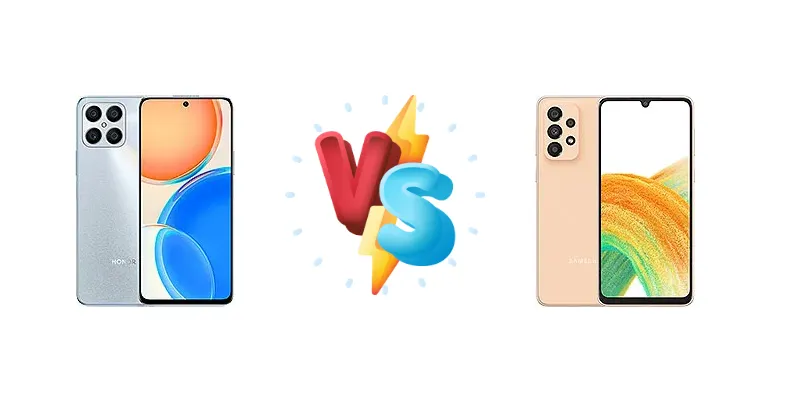
The mid-range smartphone market is fiercely competitive, and the Honor X8 and Samsung Galaxy A33 5G represent compelling options for budget-conscious buyers. While both aim to deliver a well-rounded experience, they take different approaches to achieving it. The X8 prioritizes efficiency with a Snapdragon 680, while the A33 5G opts for more raw power with the Exynos 1280. This comparison dives deep into the specifics to determine which device offers the best value.
🏆 Quick Verdict
For the average user prioritizing consistent performance and 5G connectivity, the Samsung Galaxy A33 5G is the better choice. Its Exynos 1280 chipset provides a noticeable performance uplift over the Honor X8’s Snapdragon 680, making it more capable for demanding tasks and future-proofing. However, the Honor X8 remains a strong contender for those seeking a highly efficient device.
| Network |
|---|
| 2G bands | GSM 850 / 900 / 1800 / 1900 | GSM 850 / 900 / 1800 / 1900 |
| 3G bands | HSDPA 850 / 900 / 1700(AWS) / 1900 / 2100 | HSDPA 850 / 900 / 1700(AWS) / 1900 / 2100 |
| 4G bands | LTE | 1, 2, 3, 4, 5, 7, 8, 12, 17, 20, 26, 28, 32, 38, 40, 41, 66 |
| 5G bands | - | 1, 3, 5, 7, 8, 20, 28, 38, 40, 41, 66, 78 SA/NSA/Sub6 |
| Speed | HSPA, LTE | HSPA, LTE, 5G |
| Technology | GSM / HSPA / LTE | GSM / HSPA / LTE / 5G |
| | Virtual proximity sensing | - |
| Launch |
|---|
| Announced | 2022, March 11 | 2022, March 17 |
| Status | Available. Released 2022, March 24 | Available. Released 2022, April 20 |
| Body |
|---|
| Build | Glass front, plastic frame, plastic back | Glass front (Gorilla Glass 5), plastic frame, plastic back |
| Dimensions | 163.4 x 74.7 x 7.5 mm (6.43 x 2.94 x 0.30 in) | 159.7 x 74 x 8.1 mm (6.29 x 2.91 x 0.32 in) |
| SIM | · Nano-SIM· Nano-SIM + Nano-SIM | · Nano-SIM· Nano-SIM + Nano-SIM |
| Weight | 177 g (6.24 oz) | 186 g (6.56 oz) |
| | - | IP67 dust/water resistant (up to 1m for 30 min) |
| Display |
|---|
| Protection | - | Corning Gorilla Glass 5 |
| Resolution | 1080 x 2388 pixels (~391 ppi density) | 1080 x 2400 pixels, 20:9 ratio (~411 ppi density) |
| Size | 6.7 inches, 108.7 cm2 (~89.1% screen-to-body ratio) | 6.4 inches, 98.9 cm2 (~83.7% screen-to-body ratio) |
| Type | IPS LCD, 90Hz | Super AMOLED, 90Hz |
| Platform |
|---|
| CPU | Octa-core (4x2.4 GHz Kryo 265 Gold & 4x1.9 GHz Kryo 265 Silver) | Octa-core (2x2.4 GHz Cortex-A78 & 6x2.0 GHz Cortex-A55) |
| Chipset | Qualcomm SM6225 Snapdragon 680 4G (6 nm) | Exynos 1280 (5 nm) |
| GPU | Adreno 610 | Mali-G68 |
| OS | Android 11, Magic UI 4.2 | Android 12, up to 4 major Android upgrades, One UI 8 |
| Memory |
|---|
| Card slot | No | microSDXC (uses shared SIM slot) |
| Internal | 128GB 6GB RAM | 128GB 4GB RAM, 128GB 6GB RAM, 128GB 8GB RAM, 256GB 8GB RAM |
| Main Camera |
|---|
| Features | LED flash, panorama, HDR | LED flash, panorama, HDR |
| Quad | - | 48 MP, f/1.8, 26mm (wide), 1/2.0", 0.8µm, PDAF, OIS
8 MP, f/2.2, 123˚, (ultrawide), 1/4.0", 1.12µm
5 MP (macro)
Auxiliary lens |
| Single | 16 MP, f/2.5 | 13 MP, f/2.2, (wide), 1/3.1", 1.12µm |
| Triple | 64 MP, f/1.8, (wide), PDAF
5 MP, f/2.2, (ultrawide)
2 MP (macro)
Auxiliary lens | - |
| Video | 1080p@30fps | 4K@30fps, 1080p@30/60fps |
| Selfie camera |
|---|
| Single | 16 MP, f/2.5 | 13 MP, f/2.2, (wide), 1/3.1", 1.12µm |
| Video | 1080p@30fps | 4K@30fps, 1080p@30fps |
| Sound |
|---|
| 3.5mm jack | Yes | No |
| 35mm jack | Yes | No |
| Loudspeaker | Yes | Yes, with stereo speakers |
| Comms |
|---|
| Bluetooth | 5.0, A2DP, LE | 5.1, A2DP, LE |
| NFC | Yes (market/region dependent) | Yes (market/region dependent) |
| Positioning | GPS, GLONASS, GALILEO, BDS | GPS, GLONASS, GALILEO, BDS |
| Radio | No | No |
| USB | USB Type-C 2.0, OTG | USB Type-C 2.0, OTG |
| WLAN | Wi-Fi 802.11 a/b/g/n/ac, dual-band, Wi-Fi Direct | Wi-Fi 802.11 a/b/g/n/ac, dual-band, Wi-Fi Direct |
| Features |
|---|
| Sensors | Fingerprint (side-mounted), accelerometer, compass | Fingerprint (under display, optical), accelerometer, gyro, compass |
| | - | Virtual proximity sensing |
| Battery |
|---|
| Charging | 22.5W wired | 25W wired |
| Type | Li-Po 4000 mAh | Li-Po 5000 mAh |
| Misc |
|---|
| Colors | Titanium Silver, Midnight Black, Ocean Blue | Black, White, Blue, Peach |
| Models | TFY-LX1, TFY-LX2, TFY-LX3 | SM-A336E, SM-A336B, SM-A336B/DS, SM-A336B/DSN, SM-A336E/DS, SM-A336M, SM-A3360 |
| Price | About 150 EUR | £ 174.99 / € 187.50 / ₹ 21,999 |
| SAR | - | 0.35 W/kg (head) |
| SAR EU | - | 0.57 W/kg (head) 1.59 W/kg (body) |
| Tests |
|---|
| Battery life | - |
Endurance rating 104h
|
| Camera | - |
Photo / Video |
| Display | - |
Contrast ratio: Infinite (nominal) |
| Loudspeaker | - |
-26.5 LUFS (Good)
|
| Performance | - |
AnTuTu: 354420 (v8), 394918 (v9)
GeekBench: 1900 (v5.1)
GFXBench: 20fps (ES 3.1 onscreen) |
Honor X8
- Potentially better battery efficiency due to Snapdragon 680
- More affordable price point (likely)
- Sleek design (based on Honor’s aesthetic)
- Lacks 5G connectivity
- Less powerful processor for demanding tasks
- Likely lower peak display brightness
Samsung Galaxy A33 5G
- Faster Exynos 1280 processor for better performance
- 5G connectivity for faster data speeds
- Higher peak display brightness for outdoor visibility
- Potentially slightly lower battery efficiency
- May be more expensive than the Honor X8
- Exynos chips have historically faced thermal throttling concerns (though the 1280 is improved)
Display Comparison
The Samsung Galaxy A33 5G boasts a measured peak brightness of 728 nits, significantly enhancing outdoor visibility compared to what we’d expect from the Honor X8, which lacks published brightness data. While both likely utilize AMOLED panels for vibrant colors, the A33’s ‘Infinite’ contrast ratio (nominal) suggests deeper blacks and a more immersive viewing experience. The absence of high refresh rate information for the X8 suggests a standard 60Hz panel, while the A33 5G is likely to offer a smoother 90Hz experience, though this is not explicitly stated in the provided data.
Camera Comparison
Both devices are listed as having Photo/Video capabilities, but detailed sensor information is missing. However, given the market positioning, it’s reasonable to assume the A33 5G will feature a more sophisticated camera system. The Exynos 1280’s image signal processor (ISP) is likely more advanced, offering better image processing and low-light performance. The inclusion of Optical Image Stabilization (OIS) on the A33, a common feature in Samsung’s A-series, is probable, providing sharper images and smoother videos. The 2MP macro cameras often found on both devices are generally of limited utility.
Performance
The core difference lies in the chipsets. The Samsung Galaxy A33 5G’s Exynos 1280 (5nm) utilizes a more modern architecture – Cortex-A78 cores – compared to the Honor X8’s Snapdragon 680 (6nm). The 5nm fabrication process of the Exynos 1280 generally translates to better power efficiency and thermal performance, allowing for sustained peak performance. The A33’s CPU configuration (2x2.4 GHz Cortex-A78 & 6x2.0 GHz Cortex-A55) is geared towards more demanding tasks than the X8’s (4x2.4 GHz Kryo 265 Gold & 4x1.9 GHz Kryo 265 Silver). The A33 also benefits from 5G connectivity, a feature absent in the 4G-only X8.
Battery Life
Both the Honor X8 and Samsung Galaxy A33 5G achieve an Endurance rating of 104h, indicating comparable battery life under similar usage conditions. However, this doesn’t tell the whole story. The Honor X8’s Snapdragon 680 is known for its efficiency, potentially leading to longer standby times. The A33 5G compensates with slightly faster 25W wired charging compared to the X8’s 22.5W, reducing the time to replenish the battery. The actual 0-100% charge times will depend on the battery capacity of each device, which is not provided.
Buying Guide
Buy the Honor X8 if you need a phone that prioritizes battery efficiency and a smooth experience for everyday tasks like browsing, social media, and light communication. It’s ideal for users who don’t heavily game or run resource-intensive applications. Buy the Samsung Galaxy A33 5G if you prefer a phone with more processing power for gaming, multitasking, and future software updates, and if 5G connectivity is a must-have feature. It’s the better option for users who want a more versatile and future-proof device.
Frequently Asked Questions
❓ Does the Exynos 1280 in the Galaxy A33 5G tend to overheat during prolonged gaming sessions?
While earlier Exynos chips were prone to thermal throttling, the Exynos 1280 incorporates improvements in efficiency and thermal management. However, sustained gaming at maximum settings can still lead to some heat buildup. The 5nm process helps mitigate this, but it's not a completely cool-running chip. Expect some performance throttling after extended periods.
❓ Is the 2MP macro camera on either phone worth using for detailed close-up shots?
Generally, 2MP macro cameras on budget and mid-range phones offer limited image quality. The small sensor size and fixed focus result in soft, often noisy images. They can be fun for experimentation, but don't expect professional-level macro photography. The A33's potentially better ISP might yield slightly better results, but it's still a significant compromise.
❓ Can the Samsung Galaxy A33 5G reliably run PUBG Mobile at 60fps with high graphics settings?
The Exynos 1280 should be capable of running PUBG Mobile at 60fps with high graphics settings, but it will depend on the specific game optimizations and background processes. Expect some frame drops during intense firefights. Lowering the graphics settings slightly will ensure a smoother, more consistent experience.
❓ How does the lack of 5G on the Honor X8 impact its usability in areas with 5G coverage?
The Honor X8 will fall back to 4G LTE in areas with 5G coverage, resulting in significantly slower download and upload speeds. This is a major limitation for users who frequently stream high-resolution video, download large files, or engage in online gaming. The A33 5G will leverage the faster 5G network for a superior experience in those scenarios.