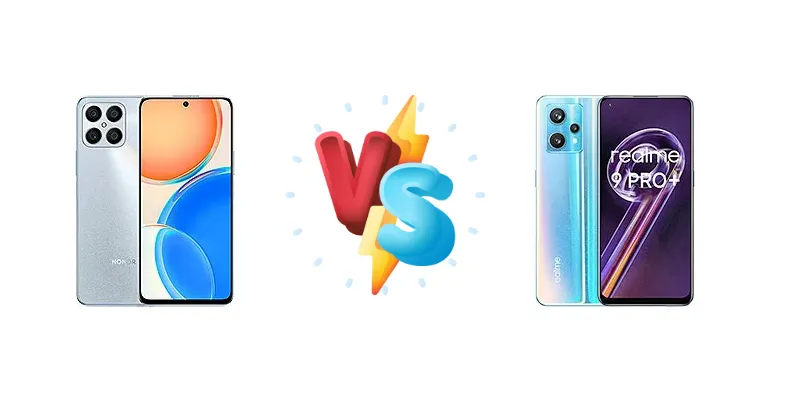
The mid-range smartphone market is fiercely competitive, and the Honor X8 and Realme 9 Pro+ represent compelling options for budget-conscious buyers. While both aim to deliver a solid experience, they take distinctly different approaches. The Honor X8 prioritizes efficiency with its Snapdragon 680, while the Realme 9 Pro+ swings for the fences with the more powerful Dimensity 920 and significantly faster charging. This comparison will dissect their strengths and weaknesses to determine which device best suits your needs.
🏆 Quick Verdict
For users prioritizing raw performance and rapid charging, the Realme 9 Pro+ is the clear winner. Its Dimensity 920 chipset offers a substantial performance uplift over the Snapdragon 680 in the Honor X8, and the 60W charging dramatically reduces downtime. However, the Honor X8 remains a viable option for those seeking a more efficient device with respectable battery life at a potentially lower price point.
| Network |
|---|
| 2G bands | GSM 850 / 900 / 1800 / 1900 | GSM 850 / 900 / 1800 / 1900 - SIM 1 & SIM 2 |
| 3G bands | HSDPA 850 / 900 / 1700(AWS) / 1900 / 2100 | HSDPA 850 / 900 / 1700(AWS) / 1900 / 2100 |
| 4G bands | LTE | 1, 2, 3, 4, 5, 7, 8, 12, 13, 17, 18, 19, 20, 26, 28, 38, 39, 40, 41, 66 - International |
| 5G bands | - | 1, 3, 5, 7, 8, 20, 28, 38, 40, 41, 66, 77, 78 SA/NSA - International |
| Speed | HSPA, LTE | HSPA, LTE-A, 5G |
| Technology | GSM / HSPA / LTE | GSM / HSPA / LTE / 5G |
| | Virtual proximity sensing | 1, 28, 41, 77, 78 SA/NSA - India |
| Launch |
|---|
| Announced | 2022, March 11 | 2022, February 16 |
| Status | Available. Released 2022, March 24 | Available. Released 2022, February 21 |
| Body |
|---|
| Build | Glass front, plastic frame, plastic back | Glass front (Gorilla Glass 5), glass back |
| Dimensions | 163.4 x 74.7 x 7.5 mm (6.43 x 2.94 x 0.30 in) | 160.2 x 73.3 x 8 mm (6.31 x 2.89 x 0.31 in) |
| SIM | · Nano-SIM· Nano-SIM + Nano-SIM | Dual SIM (Nano-SIM, dual stand-by) |
| Weight | 177 g (6.24 oz) | 182 g (6.42 oz) |
| Display |
|---|
| Protection | - | Corning Gorilla Glass 5 |
| Resolution | 1080 x 2388 pixels (~391 ppi density) | 1080 x 2400 pixels, 20:9 ratio (~411 ppi density) |
| Size | 6.7 inches, 108.7 cm2 (~89.1% screen-to-body ratio) | 6.4 inches, 98.9 cm2 (~84.2% screen-to-body ratio) |
| Type | IPS LCD, 90Hz | Super AMOLED, 90Hz, 430 nits (typ), 600 nits (HBM) |
| Platform |
|---|
| CPU | Octa-core (4x2.4 GHz Kryo 265 Gold & 4x1.9 GHz Kryo 265 Silver) | Octa-core (2x2.5 GHz Cortex-A78 & 6x2.0 GHz Cortex-A55) |
| Chipset | Qualcomm SM6225 Snapdragon 680 4G (6 nm) | Mediatek Dimensity 920 (6 nm) |
| GPU | Adreno 610 | Mali-G68 MC4 |
| OS | Android 11, Magic UI 4.2 | Android 12, upgradable to Android 13, Realme UI 4.0 |
| Memory |
|---|
| Card slot | No | No |
| Internal | 128GB 6GB RAM | 128GB 6GB RAM, 128GB 8GB RAM, 256GB 8GB RAM |
| | - | UFS 2.2 |
| Main Camera |
|---|
| Features | LED flash, panorama, HDR | LED flash, HDR, panorama |
| Single | 16 MP, f/2.5 | 16 MP, f/2.4, 27mm (wide), 1/3.09", 1.0µm |
| Triple | 64 MP, f/1.8, (wide), PDAF
5 MP, f/2.2, (ultrawide)
2 MP (macro)
Auxiliary lens | 50 MP, f/1.8, 24mm (wide), 1/1.56", 1.0µm, PDAF, OIS
8 MP, f/2.2, 119˚, 16mm (ultrawide), 1/4.0", 1.12µm
2 MP, f/2.4, (macro) |
| Video | 1080p@30fps | 4K@30fps, 1080p@30/60/120/480fps, 720p@960fps, gyro-EIS |
| Selfie camera |
|---|
| Features | - | HDR, panorama |
| Single | 16 MP, f/2.5 | 16 MP, f/2.4, 27mm (wide), 1/3.09", 1.0µm |
| Video | 1080p@30fps | 1080p@30fps, gyro-EIS |
| Sound |
|---|
| 3.5mm jack | Yes | Yes |
| 35mm jack | Yes | - |
| Loudspeaker | Yes | Yes, with stereo speakers |
| | - | 24-bit/192kHz audio |
| Comms |
|---|
| Bluetooth | 5.0, A2DP, LE | 5.2, A2DP, LE, aptX HD |
| NFC | Yes (market/region dependent) | Yes (market/region dependent) |
| Positioning | GPS, GLONASS, GALILEO, BDS | GPS, GLONASS, BDS |
| Radio | No | No |
| USB | USB Type-C 2.0, OTG | USB Type-C 2.0, OTG |
| WLAN | Wi-Fi 802.11 a/b/g/n/ac, dual-band, Wi-Fi Direct | Wi-Fi 802.11 a/b/g/n/ac/6, dual-band |
| Features |
|---|
| Sensors | Fingerprint (side-mounted), accelerometer, compass | Fingerprint (under display, optical), accelerometer, gyro, proximity, compass |
| Battery |
|---|
| Charging | 22.5W wired | 60W wired, PD3.0, 100% in 44 min (advertised) |
| Type | Li-Po 4000 mAh | Li-Po 4500 mAh, non-removable |
| Misc |
|---|
| Colors | Titanium Silver, Midnight Black, Ocean Blue | Midnight Black, Aurora Green, Sunrise Blue, Free Fire Limited Edition |
| Models | TFY-LX1, TFY-LX2, TFY-LX3 | RMX3392, RMX3393 |
| Price | About 150 EUR | € 289.90 / $ 390.00 / ₹ 25,999 |
| SAR | - | 1.19 W/kg (head) 0.73 W/kg (body) |
| Tests |
|---|
| Battery life | - |
Endurance rating 117h
|
| Camera | - |
Photo / Video |
| Display | - |
Contrast ratio: Infinite (nominal) |
| Loudspeaker | - |
-25.3 LUFS (Very good)
|
| Performance | - |
AnTuTu: 495096 (v8), 416031 (v9)
GeekBench: 2335 (v5.1)
GFXBench: 27fps (ES 3.1 onscreen) |
Honor X8
- Potentially lower price point
- Good battery efficiency with Snapdragon 680
- Reliable for everyday tasks
- Significantly slower charging speed
- Less powerful processor for gaming and multitasking
- Likely inferior camera performance
Realme 9 Pro+
- Much faster 60W charging
- Superior performance with Dimensity 920
- Likely better camera system
- Longer endurance rating
- Potentially higher price
- Dimensity 920 may run warmer under sustained load
Display Comparison
The provided data lacks detailed display specifications for either device. However, Realme typically equips its 'Pro+' models with high-quality displays. The 'Infinite' contrast ratio advertised for the Realme 9 Pro+ suggests an AMOLED panel, offering superior blacks and vibrant colors compared to the likely LCD panel on the Honor X8. Without knowing the peak brightness or refresh rates, it's difficult to make a definitive judgment, but the Realme 9 Pro+ likely offers a more visually immersive experience.
Camera Comparison
The context data is limited regarding camera specifics. However, Realme's 'Pro+' series often features a strong camera system. Without sensor size or aperture information, it's difficult to compare directly. The Honor X8 likely relies on a more basic camera setup to keep costs down. The Realme 9 Pro+ is likely to offer better image quality, especially in low-light conditions, and more advanced features like optical image stabilization (OIS) – a common inclusion in Realme's Pro+ line. The absence of details on the Honor X8's camera suggests it won't compete at the same level.
Performance
The core difference lies in the chipsets. The Realme 9 Pro+'s MediaTek Dimensity 920 (6nm) boasts a more modern architecture with 2x 2.5 GHz Cortex-A78 cores and 6x 2.0 GHz Cortex-A55 cores, designed for sustained performance. This contrasts with the Honor X8’s Qualcomm Snapdragon 680 (6nm) which utilizes 4x 2.4 GHz Kryo 265 Gold and 4x 1.9 GHz Kryo 265 Silver cores. The Cortex-A78 cores in the Dimensity 920 provide a significant advantage in CPU-intensive tasks and gaming. While both are 6nm chips, the Dimensity 920’s superior core configuration and GPU will translate to noticeably faster app loading times, smoother multitasking, and higher frame rates in games. The Realme 9 Pro+ is the clear winner for performance-focused users.
Battery Life
The Realme 9 Pro+’s 60W wired charging is a game-changer, advertised to reach 100% in just 44 minutes. This is a massive advantage over the Honor X8’s 22.5W charging. While the Honor X8 may have a slightly larger battery capacity (not specified in the data), the faster charging of the Realme 9 Pro+ minimizes downtime. The Realme 9 Pro+ also boasts an endurance rating of 117 hours, suggesting excellent battery optimization alongside its charging capabilities. The Honor X8 will likely offer respectable battery life, but the convenience of the Realme 9 Pro+'s rapid charging is a significant benefit.
Buying Guide
Buy the Honor X8 if you need a reliable daily driver with good battery life and aren't demanding of intensive gaming or heavy multitasking. It's ideal for users who prioritize efficiency and value. Buy the Realme 9 Pro+ if you prefer a smoother, more responsive experience, especially when gaming or using demanding apps, and if you value the convenience of incredibly fast charging. This phone is geared towards users who want a bit more 'oomph' from their device.
Frequently Asked Questions
❓ Will the Dimensity 920 in the Realme 9 Pro+ overheat during prolonged gaming sessions?
While the Dimensity 920 is a powerful chip, it can generate heat under sustained load. Realme typically implements thermal management solutions, but prolonged gaming at maximum settings may lead to some throttling. However, the overall performance uplift compared to the Snapdragon 680 will likely still be noticeable even with some throttling.
❓ Is the 22.5W charging on the Honor X8 slow enough to be a major inconvenience?
Yes, 22.5W charging is considerably slower than the 60W charging on the Realme 9 Pro+. Expect significantly longer charging times, potentially taking over two hours to fully charge the device. This is a major trade-off for users who frequently need to top up their battery.
❓ Does the Realme 9 Pro+ support high refresh rate gaming, like 90fps in PUBG Mobile?
The Dimensity 920 is capable of supporting high refresh rates. While not explicitly stated, the Realme 9 Pro+ likely supports 90fps in PUBG Mobile at medium to high graphics settings, providing a smoother and more responsive gaming experience. Check Realme's official specifications for confirmation.
❓ How does the Snapdragon 680's efficiency impact the Honor X8's real-world battery life?
The Snapdragon 680 is known for its power efficiency. While the battery capacity isn't specified, the 680's efficiency should translate to all-day battery life for moderate users. However, it won't match the Realme 9 Pro+'s combination of battery life *and* rapid charging.