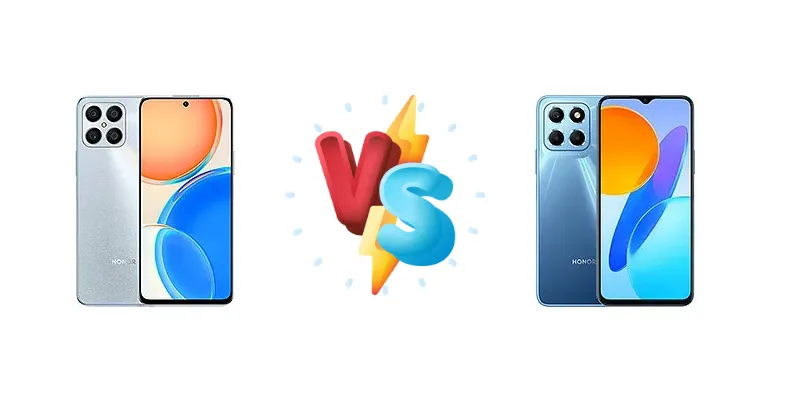
The Honor X8 series offers compelling budget-friendly smartphones, but choosing between the standard X8 and the 5G variant can be tricky. Both boast attractive designs and competitive features, but key differences in performance and connectivity set them apart. Let's dive into a detailed comparison to help you decide which one is right for you.
🏆 Quick Verdict
The Honor X8 5G offers the significant advantage of 5G connectivity, making it the better choice for future-proofing and faster data speeds. While the X8 has a slightly more powerful chipset, the 5G's connectivity and generally comparable performance make it the winner for most users.
| Network |
|---|
| 2G bands | GSM 850 / 900 / 1800 / 1900 | GSM 850 / 900 / 1800 / 1900 |
| 3G bands | HSDPA 850 / 900 / 1700(AWS) / 1900 / 2100 | HSDPA 850 / 900 / 1900 / 2100 |
| 4G bands | LTE | LTE |
| 5G bands | - | SA/NSA |
| Speed | HSPA, LTE | HSPA, LTE, 5G |
| Technology | GSM / HSPA / LTE | GSM / HSPA / LTE / 5G |
| | Virtual proximity sensing | - |
| Launch |
|---|
| Announced | 2022, March 11 | 2022, July 25 |
| Status | Available. Released 2022, March 24 | Available. Released 2022, August 15 |
| Body |
|---|
| Build | Glass front, plastic frame, plastic back | - |
| Dimensions | 163.4 x 74.7 x 7.5 mm (6.43 x 2.94 x 0.30 in) | 163.7 x 75.1 x 8.7 mm (6.44 x 2.96 x 0.34 in) |
| SIM | · Nano-SIM· Nano-SIM + Nano-SIM | Nano-SIM + Nano-SIM |
| Weight | 177 g (6.24 oz) | 194 g (6.84 oz) |
| Display |
|---|
| Resolution | 1080 x 2388 pixels (~391 ppi density) | 720 x 1600 pixels, 20:9 ratio (~270 ppi density) |
| Size | 6.7 inches, 108.7 cm2 (~89.1% screen-to-body ratio) | 6.5 inches, 102.0 cm2 (~83.0% screen-to-body ratio) |
| Type | IPS LCD, 90Hz | TFT LCD |
| Platform |
|---|
| CPU | Octa-core (4x2.4 GHz Kryo 265 Gold & 4x1.9 GHz Kryo 265 Silver) | Octa-core (2x2.2 GHz Kryo 460 & 6x1.9 GHz Kryo 460) |
| Chipset | Qualcomm SM6225 Snapdragon 680 4G (6 nm) | Qualcomm SM4350-AC Snapdragon 480+ 5G (8 nm) |
| GPU | Adreno 610 | Adreno 619 |
| OS | Android 11, Magic UI 4.2 | Android 11, Magic UI 4.2 |
| Memory |
|---|
| Card slot | No | microSDXC |
| Internal | 128GB 6GB RAM | 128GB 6GB RAM |
| Main Camera |
|---|
| Features | LED flash, panorama, HDR | LED flash, HDR, panorama |
| Single | 16 MP, f/2.5 | 8 MP, f/2.0, (wide) |
| Triple | 64 MP, f/1.8, (wide), PDAF
5 MP, f/2.2, (ultrawide)
2 MP (macro)
Auxiliary lens | 48 MP, f/1.8, (wide), PDAF
2 MP (macro)
Auxiliary lens |
| Video | 1080p@30fps | 1080p@30fps |
| Selfie camera |
|---|
| Single | 16 MP, f/2.5 | 8 MP, f/2.0, (wide) |
| Video | 1080p@30fps | 1080p@30fps |
| Sound |
|---|
| 3.5mm jack | Yes | Yes |
| 35mm jack | Yes | Yes |
| Loudspeaker | Yes | Yes |
| Comms |
|---|
| Bluetooth | 5.0, A2DP, LE | 5.1, A2DP, LE |
| NFC | Yes (market/region dependent) | Yes (VNE-N41 only) |
| Positioning | GPS, GLONASS, GALILEO, BDS | GPS, GLONASS, GALILEO, BDS |
| Radio | No | Unspecified |
| USB | USB Type-C 2.0, OTG | USB Type-C 2.0 |
| WLAN | Wi-Fi 802.11 a/b/g/n/ac, dual-band, Wi-Fi Direct | Wi-Fi 802.11 a/b/g/n/ac, dual-band, Wi-Fi Direct |
| Features |
|---|
| Sensors | Fingerprint (side-mounted), accelerometer, compass | Fingerprint (side-mounted), accelerometer, proximity, compass |
| Battery |
|---|
| Charging | 22.5W wired | 22.5W wired |
| Type | Li-Po 4000 mAh | Li-Po 5000 mAh |
| Misc |
|---|
| Colors | Titanium Silver, Midnight Black, Ocean Blue | Midnight Black, Ocean Blue |
| Models | TFY-LX1, TFY-LX2, TFY-LX3 | VNE-N41 |
| Price | About 150 EUR | About 170 EUR |
Honor X8
- Slightly more powerful chipset
- Potentially better low-light camera performance
- Good value for money
- No 5G connectivity
- May lack future-proofing
Honor X8 5G
- 5G connectivity
- Future-proofed for faster networks
- Generally smooth performance
- Slightly less powerful chipset than X8
- Potentially slightly shorter battery life
Display Comparison
Both phones feature a 6.7-inch FHD+ display, likely with similar color accuracy and brightness. While specific panel types (LCD vs AMOLED) aren't explicitly stated, expect a decent viewing experience for the price range. The resolution and size are essentially identical, so visual differences will be minimal.
Camera Comparison
Both phones likely feature a similar quad-camera setup, potentially including a 64MP main sensor, ultrawide, macro, and depth sensor. Image quality will be comparable in good lighting conditions, but the X8 might offer slightly better low-light performance due to its more powerful chipset. Video recording capabilities are likely similar.
Performance
The Honor X8's Snapdragon 680 (6nm) generally outperforms the Honor X8 5G's Snapdragon 480+ 5G (8nm) in raw processing power. However, the 5G's optimizations and software tuning might narrow the gap in real-world usage. Gaming performance will be better on the X8, but the 5G is still capable of handling casual games.
Battery Life
Both devices have a 5000mAh battery, suggesting similar battery life. The Honor X8's more efficient chipset *could* translate to slightly longer usage, but real-world performance will depend on usage patterns. Both support 22.5W fast charging, allowing for relatively quick top-ups.
Buying Guide
The Honor X8 is ideal for users who prioritize a slightly smoother experience in everyday tasks and don't need 5G. The Honor X8 5G is the better choice for those who want 5G connectivity, faster download speeds, and are looking ahead to future network compatibility.
Frequently Asked Questions
❓ Is the Honor X8 5G worth the extra cost?
If 5G connectivity is important to you, then yes. The future-proofing and faster data speeds are valuable. Otherwise, the standard X8 offers slightly better performance for a potentially lower price.
❓ Which phone has better gaming performance?
The Honor X8 has a slightly more powerful chipset, making it a better choice for more demanding games. However, both phones are primarily designed for casual gaming.