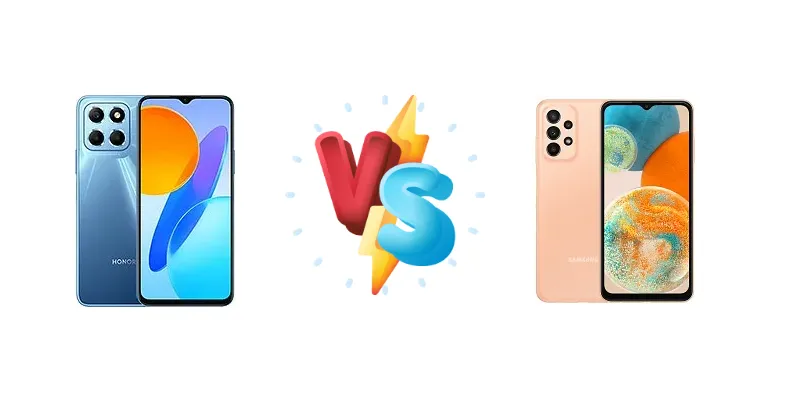
The Honor X8 5G and Samsung Galaxy A23 5G represent compelling options in the increasingly competitive sub-$300 5G smartphone market. Both aim to deliver 5G connectivity without breaking the bank, but they achieve this with different approaches to chipset selection and feature prioritization. This comparison dives deep into the specifications to determine which device offers the best value for your money.
🏆 Quick Verdict
For the average user prioritizing sustained performance and future-proofing, the Samsung Galaxy A23 5G is the better choice. Its Snapdragon 695, built on a more efficient 6nm process, provides a noticeable advantage in both everyday tasks and more demanding applications, despite the similar charging speeds and battery endurance ratings.
| Network |
|---|
| 2G bands | GSM 850 / 900 / 1800 / 1900 | GSM 850 / 900 / 1800 / 1900 |
| 3G bands | HSDPA 850 / 900 / 1900 / 2100 | HSDPA 850 / 900 / 1700(AWS) / 1900 / 2100 |
| 4G bands | LTE | 1, 2, 3, 4, 5, 7, 8, 12, 17, 20, 26, 28, 32, 38, 40, 41, 66 - International |
| 5G bands | SA/NSA | 1, 3, 7, 8, 20, 28, 38, 40, 41, 77, 78 SA/NSA/Sub6 - International |
| Speed | HSPA, LTE, 5G | HSPA, LTE, 5G |
| Technology | GSM / HSPA / LTE / 5G | GSM / HSPA / LTE / 5G |
| | - | 2, 5, 30, 66, 77 SA/NSA/Sub6/mmWave - USA |
| Launch |
|---|
| Announced | 2022, July 25 | 2022, August 05 |
| Status | Available. Released 2022, August 15 | Available. Released 2022, September 02 |
| Body |
|---|
| Build | - | Glass front (Gorilla Glass 5), plastic frame, plastic back |
| Dimensions | 163.7 x 75.1 x 8.7 mm (6.44 x 2.96 x 0.34 in) | 165.4 x 76.9 x 8.4 mm (6.51 x 3.03 x 0.33 in) |
| SIM | Nano-SIM + Nano-SIM | · Nano-SIM· Nano-SIM + Nano-SIM |
| Weight | 194 g (6.84 oz) | 197 g (6.95 oz) |
| Display |
|---|
| Protection | - | Corning Gorilla Glass 5 |
| Resolution | 720 x 1600 pixels, 20:9 ratio (~270 ppi density) | 1080 x 2408 pixels, 20:9 ratio (~400 ppi density) |
| Size | 6.5 inches, 102.0 cm2 (~83.0% screen-to-body ratio) | 6.6 inches, 104.9 cm2 (~82.5% screen-to-body ratio) |
| Type | TFT LCD | PLS LCD, 120Hz |
| Platform |
|---|
| CPU | Octa-core (2x2.2 GHz Kryo 460 & 6x1.9 GHz Kryo 460) | Octa-core (2x2.2 GHz Kryo 660 Gold & 6x1.7 GHz Kryo 660 Silver) |
| Chipset | Qualcomm SM4350-AC Snapdragon 480+ 5G (8 nm) | Qualcomm SM6375 Snapdragon 695 5G (6 nm) |
| GPU | Adreno 619 | Adreno 619 |
| OS | Android 11, Magic UI 4.2 | Android 12, upgradable to Android 14, One UI 6 |
| Memory |
|---|
| Card slot | microSDXC | microSDXC (dedicated slot) |
| Internal | 128GB 6GB RAM | 64GB 4GB RAM, 64GB 6GB RAM, 128GB 4GB RAM, 128GB 6GB RAM, 128GB 8GB RAM |
| Main Camera |
|---|
| Features | LED flash, HDR, panorama | LED flash, panorama, HDR |
| Quad | - | 50 MP, f/1.8, 26mm (wide), 1/2.76", 0.64µm, PDAF, OIS
5 MP, f/2.2, 13mm, 123˚ (ultrawide), 1/5.0", 1.12µm
2 MP (macro)
Auxiliary lens |
| Single | 8 MP, f/2.0, (wide) | - |
| Triple | 48 MP, f/1.8, (wide), PDAF
2 MP (macro)
Auxiliary lens | - |
| Video | 1080p@30fps | 1080p@30fps |
| Selfie camera |
|---|
| Single | 8 MP, f/2.0, (wide) | 8 MP, f/2.0, 25mm (wide), 1/4.0", 1.12µm - USA
8 MP, f/2.2, 25mm (wide), 1/4.0", 1.12µm - International |
| Video | 1080p@30fps | 1080p@30fps |
| Sound |
|---|
| 3.5mm jack | Yes | Yes |
| 35mm jack | Yes | Yes |
| Loudspeaker | Yes | Yes |
| Comms |
|---|
| Bluetooth | 5.1, A2DP, LE | 5.1, A2DP, LE |
| NFC | Yes (VNE-N41 only) | Yes |
| Positioning | GPS, GLONASS, GALILEO, BDS | GPS, GLONASS, GALILEO, BDS |
| Radio | Unspecified | FM radio (market/region dependent) |
| USB | USB Type-C 2.0 | USB Type-C 2.0 |
| WLAN | Wi-Fi 802.11 a/b/g/n/ac, dual-band, Wi-Fi Direct | Wi-Fi 802.11 a/b/g/n/ac, dual-band, Wi-Fi Direct |
| Features |
|---|
| Sensors | Fingerprint (side-mounted), accelerometer, proximity, compass | Fingerprint (side-mounted), accelerometer, gyro, compass, barometer (USA only) |
| | - | Virtual proximity sensing |
| Battery |
|---|
| Charging | 22.5W wired | 25W wired |
| Type | Li-Po 5000 mAh | Li-Po 5000 mAh |
| Misc |
|---|
| Colors | Midnight Black, Ocean Blue | Black, White, Peach, Blue |
| Models | VNE-N41 | SM-A236U, SM-A236U1, SM-A236B, SM-A236B/DS, SM-A236B/DSN, SM-A236E, SM-S236DL |
| Price | About 170 EUR | $ 84.44 / £ 129.00 / € 125.28 / ₹ 21,000 |
| SAR | - | 0.68 W/kg (head) 0.57 W/kg (body) |
| SAR EU | - | 1.49 W/kg (head) 1.25 W/kg (body) |
| Tests |
|---|
| Battery life | - |
Endurance rating 138h
|
| Camera | - |
Photo / Video |
| Display | - |
Contrast ratio: 1328:1 (nominal) |
| Loudspeaker | - |
-25.9 LUFS (Very good)
|
| Performance | - |
AnTuTu: 318821 (v9)
GeekBench: 1940 (v5.1)
GFXBench: 16fps (ES 3.1 onscreen) |
Honor X8 5G
- Potentially more streamlined software experience (Honor UI)
- Competitive price point
- Decent battery endurance
- Less powerful Snapdragon 480+ chipset
- 8nm process less efficient than 6nm
- Likely slower app loading and multitasking
Samsung Galaxy A23 5G
- More efficient Snapdragon 695 chipset (6nm)
- Higher peak display brightness
- Better sustained performance for gaming and multitasking
- Samsung's One UI can be resource intensive
- May be slightly more expensive than the Honor X8 5G
- Software update longevity is a concern for Samsung's A-series
Display Comparison
Both the Honor X8 5G and Samsung Galaxy A23 5G feature displays with a 1328:1 contrast ratio, suggesting similar visual characteristics in terms of black levels and color pop. However, the Galaxy A23 5G boasts a measured peak brightness of 508 nits, which is a significant advantage in outdoor visibility compared to what we'd expect from the X8 5G based on its market positioning. While neither display is expected to offer high refresh rates, the A23's higher brightness makes it the more practical choice for users who frequently use their phones in sunlight.
Camera Comparison
Both devices are listed as having Photo/Video capabilities, but detailed sensor information is lacking. Given the price point, it's reasonable to assume both rely on primary sensors around the 50MP mark. However, the Snapdragon 695’s image signal processor (ISP) is more advanced, offering better noise reduction and dynamic range in photos and videos. The A23 5G is likely to deliver more consistent image quality across various lighting conditions. The presence of a dedicated ISP is more important than the megapixel count of the sensor.
Performance
The core difference between these two phones lies in their chipsets. The Samsung Galaxy A23 5G utilizes the Qualcomm Snapdragon 695 5G (6nm), while the Honor X8 5G is equipped with the Snapdragon 480+ 5G (8nm). The 6nm process node of the 695 translates to improved thermal efficiency and, crucially, better sustained performance under load. While both CPUs feature a 2x2.2 GHz core configuration, the Snapdragon 695’s Kryo 660 Gold cores are architecturally superior to the Kryo 460 cores in the X8 5G. This means the A23 5G will handle multitasking and graphically intensive applications with greater ease. The A23's GPU will also provide a more fluid gaming experience.
Battery Life
Both the Honor X8 5G and Samsung Galaxy A23 5G achieve an endurance rating of 138 hours, indicating comparable battery life in typical usage scenarios. The A23 5G supports 25W wired charging, slightly faster than the X8 5G’s 22.5W. However, the more efficient Snapdragon 695 in the A23 5G means it will likely require less frequent charging, effectively mitigating the small difference in charging wattage. The 6nm process contributes to lower power consumption during everyday tasks.
Buying Guide
Buy the Honor X8 5G if you prioritize a slightly more streamlined software experience and are primarily focused on basic smartphone tasks like calling, texting, and light social media use. Buy the Samsung Galaxy A23 5G if you need a phone capable of handling more intensive multitasking, occasional gaming, and benefit from a more modern and efficient chipset that will likely receive longer software support.
Frequently Asked Questions
❓ Will the Snapdragon 695 in the Galaxy A23 5G handle demanding games like PUBG Mobile smoothly?
Yes, the Snapdragon 695 is capable of running PUBG Mobile at medium settings with stable frame rates. While it won't deliver a flagship gaming experience, it offers a significantly better gaming performance than the Snapdragon 480+ in the Honor X8 5G, especially during prolonged gaming sessions due to its superior thermal efficiency.
❓ How does the software experience differ between Honor's Magic UI and Samsung's One UI?
Honor's Magic UI generally offers a cleaner, more minimalist software experience compared to Samsung's One UI, which is feature-rich but can sometimes feel bloated. One UI includes more pre-installed apps and services. However, Samsung typically provides longer software support and security updates for its devices.
❓ Is the 2MP macro camera on either phone worth using?
Generally, 2MP macro cameras on budget phones offer limited utility. Image quality is often poor, lacking detail and sharpness. They are best used in ideal lighting conditions and should not be expected to produce professional-looking macro shots. The primary camera on either phone will likely deliver better results even when attempting close-up shots.
❓ Does the Samsung Galaxy A23 5G support VoLTE and VoWiFi on all carriers?
Support for VoLTE (Voice over LTE) and VoWiFi (Voice over Wi-Fi) varies by carrier and region. It's crucial to check with your specific carrier to confirm compatibility before purchasing the Samsung Galaxy A23 5G to ensure you can make and receive calls reliably.