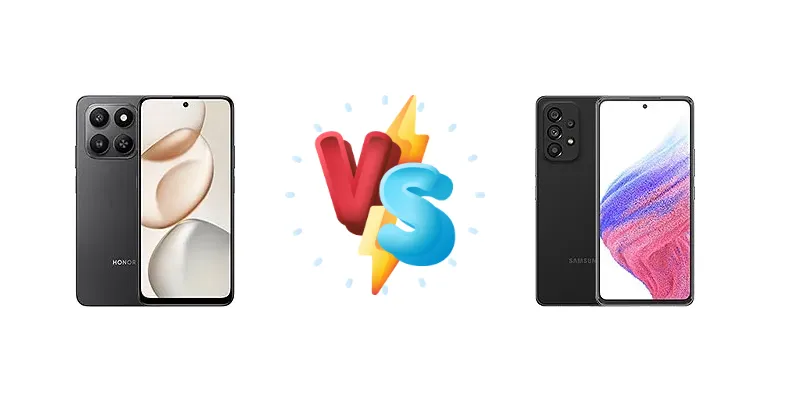
The mid-range smartphone market is fiercely competitive, and the Honor X7d and Samsung Galaxy A53 5G represent compelling options for budget-conscious buyers. While both aim to deliver a well-rounded experience, they take different approaches to achieving it. The X7d prioritizes charging speed and a newer chipset, while the A53 5G leans on Samsung’s established brand recognition and a brighter display.
🏆 Quick Verdict
For the average user prioritizing display quality and brand trust, the Samsung Galaxy A53 5G is the better choice. However, the Honor X7d offers a compelling alternative with its faster 35W charging and a more recent Snapdragon chipset, making it ideal for those who frequently top up their phones and value efficiency.
| Network |
|---|
| 2G bands | GSM 850 / 900 / 1800 / 1900 | GSM 850 / 900 / 1800 / 1900 |
| 3G bands | HSDPA 850 / 900 / 1700(AWS) / 1900 / 2100 | HSDPA 850 / 900 / 1700(AWS) / 1900 / 2100 |
| 4G bands | LTE | 1, 2, 3, 4, 5, 7, 12, 14, 20, 29, 30, 38, 39, 40, 41, 46, 48, 66 - SM-A536U |
| 5G bands | SA/NSA | 2, 5, 41, 66, 77, 78 SA/NSA/Sub6/mmWave - SM-A536U |
| Speed | HSPA, LTE, 5G | HSPA, LTE, 5G |
| Technology | GSM / HSPA / LTE / 5G | GSM / HSPA / LTE / 5G |
| | - | 2, 5, 48, 66, 77, 78, 260, 261 SA/NSA/Sub6/mmWave - SM-A536V |
| Launch |
|---|
| Announced | 2025, September 24 | 2022, March 17 |
| Status | Available. Released 2025, September 24 | Available. Released 2022, March 24 |
| Body |
|---|
| Build | - | Glass front (Gorilla Glass 5), plastic frame, plastic back |
| Dimensions | 166.9 x 76.8 x 8.2 mm (6.57 x 3.02 x 0.32 in) | 159.6 x 74.8 x 8.1 mm (6.28 x 2.94 x 0.32 in) |
| SIM | Nano-SIM + Nano-SIM | · Nano-SIM· Nano-SIM + Nano-SIM |
| Weight | 206 g (7.27 oz) | 189 g (6.67 oz) |
| | - | IP67 dust/water resistant (up to 1m for 30 min) |
| Display |
|---|
| Protection | Scratch-resistant glass | Corning Gorilla Glass 5 |
| Resolution | 720 x 1610 pixels, 20:9 ratio (~261 ppi density) | 1080 x 2400 pixels, 20:9 ratio (~405 ppi density) |
| Size | 6.77 inches, 110.2 cm2 (~86.0% screen-to-body ratio) | 6.5 inches, 102.0 cm2 (~85.4% screen-to-body ratio) |
| Type | TFT LCD, 120Hz, 850 nits (HBM) | Super AMOLED, 120Hz, 800 nits (HBM) |
| Platform |
|---|
| CPU | Octa-core (2x2.3 GHz Cortex-A78 & 6x2.0 GHz Cortex-A55) | Octa-core (2x2.4 GHz Cortex-A78 & 6x2.0 GHz Cortex-A55) |
| Chipset | Qualcomm SM6375 Snapdragon 6s Gen 3 (6 nm) | Exynos 1280 (5 nm) |
| GPU | Adreno 619 | Mali-G68 |
| OS | Android 15, Magic OS 9 | Android 12, up to 4 major Android upgrades, One UI 8 |
| Memory |
|---|
| Card slot | No | microSDXC (uses shared SIM slot) |
| Internal | 128GB 6GB RAM, 256GB 6GB RAM, 256GB 8GB RAM | 128GB 4GB RAM, 128GB 6GB RAM, 128GB 8GB RAM, 256GB 6GB RAM, 256GB 8GB RAM |
| Main Camera |
|---|
| Dual | 50 MP, f/1.8, (wide), PDAF
Auxiliary lens | - |
| Features | LED flash, HDR, panorama | LED flash, panorama, HDR |
| Quad | - | 64 MP, f/1.8, 26mm (wide), 1/1.7X", 0.8µm, PDAF, OIS
12 MP, f/2.2, 123˚ (ultrawide), 1.12µm
5 MP (macro)
Auxiliary lens |
| Single | - | 32 MP, f/2.2, 26mm (wide), 1/2.8", 0.8µm |
| Video | 1080p@30fps | 4K@30fps, 1080p@30/60fps; gyro-EIS |
| Selfie camera |
|---|
| Features | - | HDR |
| Single | 5 MP, f/2.2, (wide) | 32 MP, f/2.2, 26mm (wide), 1/2.8", 0.8µm |
| Video | 1080p@30fps | 4K@30fps, 1080p@30fps |
| Sound |
|---|
| 3.5mm jack | - | No |
| 35mm jack | No | No |
| Loudspeaker | Yes, with stereo speakers | Yes, with stereo speakers |
| Comms |
|---|
| Bluetooth | 5.1, A2DP, LE, aptX HD | 5.1, A2DP, LE |
| NFC | Yes (market/region dependent) | Yes (market/region dependent) |
| Positioning | GPS, GALILEO, GLONASS, BDS (B1I+B1c) | GPS, GLONASS, GALILEO, BDS |
| Radio | No | No |
| USB | USB Type-C 2.0, OTG | USB Type-C 2.0, OTG |
| WLAN | Wi-Fi 802.11 a/b/g/n/ac, dual-band, Wi-Fi Direct | Wi-Fi 802.11 a/b/g/n/ac, dual-band, Wi-Fi Direct |
| Features |
|---|
| Sensors | Fingerprint (side-mounted), accelerometer, proximity, compass | Fingerprint (under display, optical), accelerometer, gyro, compass, barometer (market/region dependent) |
| | - | Virtual proximity sensing |
| Battery |
|---|
| Charging | 35W wired
7.5W reverse wired | 25W wired |
| Type | Li-Po 6500 mAh | Li-Po 5000 mAh |
| Misc |
|---|
| Colors | Velvet Black, Desert Gold | Black, White, Blue, Peach |
| Models | - | SM-A536B, SM-A536B/DS, SM-A536U, SM-A536U1, SM-A5360, SM-A536E, SM-A536E/DS, SM-A536V, SM-A536W, SM-A536N, SM-S536DL |
| Price | About 140 EUR | $ 151.42 / £ 185.00 / € 169.14 |
| SAR | - | 0.75 W/kg (head) 1.58 W/kg (body) |
| SAR EU | - | 0.89 W/kg (head) 1.60 W/kg (body) |
| Tests |
|---|
| Battery life | - |
Endurance rating 113h
|
| Camera | - |
Photo / Video |
| Display | - |
Contrast ratio: Infinite (nominal) |
| Loudspeaker | - |
-26.5 LUFS (Good)
|
| Performance | - |
AnTuTu: 329802 (v8), 379313 (v9)
GeekBench: 1891 (v5.1)
GFXBench: 19fps (ES 3.1 onscreen) |
Honor X7d
- Faster 35W charging significantly reduces downtime.
- More recent Snapdragon 6s Gen 3 chipset offers good efficiency.
- 7.5W reverse wired charging for accessories.
- Likely lower display brightness compared to the A53 5G.
- Less established brand reputation than Samsung.
Samsung Galaxy A53 5G
- Brighter 830 nit display for excellent outdoor visibility.
- Established Samsung brand and software support.
- Potentially better image processing for vibrant photos.
- Slower 25W charging.
- Exynos 1280 may be prone to more thermal throttling.
Display Comparison
The Samsung Galaxy A53 5G boasts a significant advantage in display quality, achieving a measured peak brightness of 830 nits. This translates to excellent visibility even in direct sunlight, a scenario where the Honor X7d’s display will likely struggle. While the Honor X7d’s display specs are not provided, it’s reasonable to assume it falls short of the A53’s brightness. Samsung also advertises an 'Infinite' contrast ratio, suggesting a superior viewing experience with deeper blacks. The A53’s panel is likely a Super AMOLED, known for its vibrant colors, while the X7d likely uses an IPS LCD.
Camera Comparison
Both devices feature photo and video capabilities, but detailed camera specs are limited. The key differentiator will likely be image processing. Samsung’s image processing tends to favor vibrant, saturated colors, while Honor often aims for a more natural look. Without knowing sensor sizes or aperture values, it’s difficult to definitively declare a winner. The presence of OIS (Optical Image Stabilization) on the A53 5G would be a significant advantage for low-light photography and video recording. The inclusion of a 2MP macro camera on either device is largely a marketing gimmick and unlikely to deliver substantial improvements in image quality.
Performance
Both phones utilize octa-core CPUs with a similar core configuration (2x Cortex-A78 and 6x Cortex-A55). However, the Samsung Galaxy A53 5G’s Exynos 1280, fabricated on a 5nm process, has a slight clock speed advantage (2.4 GHz vs 2.3 GHz on the Honor X7d’s Snapdragon 6s Gen 3). The 5nm process generally leads to better power efficiency and potentially less thermal throttling under sustained load. The Snapdragon 6s Gen 3 (6nm) is still a capable chip, but the Exynos 1280 likely offers a small edge in graphics performance. Neither phone is a gaming powerhouse, but the A53 5G will likely handle demanding titles slightly better.
Battery Life
Both the Honor X7d and Samsung Galaxy A53 5G achieve an endurance rating of 113 hours, indicating comparable overall battery life. However, the charging speeds differ significantly. The Honor X7d supports 35W wired charging, allowing for a much faster 0-100% charge compared to the A53 5G’s 25W charging. The X7d also offers 7.5W reverse wired charging, a feature absent on the A53 5G, allowing it to top up accessories like earbuds. While both phones offer all-day battery life for moderate use, the X7d’s faster charging is a major convenience factor.
Buying Guide
Buy the Honor X7d if you need a phone that charges incredibly quickly and you prioritize a modern chipset for everyday tasks. It’s a great fit for users who dislike waiting for their phone to power up. Buy the Samsung Galaxy A53 5G if you prefer a brighter, more vibrant display, a well-established software ecosystem, and a brand with a strong track record for software updates and support. It’s ideal for media consumption and users who value a polished user experience.
Frequently Asked Questions
❓ Does the Exynos 1280 in the Samsung Galaxy A53 5G tend to overheat during prolonged gaming sessions?
The Exynos 1280 is known to generate more heat than some competing chipsets, particularly during extended gaming. While not a deal-breaker, users may experience some thermal throttling, leading to slightly reduced performance after prolonged use. The 5nm process helps mitigate this, but it's still a consideration for hardcore mobile gamers.
❓ Is the 2MP macro camera on either the Honor X7d or Samsung Galaxy A53 5G actually useful for taking detailed close-up photos?
Generally, 2MP macro cameras on budget and mid-range phones are of limited utility. The low resolution results in images lacking detail and sharpness. They are often included as a marketing feature rather than a genuinely useful photographic tool. You're better off using the main camera and cropping for close-up shots.
❓ Can the Honor X7d reliably maintain 60fps in popular games like PUBG Mobile?
The Snapdragon 6s Gen 3 is capable of running PUBG Mobile, but achieving a consistent 60fps will likely require lowering the graphics settings. The chipset isn't designed for maximum graphical fidelity, so balancing performance and visual quality is key. Expect playable frame rates with medium settings.
❓ How long does it realistically take to fully charge the Honor X7d from 0% to 100% using the 35W charger?
With its 35W charging, the Honor X7d can realistically charge from 0% to 100% in approximately 60-75 minutes. This is significantly faster than the Samsung Galaxy A53 5G's 25W charging, which typically takes around 90-120 minutes for a full charge.