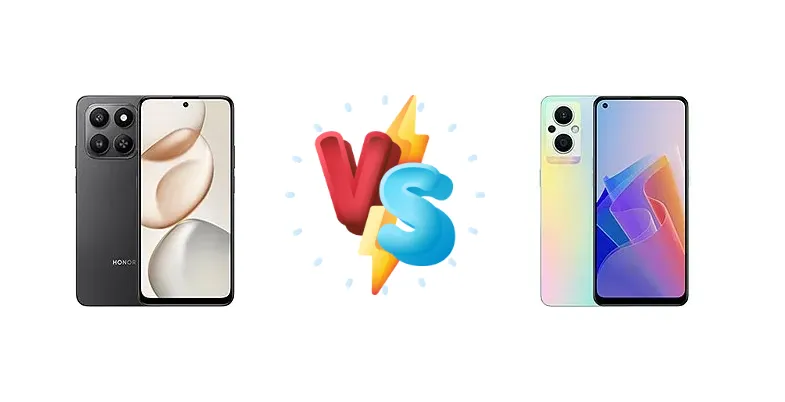
The Honor X7d and Oppo Reno7 Lite represent compelling options in the increasingly competitive budget 5G smartphone market. Both devices aim to deliver a balanced experience without breaking the bank, but they achieve this through different approaches to chipset selection and feature prioritization. This comparison dissects their key specifications to determine which phone offers the most value for your money.
🏆 Quick Verdict
For the average user prioritizing consistent performance and slightly faster charging, the Honor X7d emerges as the winner. Its Snapdragon 6s Gen 3, while not a massive leap, offers a more refined CPU architecture than the Reno7 Lite’s Snapdragon 695, translating to smoother multitasking and app loading. However, the Reno7 Lite’s endurance rating is identical, making it a strong contender for those prioritizing battery life.
| Network |
|---|
| 2G bands | GSM 850 / 900 / 1800 / 1900 | GSM 850 / 900 / 1800 / 1900 |
| 3G bands | HSDPA 850 / 900 / 1700(AWS) / 1900 / 2100 | HSDPA 800 / 850 / 900 / 1900 / 2100 |
| 4G bands | LTE | 1, 3, 5, 7, 8, 28, 34, 38, 39, 40, 41 |
| 5G bands | SA/NSA | 1, 8, 28, 41, 77, 78 SA/NSA |
| Speed | HSPA, LTE, 5G | HSPA, LTE, 5G |
| Technology | GSM / HSPA / LTE / 5G | GSM / HSPA / LTE / 5G |
| Launch |
|---|
| Announced | 2025, September 24 | 2022, April 14 |
| Status | Available. Released 2025, September 24 | Available. Released 2022, June |
| Body |
|---|
| Build | - | Glass front, plastic frame, glass back |
| Dimensions | 166.9 x 76.8 x 8.2 mm (6.57 x 3.02 x 0.32 in) | 159.9 x 73.2 x 7.5 mm (6.30 x 2.88 x 0.30 in) |
| SIM | Nano-SIM + Nano-SIM | Nano-SIM + Nano-SIM |
| Weight | 206 g (7.27 oz) | 173 g (6.10 oz) |
| | - | IPX4, dust and water resistant
RGB ring lights around the cameras (notifications, charging progress) |
| Display |
|---|
| Protection | Scratch-resistant glass | - |
| Resolution | 720 x 1610 pixels, 20:9 ratio (~261 ppi density) | 1080 x 2400 pixels, 20:9 ratio (~409 ppi density) |
| Size | 6.77 inches, 110.2 cm2 (~86.0% screen-to-body ratio) | 6.43 inches, 99.8 cm2 (~85.3% screen-to-body ratio) |
| Type | TFT LCD, 120Hz, 850 nits (HBM) | AMOLED, 430 nits (typ), 600 nits (HBM) |
| Platform |
|---|
| CPU | Octa-core (2x2.3 GHz Cortex-A78 & 6x2.0 GHz Cortex-A55) | Octa-core (2x2.2 GHz Kryo 660 Gold & 6x1.7 GHz Kryo 660 Silver) |
| Chipset | Qualcomm SM6375 Snapdragon 6s Gen 3 (6 nm) | Qualcomm SM6375 Snapdragon 695 5G (6 nm) |
| GPU | Adreno 619 | Adreno 619 |
| OS | Android 15, Magic OS 9 | Android 11, ColorOS 12 |
| Memory |
|---|
| Card slot | No | microSDXC |
| Internal | 128GB 6GB RAM, 256GB 6GB RAM, 256GB 8GB RAM | 128GB 8GB RAM, 256GB 8GB RAM |
| | - | UFS 2.2 |
| Main Camera |
|---|
| Dual | 50 MP, f/1.8, (wide), PDAF
Auxiliary lens | - |
| Features | LED flash, HDR, panorama | LED flash, HDR, panorama |
| Single | - | 16 MP, f/2.4, 27mm (wide), 1.0µm |
| Triple | - | 64 MP, f/1.7, 26mm (wide), PDAF
2 MP (macro)
Auxiliary lens |
| Video | 1080p@30fps | 1080p@30fps |
| Selfie camera |
|---|
| Features | - | HDR, panorama |
| Single | 5 MP, f/2.2, (wide) | 16 MP, f/2.4, 27mm (wide), 1.0µm |
| Video | 1080p@30fps | 1080p@30fps |
| Sound |
|---|
| 3.5mm jack | - | Yes |
| 35mm jack | No | Yes |
| Loudspeaker | Yes, with stereo speakers | Yes |
| Comms |
|---|
| Bluetooth | 5.1, A2DP, LE, aptX HD | 5.1, A2DP, LE, aptX HD |
| NFC | Yes (market/region dependent) | Yes |
| Positioning | GPS, GALILEO, GLONASS, BDS (B1I+B1c) | GPS, GLONASS, BDS, GALILEO, QZSS |
| Radio | No | No |
| USB | USB Type-C 2.0, OTG | USB Type-C 2.0, OTG |
| WLAN | Wi-Fi 802.11 a/b/g/n/ac, dual-band, Wi-Fi Direct | Wi-Fi 802.11 a/b/g/n/ac, dual-band, Wi-Fi Direct |
| Features |
|---|
| Sensors | Fingerprint (side-mounted), accelerometer, proximity, compass | Fingerprint (under display, optical), accelerometer, proximity, gyro, compass |
| Battery |
|---|
| Charging | 35W wired
7.5W reverse wired | 33W wired, PD, 31% in 15 min, 100% in 63 min
Reverse wired |
| Type | Li-Po 6500 mAh | Li-Po 4500 mAh |
| Misc |
|---|
| Colors | Velvet Black, Desert Gold | Cosmic Black, Champagne Silver |
| Models | - | CPH2343 |
| Price | About 140 EUR | About 350 EUR |
| Tests |
|---|
| Battery life | - |
Endurance rating 125h
|
| Camera | - |
Photo / Video |
| Display | - |
Contrast ratio: Infinite (nominal) |
| Loudspeaker | - |
-28.5 LUFS (Average)
|
| Performance | - |
AnTuTu: 315250 (v8), 376819 (v9)
GeekBench: 1996 (v5.1)
GFXBench: 17fps (ES 3.1 onscreen) |
Honor X7d
- More powerful CPU architecture (Cortex-A78)
- Faster wired charging (35W)
- Reverse wired charging support
- Display brightness data unavailable
- Camera specifications largely unknown
Oppo Reno7 Lite
- Higher peak display brightness (657 nits)
- PD support for charging
- Established brand reputation
- Less powerful CPU architecture (Kryo 660 Gold)
- Slightly slower charging speed (33W)
Display Comparison
The Oppo Reno7 Lite boasts a measured peak brightness of 657 nits, providing a noticeably more vibrant viewing experience in direct sunlight compared to the Honor X7d (brightness data unavailable). While both displays share an 'infinite' contrast ratio (typical for OLED/AMOLED panels), the Reno7 Lite’s higher peak brightness is a tangible advantage for outdoor visibility. The absence of refresh rate data for the X7d suggests a standard 60Hz panel, potentially making the Reno7 Lite a smoother experience if it supports a higher refresh rate (data not provided).
Camera Comparison
Both phones feature 'Photo / Video' capabilities, but detailed camera specifications are lacking. Without sensor size, aperture, or OIS information, a direct comparison is difficult. However, the prevalence of 2MP macro lenses on both devices suggests they are likely of limited utility. Image processing algorithms will play a significant role in differentiating image quality, and brand-specific tuning will be a key factor. The absence of detailed camera specs makes it impossible to declare a clear winner.
Performance
Both the Honor X7d and Oppo Reno7 Lite utilize Qualcomm’s Snapdragon 6 series, but with key architectural differences. The X7d features the Snapdragon 6s Gen 3, employing a 6nm process and an octa-core configuration with 2x2.3 GHz Cortex-A78 cores and 6x2.0 GHz Cortex-A55 cores. The Reno7 Lite uses the Snapdragon 695 5G, also on a 6nm process, but with 2x2.2 GHz Kryo 660 Gold cores and 6x1.7 GHz Kryo 660 Silver cores. The Cortex-A78 cores in the X7d represent a more powerful architecture than the Kryo 660 Gold, suggesting better single-core performance and improved responsiveness. While both support 5G, the X7d’s CPU configuration is likely to handle demanding tasks more efficiently.
Battery Life
Both the Honor X7d and Oppo Reno7 Lite achieve an endurance rating of 125 hours, indicating similar real-world battery life under comparable usage scenarios. However, their charging speeds differ. The X7d supports 35W wired charging and 7.5W reverse wired charging, while the Reno7 Lite offers 33W wired charging with PD support, reaching 31% in 15 minutes and 100% in 63 minutes. The X7d’s slightly higher wattage suggests potentially faster overall charging times, though the Reno7 Lite’s PD support offers broader compatibility with chargers. The inclusion of reverse wired charging on both devices is a convenient feature for topping up accessories.
Buying Guide
Buy the Honor X7d if you need a phone that feels responsive during everyday tasks and benefits from a more modern CPU architecture for sustained performance. This phone is ideal for users who frequently switch between apps or enjoy light gaming. Buy the Oppo Reno7 Lite if you prioritize a slightly brighter display and a well-established brand reputation, and are willing to trade a small amount of CPU performance for that.
Frequently Asked Questions
❓ Will the Snapdragon 6s Gen 3 in the Honor X7d handle demanding games like PUBG Mobile?
While the Snapdragon 6s Gen 3 isn't a flagship chipset, it should be capable of running PUBG Mobile at medium settings with reasonable frame rates. However, expect some frame drops during intense firefights. The CPU architecture is better suited for gaming than the Reno7 Lite's, but don't expect a high-end gaming experience.
❓ Does the Oppo Reno7 Lite support fast charging with any standard USB-C PD charger?
Yes, the Oppo Reno7 Lite supports USB-C Power Delivery (PD) charging. This means you can use a wide range of USB-C PD chargers to charge the device, offering greater flexibility and convenience. However, to achieve the fastest charging speeds, it's recommended to use a charger that supports Oppo's proprietary charging protocols.
❓ How significant is the difference in CPU performance between the Snapdragon 6s Gen 3 and the Snapdragon 695?
The difference is noticeable in everyday tasks. The Snapdragon 6s Gen 3's Cortex-A78 cores offer a performance advantage over the Kryo 660 Gold cores in the 695. This translates to faster app loading times, smoother multitasking, and a more responsive user experience. While both chips are capable, the X7d will feel snappier.