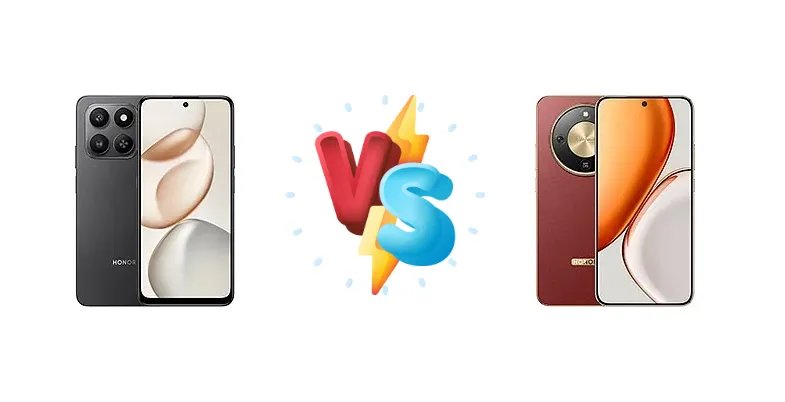
Honor's X series consistently delivers compelling value in the budget to mid-range smartphone market. The X7d and X9d represent two distinct points within that spectrum, with the X9d featuring a newer chipset and faster charging. This comparison dissects the key differences between these two devices, focusing on how those specifications translate into real-world user experience.
🏆 Quick Verdict
For most users, the Honor X9d is the superior choice. Its Snapdragon 6 Gen 4 chipset, built on a more efficient 4nm process, provides a noticeable performance uplift over the X7d’s Snapdragon 6s Gen 3. The 66W charging is a significant convenience, offsetting the slightly higher price.
| Network |
|---|
| 2G bands | GSM 850 / 900 / 1800 / 1900 | GSM 850 / 900 / 1800 / 1900 |
| 3G bands | HSDPA 850 / 900 / 1700(AWS) / 1900 / 2100 | HSDPA 850 / 900 / 1700(AWS) / 1900 / 2100 |
| 4G bands | LTE | LTE |
| 5G bands | SA/NSA | SA/NSA |
| Speed | HSPA, LTE, 5G | HSPA, LTE, 5G |
| Technology | GSM / HSPA / LTE / 5G | GSM / HSPA / LTE / 5G |
| Launch |
|---|
| Announced | 2025, September 24 | 2025, September 24 |
| Status | Available. Released 2025, September 24 | Available. Released 2025, October 09 |
| Body |
|---|
| Dimensions | 166.9 x 76.8 x 8.2 mm (6.57 x 3.02 x 0.32 in) | 161.9 x 76.1 x 7.8 mm (6.37 x 3.00 x 0.31 in) |
| SIM | Nano-SIM + Nano-SIM | Nano-SIM + Nano-SIM |
| Weight | 206 g (7.27 oz) | 193 g (6.81 oz) |
| Display |
|---|
| Protection | Scratch-resistant glass | Aluminosilicate glass |
| Resolution | 720 x 1610 pixels, 20:9 ratio (~261 ppi density) | 1200 x 2640 pixels (~427 ppi density) |
| Size | 6.77 inches, 110.2 cm2 (~86.0% screen-to-body ratio) | 6.79 inches, 112.1 cm2 (~90.9% screen-to-body ratio) |
| Type | TFT LCD, 120Hz, 850 nits (HBM) | AMOLED, 1B colors, 120Hz, 3840Hz PWM, HDR, 800 nits (typ), 1800 nits (HBM), 6000 nits (peak) |
| Platform |
|---|
| CPU | Octa-core (2x2.3 GHz Cortex-A78 & 6x2.0 GHz Cortex-A55) | Octa-core (1x2.3 GHz Cortex-A720s & 3x2.2 GHz Cortex-A720s & 4x1.8 GHz Cortex-A520s) |
| Chipset | Qualcomm SM6375 Snapdragon 6s Gen 3 (6 nm) | Qualcomm Snapdragon 6 Gen 4 (4 nm) |
| GPU | Adreno 619 | Adreno 810 |
| OS | Android 15, Magic OS 9 | Android 15, Magic OS 9 |
| Memory |
|---|
| Card slot | No | No |
| Internal | 128GB 6GB RAM, 256GB 6GB RAM, 256GB 8GB RAM | 256GB 8GB RAM, 256GB 12GB RAM, 512GB 12GB RAM |
| Main Camera |
|---|
| Dual | 50 MP, f/1.8, (wide), PDAF
Auxiliary lens | 108 MP, f/1.8, (wide), PDAF, OIS
5 MP, f/2.2, (ultrawide) |
| Features | LED flash, HDR, panorama | LED flash, panorama, HDR |
| Video | 1080p@30fps | 4K@30fps, 1080p@30fps, gyro-EIS |
| Selfie camera |
|---|
| Single | 5 MP, f/2.2, (wide) | 16 MP, f/2.5, (wide) |
| Video | 1080p@30fps | 1080p@30fps |
| Sound |
|---|
| 35mm jack | No | No |
| Loudspeaker | Yes, with stereo speakers | Yes, with stereo speakers |
| Comms |
|---|
| Bluetooth | 5.1, A2DP, LE, aptX HD | 5.2, A2DP, LE, aptX HD, aptX Adaptive |
| NFC | Yes (market/region dependent) | Yes |
| Positioning | GPS, GALILEO, GLONASS, BDS (B1I+B1c) | GPS, GALILEO, GLONASS, BDS |
| Radio | No | No |
| USB | USB Type-C 2.0, OTG | USB Type-C 2.0, OTG |
| WLAN | Wi-Fi 802.11 a/b/g/n/ac, dual-band, Wi-Fi Direct | Wi-Fi 802.11 a/b/g/n/ac/6, dual-band, Wi-Fi Direct |
| Features |
|---|
| Sensors | Fingerprint (side-mounted), accelerometer, proximity, compass | Fingerprint (under display, optical), accelerometer, compass, gyro, proximity |
| Battery |
|---|
| Charging | 35W wired
7.5W reverse wired | 66W wired
7.5W reverse wired |
| Type | Li-Po 6500 mAh | Si/C Li-Ion 8300 mAh |
| Misc |
|---|
| Colors | Velvet Black, Desert Gold | Reddish Brown, Midnight Black, Sunrise Gold, Forest Green |
| Models | - | MTN-NX1 |
| Price | About 140 EUR | About 300 EUR |
Honor X7d
- Lower price point makes it accessible.
- 35W charging is still reasonably fast for casual users.
- Sufficient for basic smartphone tasks.
- Snapdragon 6s Gen 3 is less powerful than the 6 Gen 4.
- 6nm process is less efficient, potentially leading to more heat.
- Slower charging compared to the X9d.
Honor X9d
- Snapdragon 6 Gen 4 offers a significant performance boost.
- 66W charging dramatically reduces charging time.
- 4nm process improves power efficiency and thermal management.
- Higher price compared to the X7d.
- May be overkill for users with very basic needs.
- No information on display quality.
Display Comparison
Both devices likely feature similar LCD panels, given their positioning. However, detailed display specs (resolution, refresh rate, peak brightness) are missing. The focus here is on the internal hardware. While display quality is important, the core difference lies elsewhere.
Camera Comparison
Without detailed camera specifications (sensor size, aperture), a direct comparison is limited. However, the chipset's image signal processor (ISP) plays a crucial role. The Snapdragon 6 Gen 4 in the X9d benefits from a newer ISP, likely resulting in improved image processing, better low-light performance, and more accurate color reproduction compared to the X7d. The absence of OIS on either device suggests a reliance on software stabilization.
Performance
The core differentiator is the chipset. The Honor X9d’s Qualcomm Snapdragon 6 Gen 4 (4nm) represents a significant architectural leap over the X7d’s Snapdragon 6s Gen 3 (6nm). The 4nm process inherently offers better power efficiency, translating to less heat generation and potentially sustained performance during demanding tasks. The CPU architecture also differs; the X9d utilizes Cortex-A720s cores, a newer generation than the X7d’s Cortex-A78 cores. This means the X9d will exhibit improved single-core and multi-core performance, benefiting app launch times and overall responsiveness. The X9d's GPU will also be more capable, offering a better gaming experience.
Battery Life
While battery capacity isn't specified, the X9d’s 66W wired charging is a game-changer. This allows for a significantly faster 0-100% charge compared to the X7d’s 35W charging. Even with a similar battery capacity, the X9d’s faster charging minimizes downtime. The more efficient 4nm process of the Snapdragon 6 Gen 4 in the X9d also contributes to better battery life during typical usage, potentially offsetting any capacity differences.
Buying Guide
Buy the Honor X7d if you prioritize a lower upfront cost and are primarily focused on basic smartphone tasks like calling, texting, and light social media use. Its Snapdragon 6s Gen 3 is adequate for these scenarios. Buy the Honor X9d if you value smoother multitasking, improved gaming performance, and significantly faster charging speeds. The Snapdragon 6 Gen 4 offers a more future-proof experience and reduces charging downtime.
Frequently Asked Questions
❓ Will the Snapdragon 6 Gen 4 in the X9d handle demanding games like PUBG Mobile smoothly?
The Snapdragon 6 Gen 4 represents a substantial improvement over the 6s Gen 3 in graphics performance. While it won't deliver flagship-level gaming, it should comfortably handle PUBG Mobile at medium to high settings with stable frame rates. The 4nm process also helps mitigate thermal throttling during extended gaming sessions.
❓ How much faster is the 66W charging on the X9d compared to the 35W charging on the X7d?
The 66W charging on the X9d will significantly reduce charging times. While exact figures depend on battery capacity, expect a 0-100% charge in approximately 45-60 minutes on the X9d, compared to potentially 90-120 minutes on the X7d. This is a substantial time saving for users who frequently need to top up their battery.
❓ Is the difference in chipset performance noticeable for everyday tasks like browsing and social media?
Yes, the difference is noticeable. The Snapdragon 6 Gen 4’s newer CPU architecture and faster processing speeds result in snappier app launches, smoother scrolling, and a more responsive overall user experience, even during everyday tasks. The X7d will function adequately, but the X9d provides a more fluid and enjoyable experience.