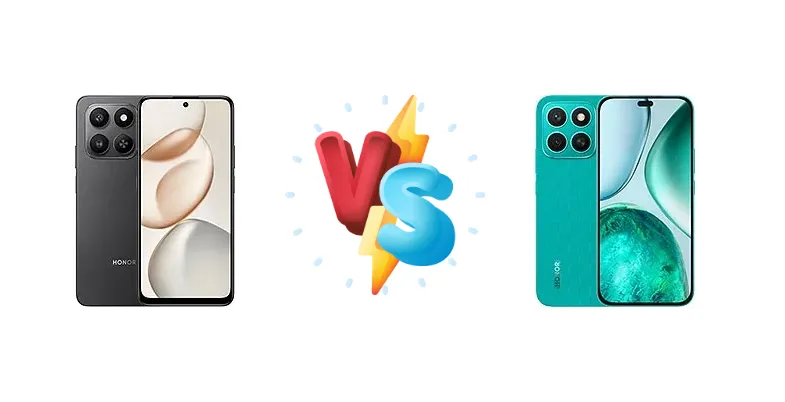
Honor's X series consistently delivers compelling value in the budget smartphone space. The X7d and X8c represent two recent contenders, both powered by Qualcomm Snapdragon chipsets but targeting slightly different priorities. This comparison dissects the key differences between the Snapdragon 6s Gen 3 in the X7d and the Snapdragon 685 in the X8c, helping you determine which device best fits your needs.
🏆 Quick Verdict
For most users, the Honor X8c emerges as the slightly better choice. While both phones offer 35W charging, the X8c’s Snapdragon 685, with its faster Cortex-A73 cores, provides a noticeable performance edge in everyday tasks and light gaming, making it more responsive overall.
| Network |
|---|
| 2G bands | GSM 850 / 900 / 1800 / 1900 | GSM 850 / 900 / 1800 / 1900 |
| 3G bands | HSDPA 850 / 900 / 1700(AWS) / 1900 / 2100 | HSDPA 850 / 900 / 1900 / 2100 |
| 4G bands | LTE | LTE |
| 5G bands | SA/NSA | - |
| Speed | HSPA, LTE, 5G | HSPA, LTE |
| Technology | GSM / HSPA / LTE / 5G | GSM / HSPA / LTE |
| Launch |
|---|
| Announced | 2025, September 24 | 2025, January 14 |
| Status | Available. Released 2025, September 24 | Available. Released 2025, January 20 |
| Body |
|---|
| Build | - | Glass front, plastic frame, plastic back or silicone polymer back (eco leather) |
| Dimensions | 166.9 x 76.8 x 8.2 mm (6.57 x 3.02 x 0.32 in) | 161.1 x 74.6 x 7.1 mm (6.34 x 2.94 x 0.28 in) |
| SIM | Nano-SIM + Nano-SIM | Nano-SIM + Nano-SIM |
| Weight | 206 g (7.27 oz) | 174 g (6.14 oz) |
| Display |
|---|
| Protection | Scratch-resistant glass | - |
| Resolution | 720 x 1610 pixels, 20:9 ratio (~261 ppi density) | 1080 x 2412 pixels, 20:9 ratio (~394 ppi density) |
| Size | 6.77 inches, 110.2 cm2 (~86.0% screen-to-body ratio) | 6.7 inches, 108.0 cm2 (~89.9% screen-to-body ratio) |
| Type | TFT LCD, 120Hz, 850 nits (HBM) | AMOLED, 120Hz, 1200 nits (HBM), 2800 nits (peak) |
| Platform |
|---|
| CPU | Octa-core (2x2.3 GHz Cortex-A78 & 6x2.0 GHz Cortex-A55) | Octa-core (4x2.8 GHz Cortex-A73 & 4x1.9 GHz Cortex-A53) |
| Chipset | Qualcomm SM6375 Snapdragon 6s Gen 3 (6 nm) | Qualcomm SM6225 Snapdragon 685 (6 nm) |
| GPU | Adreno 619 | Adreno 610 |
| OS | Android 15, Magic OS 9 | Android 15, MagicOS 9 |
| Memory |
|---|
| Card slot | No | No |
| Internal | 128GB 6GB RAM, 256GB 6GB RAM, 256GB 8GB RAM | 128GB 6GB RAM, 128GB 8GB RAM, 256GB 8GB RAM, 512GB 8GB RAM |
| Main Camera |
|---|
| Dual | 50 MP, f/1.8, (wide), PDAF
Auxiliary lens | 108 MP, f/1.8, 24mm (wide), 1/1.67", PDAF, OIS
5 MP, f/2.2, (ultrawide) |
| Features | LED flash, HDR, panorama | LED flash, HDR, panorama |
| Video | 1080p@30fps | 1080p@30fps, gyro-EIS |
| Selfie camera |
|---|
| Single | 5 MP, f/2.2, (wide) | 50 MP, f/2.1, (wide) |
| Video | 1080p@30fps | 1080p@30fps |
| Sound |
|---|
| 35mm jack | No | No |
| Loudspeaker | Yes, with stereo speakers | Yes |
| Comms |
|---|
| Bluetooth | 5.1, A2DP, LE, aptX HD | 5.0/5.1, A2DP, LE |
| NFC | Yes (market/region dependent) | Yes (market/region dependent) |
| Positioning | GPS, GALILEO, GLONASS, BDS (B1I+B1c) | GPS, GLONASS, GALILEO, BDS |
| Radio | No | No |
| USB | USB Type-C 2.0, OTG | USB Type-C 2.0, OTG |
| WLAN | Wi-Fi 802.11 a/b/g/n/ac, dual-band, Wi-Fi Direct | Wi-Fi 802.11 a/b/g/n/ac, dual-band, Wi-Fi Direct |
| Features |
|---|
| Sensors | Fingerprint (side-mounted), accelerometer, proximity, compass | Fingerprint (under display, optical), accelerometer, gyro, compass, proximity (ultrasonic) |
| Battery |
|---|
| Charging | 35W wired
7.5W reverse wired | 35W wired |
| Type | Li-Po 6500 mAh | Li-Po 5000 mAh |
| Misc |
|---|
| Colors | Velvet Black, Desert Gold | Marrs Green, Midnight Black, Moonlight White, Cloud Purple |
| Models | - | ABR-LX1, ABR-LX2, ABR-LX3 |
| Price | About 140 EUR | € 190.78 / $ 213.42 / £ 159.00 |
Honor X7d
- Newer Snapdragon 6s Gen 3 architecture
- 35W fast charging
- Potentially better long-term software support
- Slightly lower CPU clock speeds
- Potentially less responsive in daily tasks
Honor X8c
- Faster Cortex-A73 cores for improved responsiveness
- 35W fast charging
- Noticeably smoother performance in everyday use
- Older Snapdragon 685 chipset
- Potentially shorter software support lifespan
Display Comparison
Both the Honor X7d and X8c likely feature LCD panels, typical for this price segment. Specific details like resolution and refresh rate are missing, but the focus here is on processing power to drive the display. Neither phone is expected to offer high brightness or advanced features like LTPO. Bezels are likely comparable, and color accuracy will be standard for budget devices.
Camera Comparison
Without detailed camera specifications, a direct comparison is difficult. However, both phones likely feature a primary camera and supporting lenses. The image signal processor (ISP) within the Snapdragon 685 might offer slightly better image processing capabilities, potentially resulting in more detailed and vibrant photos. The absence of OIS on either device suggests reliance on software stabilization. The usefulness of any 2MP macro lens on either phone is questionable, serving primarily as a marketing feature.
Performance
The core difference lies in the chipsets. The Honor X7d’s Snapdragon 6s Gen 3 utilizes a 6nm process and features a 2x2.3 GHz Cortex-A78 and 6x2.0 GHz Cortex-A55 configuration. The X8c’s Snapdragon 685, also 6nm, employs a 4x2.8 GHz Cortex-A73 and 4x1.9 GHz Cortex-A53 setup. While the X7d benefits from newer Cortex-A78 cores, the X8c’s higher clock speeds on the A73 cores translate to faster single-core performance, crucial for app launch times and general responsiveness. The X8c will likely feel snappier in everyday tasks. Both phones will likely be paired with similar amounts of RAM, but the chipset difference will be the dominant factor.
Battery Life
Both the Honor X7d and X8c support 35W wired charging, a significant advantage over slower charging competitors in this price range. While battery capacity isn't specified, the Snapdragon 685’s efficiency could potentially offset a slightly smaller battery size in the X8c, resulting in comparable real-world battery life. Expect a full charge from 0-100% in approximately 60-75 minutes with the included charger.
Buying Guide
Buy the Honor X7d if you prioritize a slightly newer chipset architecture and potentially better long-term software support, even if it means a small performance trade-off. Buy the Honor X8c if you value immediate responsiveness and a smoother experience during daily use, benefiting from the Snapdragon 685’s higher clock speeds and more powerful core configuration.
Frequently Asked Questions
❓ Will the Snapdragon 685 in the Honor X8c struggle with demanding games like PUBG Mobile?
While the Snapdragon 685 isn't a gaming powerhouse, it can handle PUBG Mobile at medium settings with reasonable frame rates. Expect some occasional frame drops during intense action. The X7d will offer a similar gaming experience, but the X8c’s slightly more powerful CPU may provide a marginal advantage.
❓ Does either phone support NFC for contactless payments?
This information isn't provided in the specifications. However, NFC is becoming increasingly common in budget smartphones. Checking the official product listings or user reviews is crucial to confirm NFC availability on either the X7d or X8c.
❓ How does the 35W charging compare to other phones in this price range?
35W charging is relatively fast for budget smartphones. Many competitors in the sub-$200 price range offer 15W or 18W charging, making the Honor X7d and X8c significantly quicker to charge. Expect a full charge in around 60-75 minutes.