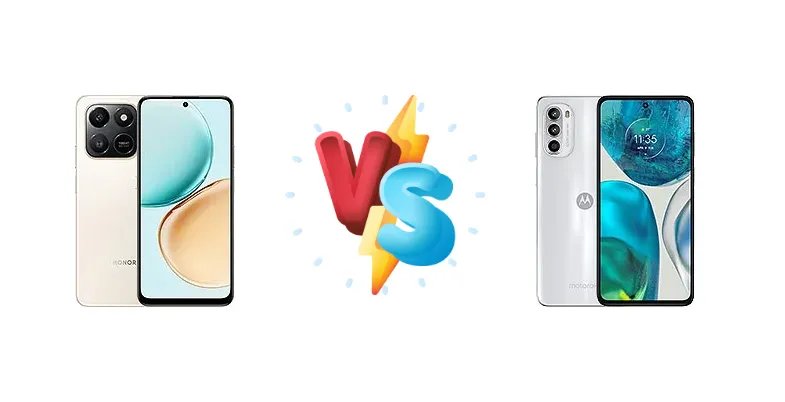
The Honor X7d 4G and Motorola Moto G52 represent compelling options in the crowded budget smartphone market. Both leverage Qualcomm's Snapdragon 6-series for efficient performance, but subtle differences in CPU architecture and charging capabilities create distinct user experiences. This comparison dissects these nuances to determine which device delivers the best value.
🏆 Quick Verdict
For most users, the Honor X7d 4G emerges as the stronger choice. Its slightly faster CPU clock speeds and notably faster 35W charging provide a tangible advantage in daily use and convenience, offsetting the Moto G52's potentially more refined software experience.
| Network |
|---|
| 2G bands | GSM 850 / 900 / 1800 / 1900 | GSM 850 / 900 / 1800 / 1900 |
| 3G bands | HSDPA 850 / 900 / 1900 / 2100 | HSDPA 850 / 900 / 1700(AWS) / 1900 / 2100 |
| 4G bands | LTE | LTE |
| Speed | HSPA, LTE | HSPA, LTE |
| Technology | GSM / HSPA / LTE | GSM / HSPA / LTE |
| Launch |
|---|
| Announced | 2025, August 25 | 2022, April 12 |
| Status | Available. Released 2025, September 15 | Available. Released 2022, April 20 |
| Body |
|---|
| Dimensions | 166.9 x 76.8 x 8.2 mm (6.57 x 3.02 x 0.32 in) | 160.1 x 74.5 x 8 mm (6.30 x 2.93 x 0.31 in) |
| SIM | Nano-SIM + Nano-SIM | Nano-SIM + Nano-SIM |
| Weight | 208 g (7.34 oz) | 169 g (5.96 oz) |
| | - | Water-repellent design |
| Display |
|---|
| Protection | Tempered glass, Mohs level 4 | - |
| Resolution | 720 x 1610 pixels, 20:9 ratio (~261 ppi density) | 1080 x 2400 pixels, 20:9 ratio (~402 ppi density) |
| Size | 6.77 inches, 110.2 cm2 (~86.0% screen-to-body ratio) | 6.6 inches, 103.6 cm2 (~86.9% screen-to-body ratio) |
| Type | TFT LCD, 120Hz | AMOLED, 90Hz |
| Platform |
|---|
| CPU | Octa-core (4x2.8 GHz Cortex-A73 & 4x1.9 GHz Cortex-A53) | Octa-core (4x2.4 GHz Kryo 265 Gold & 4x1.9 GHz Kryo 265 Silver) |
| Chipset | Qualcomm SM6225 Snapdragon 685 (6 nm) | Qualcomm SM6225 Snapdragon 680 4G (6 nm) |
| GPU | Adreno 610 | Adreno 610 |
| OS | Android 15, MagicOS 9 | Android 12, planned upgrade to Android 13 |
| Memory |
|---|
| Card slot | Unspecified | microSDXC (uses shared SIM slot) |
| Internal | 128GB 6GB RAM, 128GB 8GB RAM, 256GB 8GB RAM, 512GB 8GB RAM | 64GB 4GB RAM, 128GB 4GB RAM, 128GB 6GB RAM, 256GB 6GB RAM |
| Main Camera |
|---|
| Dual | 108 MP, f/1.8, 24mm (wide), 1/1.67", 0.64µm, PDAF
Auxiliary lens | - |
| Features | LED flash, HDR | LED flash, HDR, panorama |
| Triple | - | 50 MP, f/1.8 (wide), 1/2.76", 0.64µm, PDAF
8 MP, f/2.2, 118˚ (ultrawide), 1/4.0", 1.12µm
2 MP (macro) |
| Video | 1080p@30fps | 1080p@30fps |
| Selfie camera |
|---|
| Single | 8 MP, f/2.0, (wide) | 16 MP, f/2.5, (wide), 1.0µm |
| Video | 1080p@30fps | 1080p@30fps |
| Sound |
|---|
| 3.5mm jack | - | Yes |
| 35mm jack | No | Yes |
| Loudspeaker | Yes | Yes, with stereo speakers |
| Comms |
|---|
| Bluetooth | 5.0, A2DP, LE | 5.0, A2DP, LE |
| NFC | Yes (market/region dependent) | Yes (market/region dependent) |
| Positioning | GPS, GLONASS, GALILEO, BDS | GPS, GLONASS, GALILEO |
| Radio | No | Unspecified |
| USB | USB Type-C 2.0, OTG | USB Type-C 2.0 |
| WLAN | Wi-Fi 802.11 a/b/g/n/ac, dual-band, Wi-Fi Direct | Wi-Fi 802.11 a/b/g/n/ac, dual-band, Wi-Fi Direct |
| Features |
|---|
| Sensors | Fingerprint (side-mounted), accelerometer, proximity, compass | Fingerprint (side-mounted), accelerometer, gyro, proximity, compass |
| Battery |
|---|
| Charging | 35W wired | 30W wired |
| Type | Li-Po 6500 mAh | Li-Po 5000 mAh |
| Misc |
|---|
| Colors | Desert Gold, Ocean Cyan, Meteor Silver, Velvet Black | Charcoal Gray, Porcelain White |
| Models | LGN-LX1 | XT2221-1, XT2221-2 |
| Price | About 150 EUR | About 470 EUR |
| EU LABEL |
|---|
| Battery | 71:00h endurance, 1600 cycles | - |
| Energy | Class A | - |
| Free fall | Class A (270 falls) | - |
| Repairability | Class B | - |
Honor X7d 4G
- Faster 35W wired charging for quicker top-ups.
- Slightly more powerful CPU for smoother multitasking.
- Impressive 71-hour battery endurance and 1600 charge cycles.
- Software experience may not be as refined as Motorola's.
- Camera specs are unknown, potentially limiting image quality.
Motorola Moto G52
- Clean, near-stock Android experience.
- Potentially longer software support from Motorola.
- Efficient Snapdragon 680 chipset for good battery life.
- Slower 30W charging.
- CPU clock speeds are lower, resulting in slightly less responsive performance.
Display Comparison
Neither device boasts a standout display. Both likely utilize LCD panels, common in this price bracket. While specific details like peak brightness and color gamut coverage are unavailable, the focus here is on performance. The absence of high refresh rates on either device suggests a prioritization of battery life over visual fluidity.
Camera Comparison
Without detailed camera specs beyond the chipsets, a direct comparison is limited. Both phones likely feature a multi-camera setup with a primary sensor, but the quality will heavily depend on sensor size and image processing algorithms. The absence of information regarding OIS or aperture sizes makes it difficult to assess low-light performance. It's safe to assume both will offer acceptable image quality in good lighting conditions, but neither will challenge flagship camera systems.
Performance
The core difference lies in the chipsets: the Honor X7d 4G features the Qualcomm Snapdragon 685 (6nm) while the Moto G52 uses the Snapdragon 680 (6nm). Both are octa-core CPUs, but the X7d’s configuration – 4x2.8 GHz Cortex-A73 & 4x1.9 GHz Cortex-A53 – offers a higher peak clock speed compared to the Moto G52’s 4x2.4 GHz Kryo 265 Gold & 4x1.9 GHz Kryo 265 Silver. This translates to slightly snappier performance in CPU-intensive tasks. While both are built on the efficient 6nm process, the X7d’s faster cores provide a marginal edge. The impact on gaming will be noticeable, though neither phone is designed for demanding titles.
Battery Life
The Honor X7d 4G boasts a remarkable 71-hour endurance rating and a claimed 1600 charge cycles, suggesting excellent battery longevity. The Moto G52’s endurance is not specified, but its 30W charging is slower than the X7d’s 35W. This difference in charging speed is significant; the X7d will replenish its battery faster, reducing downtime. While a larger battery capacity isn't guaranteed, the X7d’s endurance rating indicates efficient power management, potentially offsetting any capacity difference.
Buying Guide
Buy the Honor X7d 4G if you prioritize quick charging and a responsive user experience for everyday tasks and light gaming. Its 35W charging is a significant benefit for those who dislike waiting for their phone to power up. Buy the Motorola Moto G52 if you value a cleaner, near-stock Android experience and potentially longer software support, and are less concerned with maximizing charging speed or peak CPU performance.
Frequently Asked Questions
❓ Will the Snapdragon 685 in the Honor X7d 4G handle demanding games like PUBG Mobile?
While the Snapdragon 685 is capable, PUBG Mobile will likely require reduced graphics settings for a smooth experience. The chipset isn't designed for high-end gaming, but it can handle less demanding titles without issue. Expect playable frame rates at medium settings.
❓ How long will it take to fully charge the Honor X7d 4G with the 35W charger?
While a precise 0-100% time isn't specified, the 35W charging should significantly reduce charging times compared to the Moto G52's 30W. Expect a full charge in approximately 60-75 minutes, depending on usage during charging.
❓ Does the Motorola Moto G52 receive regular software updates?
Motorola has improved its software update cadence in recent years. The Moto G52 is likely to receive at least one major Android update and several security patches, but the long-term support commitment is not as extensive as some other brands.
❓ Is the difference in CPU clock speed between the Snapdragon 685 and 680 noticeable in everyday use?
The difference is subtle but present. The Honor X7d 4G will feel slightly more responsive when launching apps, switching between tasks, and browsing the web. It won't be a night-and-day difference, but it's a measurable advantage.