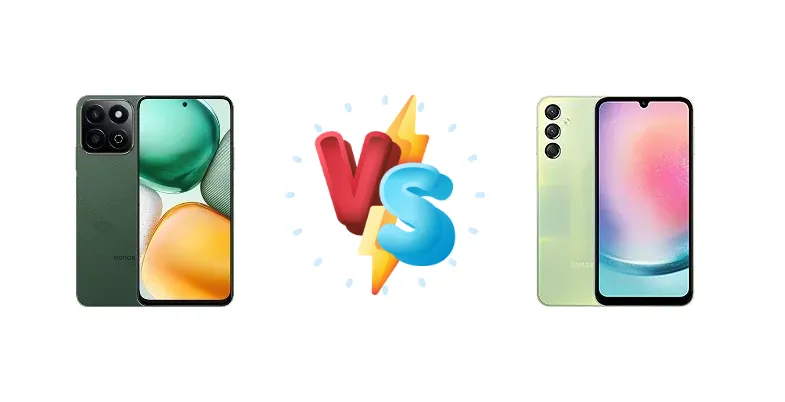
The sub-$200 smartphone market is fiercely competitive. The Honor X7c and Samsung Galaxy A24 4G both aim to deliver a compelling experience without breaking the bank, but they take different approaches. The X7c prioritizes processing efficiency with a newer 4nm Snapdragon, while the A24 4G focuses on display brightness and Samsung’s established brand recognition. This comparison will dissect their strengths and weaknesses to determine which device offers the best value.
🏆 Quick Verdict
For most users, the Honor X7c emerges as the stronger contender. Its more efficient Snapdragon 4 Gen 2 chipset, built on a 4nm process, provides a noticeable performance advantage and better thermal management compared to the Galaxy A24 4G’s Helio G99. While the A24 boasts a brighter display, the X7c’s overall package offers superior value.
| Network |
|---|
| 2G bands | GSM 850 / 900 / 1800 / 1900 | GSM 850 / 900 / 1800 / 1900 |
| 3G bands | HSDPA 850 / 900 / 1700(AWS) / 1900 / 2100 | HSDPA 850 / 900 / 2100 |
| 4G bands | LTE | 1, 3, 5, 7, 8, 20, 28, 38, 40, 41 |
| 5G bands | SA/NSA | - |
| Speed | HSPA, LTE, 5G | HSPA, LTE |
| Technology | GSM / HSPA / LTE / 5G | GSM / HSPA / LTE |
| Launch |
|---|
| Announced | 2025, August 18 | 2023, April 19 |
| Status | Available. Released 2025, August 20 | Available. Released 2023, May 05 |
| Body |
|---|
| Build | - | Glass front, plastic frame, plastic back |
| Dimensions | 166.9 x 76.8 x 8.2 mm (6.57 x 3.02 x 0.32 in) | 162.1 x 77.6 x 8.3 mm (6.38 x 3.06 x 0.33 in) |
| SIM | Nano-SIM + Nano-SIM | · Nano-SIM· Nano-SIM + Nano-SIM |
| Weight | 193 g (6.81 oz) | 195 g (6.88 oz) |
| Display |
|---|
| Protection | Aluminosilicate glass | - |
| Resolution | 1080 x 2412 pixels, 20:9 ratio (~389 ppi density) | 1080 x 2340 pixels, 19.5:9 ratio (~396 ppi density) |
| Size | 6.8 inches, 111.3 cm2 (~86.8% screen-to-body ratio) | 6.5 inches, 103.7 cm2 (~82.4% screen-to-body ratio) |
| Type | TFT LCD, 120Hz, 850 nits (peak) | Super AMOLED, 90Hz, 1000 nits (peak) |
| Platform |
|---|
| CPU | Octa-core (2x2.2 GHz Cortex-A78 & 6x1.95 GHz Cortex-A55) | Octa-core (2x2.2 GHz Cortex-A76 & 6x2.0 GHz Cortex-A55) |
| Chipset | Qualcomm SM4450 Snapdragon 4 Gen 2 (4 nm) | Mediatek Helio G99 (6 nm) |
| GPU | Adreno 613 | Mali-G57 MC2 |
| OS | Android 14, MagicOS 8 | Android 13, up to 4 major Android upgrades, One UI 6 |
| Memory |
|---|
| Card slot | No | microSDXC (dedicated slot) |
| Internal | 256GB 8GB RAM | 128GB 4GB RAM, 128GB 6GB RAM, 128GB 8GB RAM |
| Main Camera |
|---|
| Dual | 50 MP, f/1.8, (wide), PDAF
Auxiliary lens | - |
| Features | LED flash, HDR | LED flash, panorama, HDR |
| Triple | - | 50 MP, f/1.8, 27mm (wide), 1/2.76", 0.64µm, PDAF, OIS
5 MP, f/2.2, 17mm, 123˚ (ultrawide), 1/5.0", 1.12µm
2 MP (macro) |
| Video | 1080p@30fps | 1080p@30fps, gyro-EIS |
| Selfie camera |
|---|
| Single | 5 MP, f/2.2, (wide) | 13 MP, f/2.2, 25mm (wide), 1/3.06", 1.12µm |
| Video | 1080p@30fps | 1080p@30fps |
| Sound |
|---|
| 35mm jack | Yes | Yes |
| Loudspeaker | Yes | Yes |
| Comms |
|---|
| Bluetooth | 5.0, A2DP, LE | 5.3, A2DP, LE |
| NFC | Yes (market/region dependent) | Yes (market/region dependent) |
| Positioning | GPS, GLONASS, GALILEO, BDS | GPS, GLONASS, GALILEO, BDS, QZSS |
| Radio | No | Unspecified |
| USB | USB Type-C 2.0, OTG | USB Type-C 2.0 |
| WLAN | Wi-Fi 802.11 a/b/g/n/ac, dual-band, Wi-Fi Direct | Wi-Fi 802.11 a/b/g/n/ac, dual-band, Wi-Fi Direct |
| Features |
|---|
| Sensors | Fingerprint (side-mounted), accelerometer, proximity, compass | Fingerprint (side-mounted), accelerometer, gyro, compass |
| Battery |
|---|
| Charging | 35W wired | 25W wired |
| Type | Li-Po 5200 mAh | Li-Po 5000 mAh |
| Misc |
|---|
| Colors | Moonlight White, Forest Green | Black, Lime Green, Blue gradient, Dark red |
| Models | ALT-NX1 | SM-A245F, SM-A245F/DS, SM-A245F/DSN, SM-A245M, SM-A245M/DS, SM-A245N |
| Price | About 150 EUR | About 150 EUR |
| SAR EU | - | 0.41 W/kg (head) 1.30 W/kg (body) |
Honor X7c
- More efficient 4nm Snapdragon 4 Gen 2 chipset
- Faster 35W wired charging
- Potentially better sustained performance due to thermal efficiency
- Display brightness likely lower than the A24
- Camera performance largely unknown
Samsung Galaxy A24 4G
- Very bright 1012 nit display
- Samsung brand recognition and software ecosystem
- Good battery endurance rating
- Less efficient 6nm Helio G99 chipset
- Slower 25W charging
- Potential for thermal throttling under heavy load
Display Comparison
The Samsung Galaxy A24 4G immediately stands out with its measured peak brightness of 1012 nits, significantly exceeding what’s typically found in this price bracket. This makes it ideal for outdoor use under direct sunlight. However, the Honor X7c, while lacking specific brightness data, likely offers a standard LCD experience. The A24’s panel technology isn’t specified as AMOLED, suggesting a standard LCD, but the high brightness is its key advantage. Bezels appear comparable on both devices based on available imagery, and color accuracy is likely similar, leaning towards the ‘vibrant’ side common in budget displays.
Camera Comparison
Both phones feature a multi-camera setup, but details are sparse. The Samsung Galaxy A24 4G likely features a higher resolution main sensor, typical of Samsung’s A-series. However, sensor size and aperture are critical factors not provided. The Honor X7c’s camera performance is largely unknown, but Qualcomm’s ISP (Image Signal Processor) within the Snapdragon 4 Gen 2 is generally capable. We can safely assume both phones include standard features like HDR and portrait modes, but image quality will heavily depend on software processing and sensor quality, which remain unclear. The inclusion of a 2MP macro camera on either device is largely a marketing gimmick and unlikely to deliver significant photographic value.
Performance
The core difference lies in the chipsets. The Honor X7c’s Qualcomm Snapdragon 4 Gen 2 (4nm) is a more modern design than the Samsung Galaxy A24 4G’s MediaTek Helio G99 (6nm). The 4nm fabrication process inherently offers better power efficiency and thermal performance, meaning the X7c is less likely to throttle under sustained load. While both CPUs feature a 2x2.2 GHz core configuration, the Snapdragon utilizes Cortex-A78 cores, which are architecturally superior to the A24’s Cortex-A76 cores, providing a performance edge. The X7c’s GPU will also benefit from the more efficient process node. RAM configurations are not specified, but the chipset advantage favors the Honor device.
Battery Life
The Samsung Galaxy A24 4G boasts an endurance rating of 141 hours, indicating solid battery life. However, this is a holistic rating and doesn’t directly translate to screen-on time. The Honor X7c’s battery capacity is unknown, but its more efficient 4nm chipset should offset any potential capacity disadvantage. The A24 4G supports 25W wired charging, while the X7c steps up to 35W. This faster charging speed on the X7c will result in significantly quicker 0-100% charge times, a tangible benefit for users who prioritize convenience.
Buying Guide
Buy the Honor X7c if you prioritize sustained performance for gaming or multitasking, and value a more efficient processor that will likely translate to longer software support. Buy the Samsung Galaxy A24 4G if a brighter display is paramount, and you prefer the Samsung ecosystem and its associated software features, even if it means sacrificing some processing power.
Frequently Asked Questions
❓ Will the Helio G99 in the Galaxy A24 4G overheat during prolonged gaming sessions?
The Helio G99, while capable, is built on a 6nm process. This means it's more prone to thermal throttling during extended gaming compared to the Honor X7c’s Snapdragon 4 Gen 2 (4nm). Expect potential frame rate drops and reduced performance after 30-45 minutes of demanding games.
❓ Is the 35W charging on the Honor X7c significantly faster than the 25W charging on the Galaxy A24 4G?
Yes, the 35W charging on the X7c will noticeably reduce charging times. While exact figures depend on battery capacity, expect a 0-100% charge to be approximately 30-45 minutes faster on the Honor X7c compared to the Samsung Galaxy A24 4G.
❓ Does the Samsung Galaxy A24 4G support any form of video stabilization?
Samsung doesn't explicitly advertise OIS (Optical Image Stabilization) on the A24 4G. It likely relies on EIS (Electronic Image Stabilization), which uses software to reduce shake but is less effective than OIS, especially in low light.
❓ How does the Snapdragon 4 Gen 2 in the Honor X7c compare to previous generation Snapdragon 600 series chips?
The Snapdragon 4 Gen 2 generally outperforms older Snapdragon 600 series chips in both CPU and GPU performance, despite being positioned in a lower numerical series. The architectural improvements and 4nm process give it a significant edge in efficiency and sustained performance.