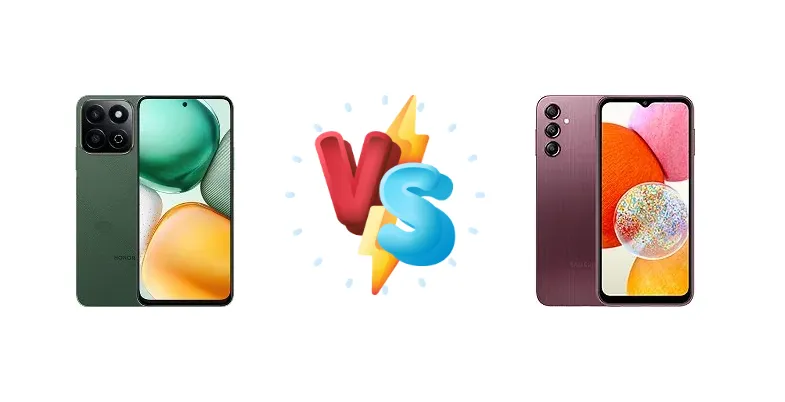
The Honor X7c and Samsung Galaxy A14 represent compelling options in the crowded sub-$200 smartphone market. The X7c leverages Qualcomm’s newer, more efficient Snapdragon 4 Gen 2, while the Galaxy A14 offers a choice between Mediatek’s Helio G80 and Samsung’s own Exynos 850, creating a fascinating performance disparity we’ll explore.
🏆 Quick Verdict
For most users, the Honor X7c emerges as the stronger choice. Its Snapdragon 4 Gen 2 chipset, built on a 4nm process, delivers noticeably better performance and efficiency than either version of the Galaxy A14, justifying its position as the winner for demanding tasks and longevity.
| Network |
|---|
| 2G bands | GSM 850 / 900 / 1800 / 1900 | GSM 850 / 900 / 1800 / 1900 |
| 3G bands | HSDPA 850 / 900 / 1700(AWS) / 1900 / 2100 | HSDPA 850 / 900 / 2100 |
| 4G bands | LTE | 1, 3, 5, 7, 8, 20, 28, 38, 40, 41 |
| 5G bands | SA/NSA | - |
| Speed | HSPA, LTE, 5G | HSPA, LTE |
| Technology | GSM / HSPA / LTE / 5G | GSM / HSPA / LTE |
| Launch |
|---|
| Announced | 2025, August 18 | 2023, February 28 |
| Status | Available. Released 2025, August 20 | Available. Released 2023, March 27 |
| Body |
|---|
| Build | - | Glass front, plastic back, plastic frame |
| Dimensions | 166.9 x 76.8 x 8.2 mm (6.57 x 3.02 x 0.32 in) | 167.7 x 78 x 9.1 mm (6.60 x 3.07 x 0.36 in) |
| SIM | Nano-SIM + Nano-SIM | · Nano-SIM· Nano-SIM + Nano-SIM |
| Weight | 193 g (6.81 oz) | 201 g (7.09 oz) |
| Display |
|---|
| Protection | Aluminosilicate glass | - |
| Resolution | 1080 x 2412 pixels, 20:9 ratio (~389 ppi density) | 1080 x 2408 pixels, 20:9 ratio (~400 ppi density) |
| Size | 6.8 inches, 111.3 cm2 (~86.8% screen-to-body ratio) | 6.6 inches, 104.9 cm2 (~80.2% screen-to-body ratio) |
| Type | TFT LCD, 120Hz, 850 nits (peak) | PLS LCD |
| Platform |
|---|
| CPU | Octa-core (2x2.2 GHz Cortex-A78 & 6x1.95 GHz Cortex-A55) | Octa-core (2x2.0 GHz Cortex-A75 & 6x1.8 GHz Cortex-A55) - Version AOcta-core (4x2.0 GHz Cortex-A55 & 4x2.0 GHz Cortex-A55) - Version B |
| Chipset | Qualcomm SM4450 Snapdragon 4 Gen 2 (4 nm) | Mediatek MT6769 Helio G80 (12 nm) - Version AExynos 850 (8 nm) - Version B |
| GPU | Adreno 613 | Mali-G52 MC2 |
| OS | Android 14, MagicOS 8 | Android 13, upgradable to Android 15, One UI 7 |
| Memory |
|---|
| Card slot | No | microSDXC (dedicated slot) |
| Internal | 256GB 8GB RAM | 64GB 4GB RAM, 128GB 4GB RAM, 128GB 6GB RAM |
| Main Camera |
|---|
| Dual | 50 MP, f/1.8, (wide), PDAF
Auxiliary lens | - |
| Features | LED flash, HDR | LED flash, panorama, HDR |
| Single | - | 13 MP, f/2.0, (wide) |
| Triple | - | 50 MP, f/1.8, 26mm (wide), 1/2.75", 0.64µm, PDAF
5 MP, f/2.2, 17mm (ultrawide), 1/5.0", 1.12µm
2 MP (macro) |
| Video | 1080p@30fps | 1080p@30fps |
| Selfie camera |
|---|
| Single | 5 MP, f/2.2, (wide) | 13 MP, f/2.0, 26mm (wide), 1/3.1", 1.12µm |
| Video | 1080p@30fps | 1080p@30fps |
| Sound |
|---|
| 3.5mm jack | - | Yes |
| 35mm jack | Yes | Yes |
| Loudspeaker | Yes | Yes |
| Comms |
|---|
| Bluetooth | 5.0, A2DP, LE | 5.1 or 5.3, A2DP, LE |
| NFC | Yes (market/region dependent) | Yes (market/region dependent) |
| Positioning | GPS, GLONASS, GALILEO, BDS | GPS, GALILEO, GLONASS, BDS, QZSS |
| Radio | No | Unspecified |
| USB | USB Type-C 2.0, OTG | USB Type-C 2.0 |
| WLAN | Wi-Fi 802.11 a/b/g/n/ac, dual-band, Wi-Fi Direct | Wi-Fi 802.11 a/b/g/n/ac, dual-band, Wi-Fi Direct |
| Features |
|---|
| Sensors | Fingerprint (side-mounted), accelerometer, proximity, compass | Fingerprint (side-mounted), accelerometer, proximity, compass |
| Battery |
|---|
| Charging | 35W wired | 15W wired |
| Type | Li-Po 5200 mAh | Li-Po 5000 mAh |
| Misc |
|---|
| Colors | Moonlight White, Forest Green | Black, Dark Red, Silver, Green |
| Models | ALT-NX1 | SM-A145F, SM-A145F/DSN, SM-A145M, SM-A145M/DS, SM-A145P, SM-A145R |
| Price | About 150 EUR | € 85.76 / $ 147.60 / £ 79.95 |
| SAR EU | - | 0.46 W/kg (head) 1.37 W/kg (body) |
Honor X7c
- Superior chipset performance (Snapdragon 4 Gen 2)
- Faster 35W charging
- More efficient 4nm process
- Less established brand recognition
- Potentially limited software updates compared to Samsung
Samsung Galaxy A14
- Larger battery capacity (typically)
- Samsung’s brand reputation and software ecosystem
- Wider availability
- Inferior chipset performance (Helio G80 or Exynos 850)
- Slower 15W charging
- Less efficient chipset
Display Comparison
Neither device boasts a standout display. Both likely utilize LCD panels, a common trait in this price bracket. However, detailed specs like peak brightness and color gamut coverage are missing. The Galaxy A14’s larger screen size (typically 6.6 inches vs. the X7c’s 6.75 inches) may appeal to some, but the difference is minimal. The absence of high refresh rates on both devices suggests a focus on power efficiency over visual fluidity.
Camera Comparison
Camera performance is difficult to assess without detailed sensor information. Both phones likely feature a primary camera accompanied by auxiliary lenses (depth, macro). The X7c’s camera system is likely optimized for general-purpose photography, while Samsung’s image processing tends towards vibrant, saturated colors. The presence of Optical Image Stabilization (OIS) is unlikely on either device at this price point. The usefulness of the 2MP macro cameras on both phones is questionable; image quality will be limited. Focusing on the main sensor’s megapixel count and aperture is more crucial.
Performance
This is where the X7c truly shines. The Qualcomm Snapdragon 4 Gen 2 (4nm) is architecturally superior to both the Mediatek Helio G80 (12nm) and the Exynos 850 (8nm). The 4nm process node translates to significantly improved power efficiency and thermal performance, meaning the X7c will sustain peak performance for longer periods without throttling. The X7c’s CPU configuration – 2x2.2 GHz Cortex-A78 & 6x1.95 GHz Cortex-A55 – offers a more modern and capable core arrangement than the A14’s Helio G80 (2x2.0 GHz Cortex-A75 & 6x1.8 GHz Cortex-A55). The Exynos 850 version of the A14 offers a slight improvement over the Helio G80, but still lags behind the Snapdragon 4 Gen 2 in overall performance and efficiency. The X7c will handle demanding apps and games with greater ease.
Battery Life
The Galaxy A14 typically features a larger battery capacity (around 5000mAh) compared to the Honor X7c (around 5000mAh). However, the X7c’s more efficient Snapdragon 4 Gen 2 chipset will likely offset this difference in real-world usage. Crucially, the X7c supports 35W wired charging, significantly faster than the A14’s 15W charging. This translates to a much quicker 0-100% charge time for the X7c, a significant convenience factor.
Buying Guide
Buy the Honor X7c if you prioritize sustained performance for gaming, multitasking, or future-proofing. The Snapdragon 4 Gen 2 offers a significant advantage in these areas. Buy the Samsung Galaxy A14 if you are deeply embedded in the Samsung ecosystem, value brand recognition, or find a significantly lower price point that outweighs the performance difference. The A14’s wider availability and Samsung’s software support are also considerations.
Frequently Asked Questions
❓ Does the Exynos 850 chip in the Galaxy A14 tend to overheat during prolonged gaming sessions?
The Exynos 850, built on an 8nm process, is prone to thermal throttling under sustained load. While it can handle casual gaming, demanding titles will likely result in reduced performance after a short period. The Honor X7c’s Snapdragon 4 Gen 2, with its 4nm process, manages heat much more effectively, allowing for longer gaming sessions without significant performance drops.
❓ Is the 35W charging on the Honor X7c a significant advantage over the Galaxy A14’s 15W charging in real-world use?
Yes, the difference is substantial. 35W charging will significantly reduce the time it takes to fully charge the Honor X7c. Expect a full charge in approximately 1.5-2 hours, compared to 3+ hours for the Galaxy A14. This is particularly beneficial for users who frequently need to top up their battery quickly.
❓ How does the Snapdragon 4 Gen 2 handle multitasking compared to the Helio G80?
The Snapdragon 4 Gen 2 offers a noticeable improvement in multitasking performance. Its more powerful CPU cores and efficient architecture allow it to handle multiple apps simultaneously with greater fluidity. The Helio G80 may struggle with heavier multitasking loads, leading to lag or app crashes.