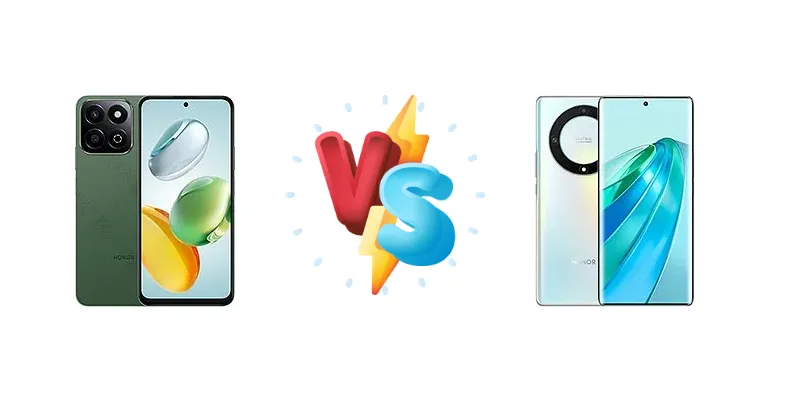
Honor's X series consistently delivers compelling value, but the X7c 4G and X9a represent distinct approaches. The X7c prioritizes affordability, while the X9a steps up with 5G connectivity and a slightly more powerful chipset. This comparison dissects the key differences to help you determine which Honor phone best suits your needs.
🏆 Quick Verdict
For most users, the Honor X9a is the superior choice. Its Snapdragon 695 5G offers a noticeable performance boost over the X7c’s Snapdragon 685, and the 40W charging is significantly faster. While the X7c is cheaper, the X9a’s added features justify the price difference.
| Network |
|---|
| 2G bands | GSM 850 / 900 / 1800 / 1900 | GSM 850 / 900 / 1800 / 1900 |
| 3G bands | HSDPA 850 / 900 / 1900 / 2100 | HSDPA 850 / 900 / 1900 / 2100 |
| 4G bands | LTE | LTE |
| 5G bands | - | SA/NSA |
| Speed | HSPA, LTE | HSPA, LTE, 5G |
| Technology | GSM / HSPA / LTE | GSM / HSPA / LTE / 5G |
| Launch |
|---|
| Announced | 2024, October 18 | 2023, January 04 |
| Status | Available. Released 2024, October 18 | Available. Released 2023, January 06 |
| Body |
|---|
| Dimensions | 166.9 x 76.8 x 8.1 mm (6.57 x 3.02 x 0.32 in) | 161.6 x 73.9 x 7.9 mm (6.36 x 2.91 x 0.31 in) |
| SIM | Nano-SIM + Nano-SIM | Nano-SIM + Nano-SIM |
| Weight | 194 g or 196 g (6.84 oz) | 175 g (6.17 oz) |
| Display |
|---|
| Protection | Tempered glass | - |
| Resolution | 720 x 1610 pixels, 20:9 ratio (~261 ppi density) | 1080 x 2400 pixels, 20:9 ratio (~395 ppi density) |
| Size | 6.77 inches, 110.2 cm2 (~86.0% screen-to-body ratio) | 6.67 inches, 107.4 cm2 (~89.9% screen-to-body ratio) |
| Type | TFT LCD, 120Hz | AMOLED, 1B colors, 120Hz, 800 nits (HBM) |
| Platform |
|---|
| CPU | Octa-core (4x2.8 GHz Cortex-A73 & 4x1.9 GHz Cortex-A53) | Octa-core (2x2.2 GHz Kryo 660 Gold & 6x1.7 GHz Kryo 660 Silver) |
| Chipset | Qualcomm SM6225 Snapdragon 685 (6 nm) | Qualcomm SM6375 Snapdragon 695 5G (6 nm) |
| GPU | Adreno 610 | Adreno 619 |
| OS | Android 14, MagicOS 8 | Android 12, upgradable to Android 13, MagicOS 7 |
| Memory |
|---|
| Card slot | Unspecified | No |
| Internal | 128GB 6GB RAM, 128GB 8GB RAM, 256GB 4GB RAM, 256GB 8GB RAM, 512GB 8GB RAM | 128GB 6GB RAM, 128GB 8GB RAM, 256GB 8GB RAM |
| Main Camera |
|---|
| Dual | 108 MP, f/1.8, 24mm (wide), 1/1.67", 0.64µm, PDAF
Auxiliary lens | 64 MP, f/1.8, (wide), PDAF
5 MP, f/2.2, (ultrawide)
2 MP (macro) |
| Features | LED flash, HDR | LED flash, panorama, HDR |
| Single | - | 16 MP, f/2.5, (wide) |
| Video | 1080p@30fps | 1080p@30fps |
| Selfie camera |
|---|
| Single | 8 MP, f/2.0, (wide) | 16 MP, f/2.5, (wide) |
| Video | 1080p@30fps | 1080p@30fps |
| Sound |
|---|
| 3.5mm jack | - | No |
| 35mm jack | Yes | No |
| Loudspeaker | Yes, with stereo speakers | Yes |
| Comms |
|---|
| Bluetooth | 5.0, A2DP, LE | 5.1, A2DP, LE, aptX HD |
| Infrared port | - | Yes |
| NFC | Yes (market/region dependent) | Yes |
| Positioning | GPS, GLONASS, GALILEO, BDS | GPS, GLONASS, GALILEO, BDS |
| Radio | No | No |
| USB | USB Type-C 2.0, OTG | USB Type-C 2.0, OTG |
| WLAN | Wi-Fi 802.11 a/b/g/n/ac, dual-band, Wi-Fi Direct | Wi-Fi 802.11 a/b/g/n/ac, dual-band, Wi-Fi Direct |
| Features |
|---|
| Sensors | Fingerprint (side-mounted), accelerometer, proximity, compass | Fingerprint (under display, optical), accelerometer, gyro, proximity, compass |
| | - | 24-bit/192kHz audio |
| Battery |
|---|
| Charging | 35W wired | 40W wired |
| Type | Li-Po 5200/6000 mAh (market/region dependent) | Li-Po 5100 mAh |
| Misc |
|---|
| Colors | Midnight Black, Forest Green, Moonlight White | Titanium Silver, Emerald Green, Midnight Black |
| Models | ALT-LX2 | RMO-NX1 |
| Price | - | $ 212.08 |
Honor X7c 4G
- More affordable price point
- Decent performance for basic tasks
- Reliable Snapdragon 685 chipset
- Slower charging speed (35W)
- Lacks 5G connectivity
- Potentially less responsive UI
Honor X9a
- Faster 40W wired charging
- 5G connectivity for future-proofing
- More powerful Snapdragon 695 chipset
- Higher price compared to the X7c
- May not offer a dramatically different display experience
- Potentially slightly lower battery life due to increased power draw
Display Comparison
Both devices utilize 6.78-inch LCD panels, but detailed display specs like resolution and refresh rate are missing. However, the core difference lies in the processing power driving them. The X9a’s Snapdragon 695, being a more capable chipset, will likely handle display rendering and animations with greater fluidity. While neither is expected to offer high peak brightness, the X9a’s GPU will contribute to better color reproduction and contrast.
Camera Comparison
Without detailed camera specifications beyond the chipsets, a direct comparison is limited. However, the X9a’s more powerful processor will enable more sophisticated image processing algorithms, potentially resulting in better dynamic range and noise reduction. The Snapdragon 695’s ISP (Image Signal Processor) is more advanced, allowing for faster image capture and improved video stabilization. It’s reasonable to assume the X9a will deliver superior camera performance, even if both phones share similar sensor resolutions (which is currently unknown).
Performance
The Snapdragon 695 in the Honor X9a represents a clear upgrade over the Snapdragon 685 in the X7c. The 695 features a different CPU core configuration – 2x2.2 GHz Kryo 660 Gold and 6x1.7 GHz Kryo 660 Silver – compared to the X7c’s 4x2.8 GHz Cortex-A73 & 4x1.9 GHz Cortex-A53. This translates to faster app launch times and smoother multitasking on the X9a. The 695 also includes an integrated 5G modem, offering significantly faster data speeds where available. While both are built on a 6nm process, the architectural improvements in the 695 provide a tangible performance advantage, particularly for users who engage in moderate gaming or resource-intensive applications.
Battery Life
Both phones offer respectable battery life, but the charging speeds differ significantly. The Honor X9a’s 40W wired charging is considerably faster than the X7c’s 35W charging. This means the X9a will reach a full charge in less time, minimizing downtime. While the actual battery capacity is not specified, the faster charging speed of the X9a is a significant convenience factor, especially for users who frequently find themselves needing to top up their battery quickly.
Buying Guide
Buy the Honor X7c 4G if you primarily need a reliable phone for basic tasks like calling, texting, and light social media, and are on a very tight budget. You’ll appreciate its affordability and decent battery life. Buy the Honor X9a if you want a smoother experience for multitasking, occasional gaming, and future-proofing with 5G connectivity, and are willing to spend a bit more for the improved performance and faster charging.
Frequently Asked Questions
❓ Will the Snapdragon 695 in the X9a handle demanding games like PUBG Mobile smoothly?
The Snapdragon 695 is capable of running PUBG Mobile, but expect to play at medium settings for a consistently smooth experience. While it’s not a gaming powerhouse, it offers a noticeable improvement over the Snapdragon 685 in the X7c, allowing for higher frame rates and reduced lag.
❓ How much faster is the 40W charging on the X9a compared to the 35W charging on the X7c?
While exact charging times depend on battery capacity (which isn't specified), the 40W charging on the X9a will likely reduce a full charge time by approximately 20-30 minutes compared to the X7c. This difference is particularly noticeable when quickly topping up the battery.
❓ Does the Honor X9a's 5G connectivity actually make a difference in real-world usage?
The benefit of 5G depends on your location and carrier. If you live in an area with 5G coverage, you'll experience significantly faster download and upload speeds, making streaming, browsing, and downloading large files much quicker. If 5G isn't available, the phone will fall back to 4G.